All posts

Training notes: Tanto dori – Munetsuki hiji kime

In the below video, Dojo senior Jeremy Gehrke demonstrates the Aikido technique – Munetsuki hiji kime.  The technique is applied in the context of a traditional knife attack to the abdomen.


ADDITIONAL NOTES

  • Alternate version 

In the below video clip, Mike Jones Sensei from NY Aiki kai demonstrates an alternate version of tanto tori munetsuki hiji kime.  In this version the nage remains standing at the completion of the technique (similar to a traditional kokyu nage ending ).  The principles being applied, however, are the same and equally applicable to the featured video demonstration (above).

Also included in the video are combined elbow and choke retraining techniques for addressing an attack with a tanto.  These techniques are also practised at our dojo.

Have a great week

Ian Grant
Dojo Cho
Aikido Warrior Dojo


Training notes: Katatedori irimi nage

In 1938 Master Morihei Ueshiba, the Founder of Aikido, finalised the 2nd of his 3 technical texts.  Simply titled “Budo“, the text contains a sampling of techniques from a wide range of attacks, including grabs, strikes and attacks from different weapons.

Notably the first complete technique referred to in “Budo” is katatedori irimi nage.  Its early placement in the text and the level of explanation that is given suggests the importance that the Founder placed on this technique.  This is further supported by its inclusion in the Founder’s 3rd technical text (“Maki no ichi”) from the early 1950’s where again it is covered in detail relative to other techniques in that text.

The below video features photographic demonstrations of katatedori irimi nage as they appear in “Budo“.  Also included is a demonstration of the technique by Morihiro Saito Sensei who was a direct student of the Founder for more than 20 years.


ADDITIONAL NOTES

  • Description of technique in “Budo” (Drawings from “Maki no ichi”)
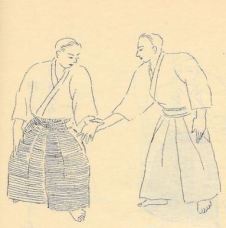
katatedori iriminage 1

Uke – “Grab partner’s left wrist with your tight hand”


katatedori iriminage 2

(2) Nage – “Put strength into your fingertips of your left hand, turn the palm of hand upward, slide forward diagonally and enter deeply to your partner’s right.

Remain aware of attacks from the rear”


katatedori iriminage 3(3) Nage – “Grab your partner’s right wrist from underneath with your right hand, release his grip and strike his face.”


katatedori iriminage 6(4) Nage – “Slide in further, grab his collar (or pin his hips against your body), step forward on your right foot bringing your partner’s arm around his neck and then down him.

During this last part of the technique it is vital to put strength in your finger tips of your right hand and bring your arm down to the inside.”


  • Katate dori irimi nage – Post war forms

In the below video Morihiro Saito Sensei (1928-2002) demonstrates the 3 versions of katatadori irimi nage nage practised by O’Sensei (the Founder of Aikido) in the immediate post-war period of his life.


  • Katate dori irimi nage – Aikido Yuishinkai version

In the below video Peter Kelly Sensei, International Instructor, Aikido Yuishinkai  provides instruction on an alternate version of katate dori irimi nage.  The video was recorded at our dojo in 2015.


Have a great week

Ian Grant
Dojo Cho
Aikido Warrior Dojo
 

Training notes: Jo nage shiho nage

saito osenseiThe below video was recorded at a recent class at our dojo where we studied a form of Aikido practice referred to as jo nage.  In this type of practice the nage (i.e. the person applying the technique) is armed with a wooden staff (a jo).

The jo nage technique being explored is the traditional version of shiho nage (4 directions throw).  Both the omote and ura forms are demonstrated.


ADDITIONAL NOTES

  • Jo nage shiho nage – more detailed look

saito_seiza_260For more detailed instruction the traditional form of jo nage shiho nage see the below a video of  Morihiro Saito Sensei (1928-2002) providing instruction on the technique.

Saito Sensei’s practice of Aikido spanned 56 years and he is one of the most important teachers in Aikido history.  Saito Sensei was a live-in student of O’sensei for more than 20 years at his home dojo in Iwama, Japan.


Have a great weekend.

Ian Grant
Head Instructor
Aikido Warrior Dojo


Video compilation – Aikido Warrior Dojo class – 4 June 2016

A fun video compilation recorded at a class at our dojo on 4 June 2016.

Training notes – Shomenuchi koshi nage (shiho nage form)

OLYMPUS DIGITAL CAMERAOne of our favourite throws to practice at the dojo is koshi nage (hip throw).  Koshi nage can be applied in response to a wide variety of attacks, incuding where the uke attacks the nage by executing a downward strike to to the temple (shomenuchi).

In the below video Morihiro Saito Sensei (1928-2002) provides instruction on one of the traditional forms of shomenuchi koshi nage as practised by O’Sensei (the Founder of Aikido) in the immediate post-war period of his life. In this particular form the entry is the same as if executing a shomenuchi shiho nage (4 directions throw). For further information on the life of Saito Sensei and his unique access to the Founder of Aikido see the Additional Notes section below.


ADDITIONAL NOTES

  • Learning how safely receive a hip throw

In the below video seniors at our dojo explore the learning progression to safely receive a koshi nage technique.


  • Brief Biography – Morihiro Saito Sensei (1928-2002)

morihiro-saito-koshinageMorihiro Saito Sensei’s  practice of Aikido spanned 56 years and he is one of the most important teachers in Aikido history.  Saito Sensei was a live-in student of O’sensei for more than 20 years at his home dojo in Iwama, Japan.

Saito Sensei spent his teaching life dedicated to preserving the technical style of Aikido as practised and shown to him by O’sensei in the post-war period.  Without his commitment to preserving the Aikido of the Founder and extensive efforts to record and document his teachings, much of the Aikido of O’sensei would have no doubt been lost.  The Aikido world owes him a great debt.

Have a great week

Ian Grant
Head Dojo Instructor
Aikido Warrior Dojo