Aikido Warrior

Training notes: Ai hanmi katatedori yonkyo

Yonkyo Osensei 2In the below video, Mike Jones Sensei (New York Aikikai)  demonstrates how to perform a basic yonkyo (No 4 wrist technique) from a cross hand grab (Ai hanmi katatedori yonkyo).

The video also includes a step-by-step breakdown of the mechanics of applying yonkyo where the nage has initially responded to the attack as if they were completing an ikkyo technique.  The reason for this approach is that an ikkyo entry is one of the easiest ways to initially set up the conditions necessary for an effective yonkyo response.


ADDITIONAL NOTES

  • Kosadori yonkyo – Morihiro Saito Sensei

Ai hanmi katate dori yonkyo is referred to Kosadori yonkyo in some schools. See below video of Morihiro Saito Sensei (9th Dan) explaining the fundamental elements of  Kosadori nikyo as practised by O’sensei in the immediate post war period of his training life.


  • Yonkyo – Ki aikido version 

For comparison purposes, see below an application of yonkyo as practised in Aikido Yuishinkai.  This method of application is typical to that often seen practised in ki aikido schools.

Of note at Step 3 in the the video, Koretoshi Maruyama Sensei changes his hand position prior to executing the yonkyo cut to what is referred to as a “traditional sankyo” hand position.  This is done in part to aid easier learning of the technique.

However, it should be noted that the change in hand position is not critical in the omote application of sankyo if the intent is to merely cut the uke straight to the mat (as occurs in the video).  The hand change without the sankyo is demonstrated in the following photographs.

Yonkyo 1aYonkyo 4


  • Yonkyo doesn’t work on everyone

From a martial perspective, one of the concerns about yonkyo is that it’s effectiveness relies on the uke experiencing ulna nerve pain.  However, about 10% of people seem immune to this type of pain.  This, combined with the possibility of nage error in its application, makes yonkyo a potentially high risk technique.

To minimise this risk it is essential that the technique be applied on a uke whose balance is completely broken.  This facilitates alternate back up options should things not go as planned. For example, in the context of the above method of application, an attempted (although technically not successful) yonkyo can still be used to take an unbalanced uke to the ground.  This is done by the nage directing energy to the ukes elbow and driving it to the mat.

Enjoy the rest of your week.

Ian

Ian Grant
Head Instructor
Aikido Warrior Dojo, Brisbane


Training Notes: Ushiro ryotedori kotegaeshi

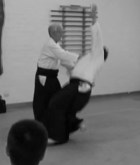
kotegeashi is an outward wrist turn and traditionally is broadly categorised in Aikido as a kaiten (open and turn) technique.

In the below video Morihiro Saito Sensei demonstrates how kotegaeshi may be applied in circumstances where the uke has pinned the nage’s hands behind their back.

Depending on the Aikido style, the technique is referred to as Ushiro ryotedori kotegaeshi or Ushiro tekubidori kotegaeshi .


ADDITIONAL NOTES

  • How to release the grip – Pictorial illustration


  • Additional details 

In the below video, Sensei Andy Hathaway of the London Aikido Club explores the Aiki principles underpinning Ushiro ryotedori kotegaeshi .  Hathaway Sensei emphasises the importance of getting off-line and the use of balance breaking principles to effectively execute the technique. These principles are particularly important where the uke has a strong grip on the wrists.


  • Ki aikido approach

In the below video, Koretoshi Maruyama Sensei demonstrates how ushiro ryotedori kotegaeshi  is practised in  Aikido Yuishinkai.  The method of practice is typical of that found in many ki aikido schools inspired by the teachings of Koichi Tohei Sensei.


Have a great week.

Ian Grant
Head Instructor
Aikido Warrior Dojo

Taninzugake demonstration: Katate dori

Peter KellyIn the below video, Peter Kelly Sensei, Chief Instructor, Aikido Yuishinkai Australia, gives a demonstration of taninzugake.

In our School, taninzugake (or free form practice) is commonly practiced at the end of each class.  This type of practice allows the nage to respond to the selected attack type by using any technique they so choose.  The attack type in the video is katate dori, which is a single wrist grab.

Katate dori taninzugake forms part of the Aikido Yuishinkai grading syllabus for 1st kyu (brown belt) gradings.

Have a great week

Ian Grant
Head Instructor
Aikido Warrior Dojo


Searching for O’Sensei – The forgotten manuals of Aikido

Master Morihei Ueshiba (O’sensei), the Founder of Aikido, produced 2 instructional manuals for his martial art in the 1930’s.

Evident in both manuals is the time and effort taken to not only write but also make visual representations to support the instruction.  For example, in one of the manuals there are 166 techniques, all of which are accompanied by hand drawings to assist the reader.

In the 2nd manual, the instructional aspects are supported by photographs. However, even this would have been painstakingly long process given the relative primitive state of photography at the time.

Unfortunately, and one might even say bizarrely, neither of the manuals appear to be a major reference point for modern aikido practice with the exception of Iwama Aikido.  I have heard a number of reasons given for this.  However, they also seem to share the common ground that O’Sensei’s  pre-war Aikido (or Aikido Budo as it was then labelled) was very different to post-war, hence making the manuals historically interesting but largely irrelevant.

336890I have long struggled with this argument as it doesn’t align with personal experience. For example, we frequently use the manuals as reference points to inform our practice in our dojo and have found them to be very relevant and insightful in our study of O’Sensei’s Aikido through Aikido Kenkyukai.

In fact I would go as far to say that in substance O’Sensei’s prewar Aikido share many similarities with his post war Aikido. The main differences being that in his later years O’sensei seems to have stopped teaching the more complex pins. Other changes could be described as refinements and at most, alternative variations.

However, don’t take my word for it.  Look at the below video and make up your own mind.

In the meantime, I think we at Aikido Warrior Dojo will continue to hold the only written technical teachings of the Founder of Aikido in the highest regard.

Ian Grant
Dojo Cho
Aikido Warrior Dojo

Acknowledgement: The above video was not made by Aikido Warrior Dojo, but by a person who goes by the You tube name of Marius V.  While I have never met Marius V, I would like to acknowledge and thank him for his extraordinary work in producing the video.


Training Notes: Yokomenuchi kokyu nage

Yokomenuchi kokyu nage 3In the below video Master Koretoshi Maruyama, Founder of Aikido Yuishinkai, demonstrates and provides instruction on the Aikido technique, yokomenuchi kokyu nage (irimi), as is practiced in our school.

The technique is performed as a response to a yokomenuchi strike, which is a side blow to the head.

Yokomenuchi kokyu nage is a particular useful technique for developing fundamental skills in timing, entering and directly meeting an attack without clashing.  We have also found at the dojo that with slight modifications, yokomenuchi kokyu nage (irimi) can be used to effectively deal with non-traditional strikes, including for example a hook punch.


ADDITIONAL NOTES

  • Origins of technique

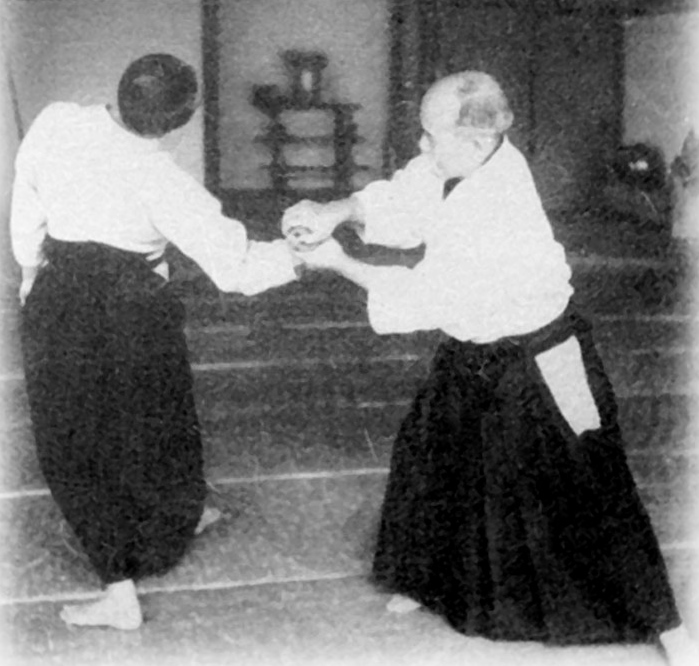
Yokomenuchi kokyu nage (irimi) has a long history in Aikido. The technique appears as technique number 42 in O’senseis first technical manual “Budo Renshu” (1934).  The notable difference in this early version is that the nage cuts down through the uke‘s neck and also cuts down and then hold’s the wrist of the uke’s attacking arm.  (See O’senseis drawings below).

However, the kokyu ho principles necessary to effectively apply the technique remain the same.

Drawing (1) No 42

Drawing 2 no 42


Kokyu nage - OsenseiIn O’sensei’s 2nd manual “Budo” (1938) the roles of nage and uke for the technique are described as follows:

Uke: Deliver a yokomen strike with your right hand.  “Tori (i.e. nage): Step forward on your left foot and use your left te gatana (i.e. hand sword) to neutralise your opponent’s attack, simultaneously striking his face  (and down him).”


  • Kokyu ho principles underpinning technique

Kokyu ho exercises are something that we do a lot of at our dojo as a means of developing internal strength in our techniques.  Kokyu ho exercises were the traditional method used by O’sensei to develop “ki power” in his Aikido.

In the below video, Morihei Saito Sensei demonstrates and explains the kokyu ho exercise relevant to yokomenuchi kokyu nage (irimi).


Ian Grant
Head Instructor
Aikido Warrior Dojo, Brisbane