Fudoshin dojos Australia

Training Notes – Katatedori nikyo

nikyo (1)Nikyo techniques involve the application of a painful pronating or adductive wristlock to subdue or pin an attacker.  They are a common feature in the syllabus of most Aikido schools.

Nikyo techniques can be used to address a wide variety of attacks.  They are particularly effective in circumstances where the uke attempts to grab the clothing or wrist of a nage (as a prelude to follow up strike).

In the below video Morihiro Saito Sensei (9th Dan) explains the fundamental principles that underpin the application of katatedori nikyo. This form of nikyo is applied in response to an attack in the form of a same side grab.


ADDITIONAL NOTES

  • Katatedori nikyo – Fundamentals

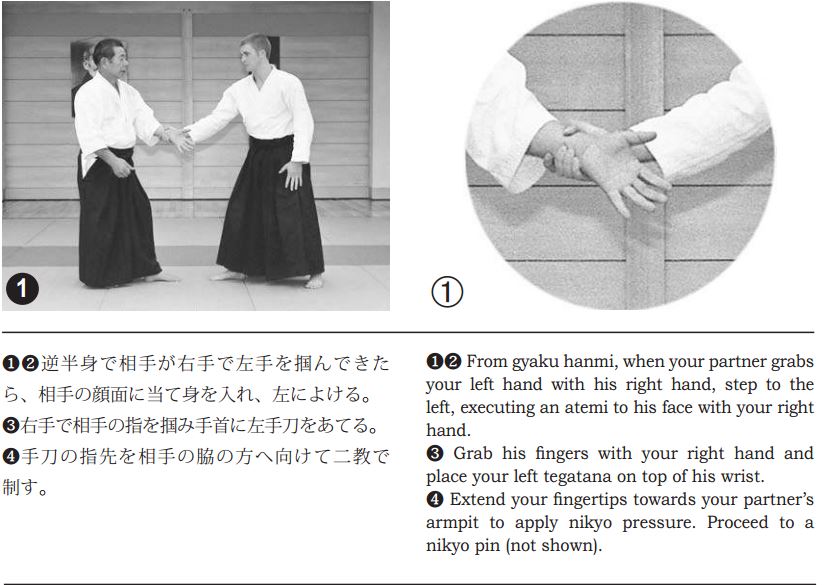
See below a photo demonstration (including description) by Morihiro Saito Sensei (9th Dan) of the fundamental elements of katatedori nikyo as practised by O’sensei in the immediate post war period of his training life.

katatedori-nikyo-1katatedori-nikyo-2


  • Katatedori nikyo – Alternate application (1)

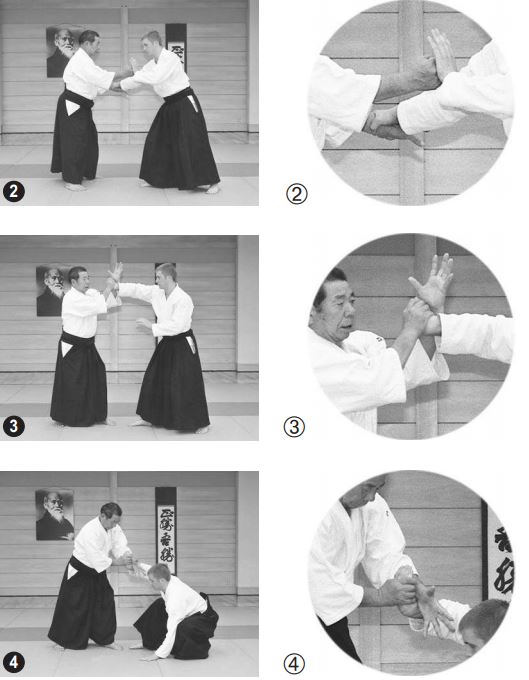
See below a photo demonstration (including description) by Morihiro Saito Sensei (9th Dan) of an alternate form of katatedori nikyo which was also practised by O’sensei in the immediate post war period of his training life.

katatedori-nikyo-1a

katatedori-nikyo-2a


  • Katatedori nikyo – Alternate application (2)


  • Avoiding the potential to be kicked in the kneecap 

The method of application in the below video overcomes a common problem sometimes seen with nikyo in that the uke can readily kick the nage in the knee cap to escape. Also included are some suggested exercises to assist in the learning process.


  • Brief Biography – Morihiro Saito Sensei (1928-2002)

saito_seiza_260Morihiro Saito Sensei’s  practice of Aikido spanned 56 years and he is one of the most important teachers in Aikido history.  Saito Sensei was a live-in student of O’sensei for more than 20 years at his home dojo in Iwama, Japan.

Saito Sensei spent his teaching life dedicated to preserving the technical style of Aikido as practised and shown to him by O’sensei in the post-war period.  Without his commitment to preserving the Aikido of the Founder and extensive efforts to record and document his teachings, much of the Aikido of O’sensei would have no doubt been lost.  The Aikido world owes him a great debt.

Have a great week.

Ian Grant
Dojo Cho
Aikido Warrior Dojo, Brisbane


Munetsuki irimi nage – Learning from O’Sensei

See below a short video taken at the dojo where we explored munetsuki irimi nage as illustrated in O’Sensei‘s 1938 text “Budo“.


Although difficult to see in the below photo demonstrations featuring  O’Sensei, a key technical aspect of the technique is the placement of the nage’s hand on the upper part of the uke’s shoulder.  As the technique is executed, this hand eventually ends up immediately below the nage’s armpit.  Relaxed and centred execution of the technique is essential to avoid any clash and achieve the necessary off-balancing of the uke.

4

For the uke, receiving the technique feels a bit like hitting a “wall of feathers”. As you would have noticed in the video, we also played with adding extra atemi. It makes receiving the ukemi a bit more challenging in terms of uke sensitivity but is well worth the experiment.

Big thanks to dojo senior Peter Marendy for joining me in the demo and to Eden for filming it.

ADDITIONAL NOTES

  • Munetsuki irimi nage – A deeper look 

In the below videos Morihiro Saito Sensei (1928-2002) provides instruction on the traditional version of  munetsuki irimi nage as practised by O’Sensei (the Founder of Aikido) in the immediate post-war period of his life. Notably the method of execution is the same as that outlined in the “Budo” text.

  • Brief Biography – Morihiro Saito Sensei (1928-2002)

saito_seiza_260Morihiro Saito Sensei’s  practice of Aikido spanned 56 years and he is one of the most important teachers in Aikido history.  Saito Sensei was a live-in student of O’sensei for more than 20 years at his home dojo in Iwama, Japan.

Saito Sensei spent his teaching life dedicated to preserving the technical style of Aikido as practised and shown to him by O’sensei in the post-war period.  Without his commitment to preserving the Aikido of the Founder and extensive efforts to record and document his teachings, much of the Aikido of O’sensei would have been lost.

All the best

Ian Grant
Dojo Cho
Aikido Warrior Dojo


Training notes: Zagi waza shomenuchi ikkyo

O sensei - Suwari WazaZagi waza (also referred to as suwari waza) is a form of Aikido practice performed from the initial position of nage and uke sitting opposite and facing each other while kneeling  (seiza). This type of practice is particularly useful for developing skills relevant to maintaining and taking balance, moving the body off-line and as a single unit, leverage principles, breath power and keeping centre line.

In our dojo, suwari waza is practiced at most classes. Initially, the typical form of practice is static in nature and involves the uke holding the nage’s wrists with each hand. This static form of practice is referred to as zagi waza kokyu ho. 

As we progress in our studies, other forms of attack are added to our zagi waza practice including responses to strikes.

In the below video, Chicko Xerri Sensei (6th Dan AKI Aikikai) explores some of the key Aiki principles underpinning the practice of zagi waza shomenuchi ikkyo.  There are many recordings of the Founder of Aikido demonstrating this particular form of zagi waza which is performed in the context of a downward strike to the temple (shomenuchi).


ADDITIONAL NOTES

  • Zagi waza shomenuchi ikkyo – technical notes

The below video features suwari waza when responding to a straight strike to the centre of the head (shomenuchi). The demonstrated technique (performed by Yoshimitsu Yamada Sensei) is suwari waza shomenuchi ikkyo.


  • Suwari waza shomenuchi ikkyo – Seishin no Shugyo Dojo, Tasmania 

The below demonstration is by Peter Kelly Sensei, Seishin no Shugyo Dojo, Tasmania. The source material was kindly provided courtesy of Bill Hely.

Ian Grant
Dojo Cho
Aikido Warrior Dojo

Training notes – Yokomenuchi irimi nage

In the below video Morihiro Saito Sensei (1928-2002) demonstrates the three traditional versions of  Yokomenuchi irimi nage as practised by O’Sensei (the Founder of Aikido) in the immediate post-war period of his life.

Irimi means to enter physically and spiritually into an attack while at the same time simultaneously side stepping it. In the demonstrated technique irimi nage (“entering throw”) is being used to address a traditional strike to the side of the head.  This form of strike is called yokomenuchi.


ADDITIONAL NOTES

  • Technical notes – Kihon application (1) – London Aikido Club 


  • Technical notes – Kihon application (2) – Morihiro Saito Sensei


  • Technical notes – Yokomenuchi – Ki no nagare – Morihiro Saito Sensei


  • Additional technical notes – Yoshimitsu Yamada Sensei 

In the below video Yoshimitsu Yamada Sensei (8th Dan Aikikai) gives instruction and training tips from an alternate perspective.


All the best

Ian Grant
Dojo Cho
Aikido Warrior Dojo

Training Notes – Morotedori kokyu ho

OsenseiMorote tori kokyu ho was one of the three techniques O’Sensei taught at all of his classes.  At basic level, the technique is practised against a uke who is offering  resistance.  O”Sensei considered that the regular practice of morotedori kokyu ho was essential to build an “aiki body“.

Given the high emphasis that the Founder placed on morote tori kokyu, it is regularly practised at our dojo.

In the below videos Morihiro Saito Sensei (9th Dan) demonstrates morotedori kokyu ho at kihon (basic) and ki no nagare (free flowing) levels.


ADDITIONAL NOTES

  • Technical details – Basic (kihon) level – Morihiro Saito Sensei


  • Morotedori kokyu ho – ki no nagare

In the below video, Saito Sensei demonstrates how to apply Morotedori kokyu ho at a higher level free flowing technique.  This level of application should not be attempted until mastery of the basic version has been achieved.


  • Hanmi

In the following video, Saito Sensei explains in more detail the hanmi principles underlying morotedori kokyu ho.


  • Correct way to grab


  • Morotedori kokyu ho – Peter Kelly Sensei 

In the below video, Peter Kelly Sensei, Aikido Yuishinkai Tasmania, provides training tips on morote tori kokyu ho.  Peter Sensei describes the movement as follows:

The basic premis is a double spiral, both the hara and the arm. The left hand atemi to the abdomen helps get the pelvis in the correct position to not use strength in the hand which is twisted and held down with alot of resistance. The resistance helps to generate powerful hips and body.”   


  • Morotedori kokyu ho (ura)

In the below video Saito Sensei demonstrates how Morotedori kokyu ho is applied if the nage commences the exercise with a tenkan movement.


  • An alternate approach

In the following video, Takashi Kuroki Sensei of Nishio Aikido gives instruction on an alternate approach to Morotedori kokyu ho.  This approach is also practiced at our dojo.


Ian Grant
Dojo Cho
Aikido Warrior Dojo