Aikido Warrior

Training notes: Shomenuchi kaiten nage

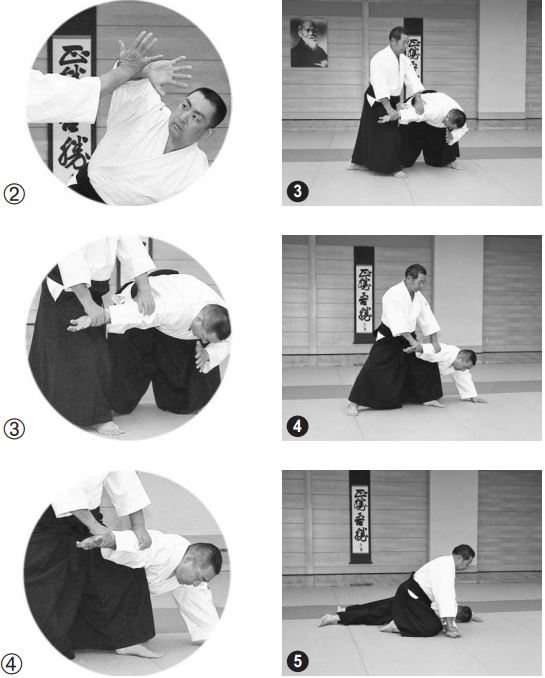
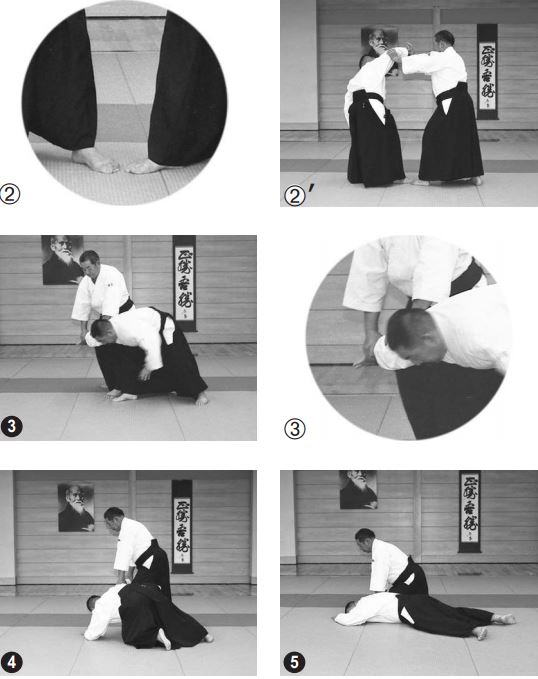
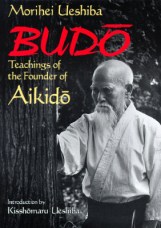
In modern Aikido kaiten techniques are typically referred to as “wheel throws” because the uke is projected in a wheel like shape.  Traditionally, however, they were referred to as “open and turn” techniques.  In the text “Budo“, Master Morihei Ueshiba  describes kaiten as a turn and transform movement.

In the below video, Morhiro Saito Sensei demonstrates shomenuchi kaiten nage. 


ADDITIONAL NOTES

  • Technical instruction

In the below video produced by the London Aikido Club, Andy Hathaway Sensei provides instruction on technical aspect of the technique.

The London Aikido Club shares many of its teachings on the web.  Those interested in the study of traditional Aikido as taught by the Founder in the post war period of his life may wish to check out the London Aikido Club’s You tube channel.


  • Aikido Warrior Demonstration  

See below an informal practice session by Aikido Warrior dojo seniors experimenting with alternate applications of  shomenuchi kaiten nage including from hamni handachi (nage is kneeling) .  The recording was taken after a Saturday morning class.


  • Shomenuchi kaiten nage – Parrying

For detailed instruction on parrying and balance taking methods for shomenuchi strikes  see – Shomenuchi deflections methods.

  • Oher kaiten nage techniques

For training notes on other applications of kaiten nage see Video Library: Unarmed arts (by technique).  Technique groups (e.g. ikkyoirimi nage etc.) are ordered alphabetically.

Have a great week.

Ian Grant
Head Instructor
Aikido Warrior Dojo


Budo Manual – Chart of Techniques

336890In the 1930’s Master Morihei Ueshiba (O’sensei), the Founder of Aikido, published two known technical manuals for his Art.  Both manuals are a source of constant reference at our dojo and form an important part of our study of O’Sensei’s Aikido through Aikido Kenkyukai.

The second of the two manuals, and certainly the most well-known, is simply titled Budo (1938).  The content of this 2nd manual is supported by step by step photographs and instructional commentary for each technique.

For a convenient overview of the techniques referenced in the manual see below a chart that was prepared by Preston Aikido Sakura Dojo in Preston, Lancashire, UK.

Budo Chart


Ian Grant
Head Instructor
Aikido Warrior Dojo


Training notes: Shomenuchi ikkyo

Ikkyo Osensei 2In the below video Morihiro Saito Sensei (9th Dan) demonstrates the Aikido technique shomenuchi ikkyo (omote and ura).

In the demonstrated technique, which is based on The Founder’s instruction in the text “Budo” (1938), the nage initiates the application by applying a vertical strike to the face of the uke.

Pinning techniques are referred to as osae waza in Aikido practice. Ikkyo is the “first technique” in osae waza.


ADDITIONAL NOTES

  • Technical instruction – Omote and ura applications – Morihiro Saito Sensei


  • Shomenuchi ikkyo (omote) – Takemusu Aikido Vol 1.

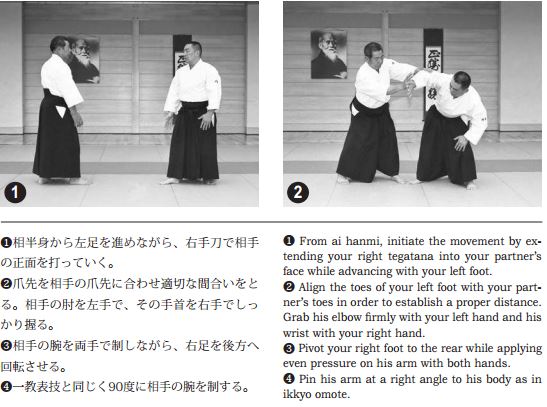
In the below pictorial demonstration, Morihiro Saito provides instruction on the basic omote application of the technique. Notably in the basic application the nage strikes first.

ikkyo-1-omoteikkyo-2


Shomenuchi ikkyo (ura) – Takemusu Aikido, Vol. 1 

In the below pictorial demonstration, Morihiro Saito provides instruction on the basic ura application of the technique. Notably in the basic application outlined below the nage strikes first.

However, the basic ura version is also able to be applied if the nage initiates the strike first.    In the Founder’s 1938 manual it states “When your opponent strikes first with shomen, turn around the attack with irimi tankan, use your right hand to receive the blow and then control your opponent as described..”.
shomen-ikkyo-ura-1shomen-ikkyo-ura-2


  • Ikkyo pin

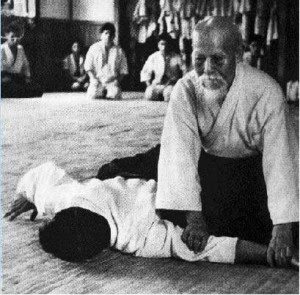
The pin for this technique is often seen done with a form of nikyo pin.  This is not in fact the correct pin.  In the below picture, O’sensei demonstrates the pin for shomenuchi ikkyo.

Osensei ikkyo-pinikkyo in 2 o sensei_1-300x295


In his 1933 text “Budo“, Master Morihei Ueshiba (O’sensei) also states that “when pinning your opponent to the ground it is essential that his arm be at a right angle to his body” (see picture).

  • Uke’s arm remains horizontal and in front of nage’s centre

The uke’s arm remains horizontal in the second part of the technique.  The uke’s hand should not be higher than their shoulder or vice versa. The uke’s arm always remains in front of the nage’s centre.

This is the case regardless of whether the technique is performed standing or where uke and nage are both kneeling (suwari waza).

  • Footwork for ki no nagare practice

In the following video Chicko Sensei uses the sword to demonstrate the footwork for entering for omote applications in (ki no nagare) free flowing practice. Ura footwork is also explained.


  • Shomenuchi ikkyo – Other Aiki principles for ki no nagare practice

In the below video Chicko Xerri Sensei (6th Dan AKI Aikikai) provides instruction on some of the key Aiki principles that underpin practice of  Shomenuchi ikkyo for free flowing practice (ki no nagare).

Our dojo is part of the Fudoshin Australia Group of dojos  operating under the guidance and mentorship of Chicko Sensei.

The technical aspects underpinning dynamic practice of shomenuchi ikkyo are further explored in the below instructional video featuring Yoshimitsu Yamada Sensei (8th Dan Aikikai).  The uke is a young Donovan Waite Sensei (7th Dan ).

  • Alternate atemi application – Aikido Warrior Fudoshin Dojo

In the below video students from our dojo demonstrate an application of the technique where the elbow is used by the nage to strike and take the initial balance of the uke.


  • Demonstration by Morihei Ueshiba, Founder of Aikido 


  • Shomenuchi ikkyo – Zagi Waza

In the below video Chicko Xerri Sensei explains the Aiki principles for shomenuchi ikkyo when it is practised from zagi waza/suwari waza (ie where both nage and uke are kneeling).


Ian Grant
Dojo Cho
Aikido Warrior Fudoshin Dojo, Brisbane


“Free Wielding Sword” (Bokken Kata 2) – Aikido Yuishinkai

In the below video Master Koretoshi Maruyama, Founder of Aikido Yuishinkai, gives a demonstration of one of the three major bokken katas practised in Aikido Yuishinkai  – “Free Wielding Sword” (Bokken Kata 2).  For further detail on key aspects of the kata see videos in the “Detailed Notes” below.


DETAILED NOTES

  • Overview of kata


  • The first four cuts


  • Kyu and ju cuts


  • Ju san and ju hachi cuts


  • Ju roku cut 


All the best

Ian Grant
Head Instructor
Aikido Warrior Dojo


Training notes: Hanmi handachi katate dori shiho nage

Hamni Handachi shiho nageHanmi handachi waza (sometimes called Zagi handachi waza) is a common form of Aikido practice whereby the nage is in a kneeling position and the uke  attacks while standing.  In this type of training the uke has the  advantage of both mobility and height. The nage, however, has the advantage of a lower centre of gravity and a triangular base.

Training in Hanmi handachi waza is particularly beneficial as it develops skills in taking a ukes balance with only minimal lower body movement.  The training also assists in understanding the importance of centre and use of the centre line in Aikido practice.

In the below video, seniors from our dojo demonstrate how we typically practice the Aikido technique Hanmi handachi katate dori shiho nage.  This technique is from the broader Aikido syllabus and is demonstrated both a static attack and where the attack is under motion. The static version that we practice is inspired by O’sensei‘s manual “Budo Renshu“.


ADDITIONAL NOTES

  • Alternate single handed version 

In the below video, Master Morihei Useshiba (O’sensei) demonstrates Hanmi handachi katate dori shiho nage from a single grab. Particularly notable in this version is the use of atemi (striking) by the nage.


  • Other forms of hanmi handachi katate dori shiho nage


Ian Grant
Head Instructor
Aikido Warrior Dojo