Aikido self-defence

Atemi waza – Munetsuki strikes

MunetsukiIn Aikido, strikes (atemi) are often used to set up techniques, as well as being an end in themselves.

In the below video Koretoshi Maruyama Sensei demonstrates and provides instruction on how strikes to the torso (munetsuki) are executed in Aikido Yuishinkai.

The demonstrated method of munetsuki generates its power through the lower limbs to take full advantage of what is sometimes referred to in Aikido as the vertical-horizontal plane.  In most simple terms – one sinks to move forward.

The result is that the strike is backed by the entire body of the nage rather just the activation of the muscle groups in the upper arm.  It also allows the nage’s body to naturally move off the line of an incoming direct attack and facilitates extra strike reach than would normally be expected (see below video).


For further videos and discussion of atemi waza in Aikido training on this site see – Atemi arts (striking)

Have a great week.

Ian Grant
Dojo Cho
Aikido Warrior Dojo


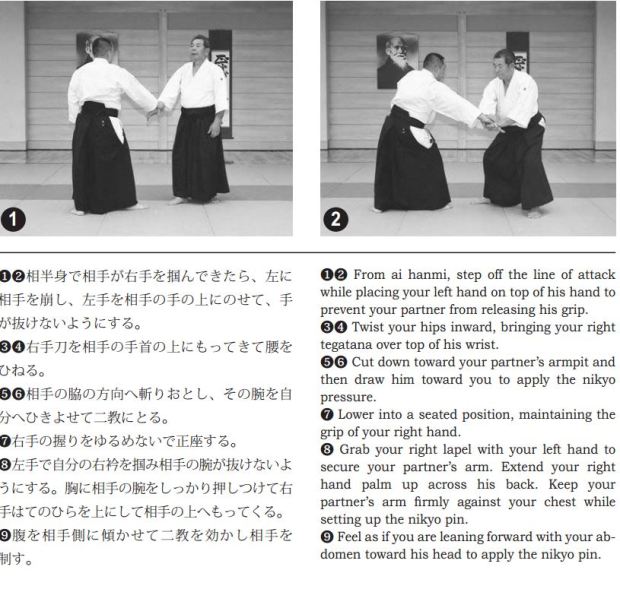
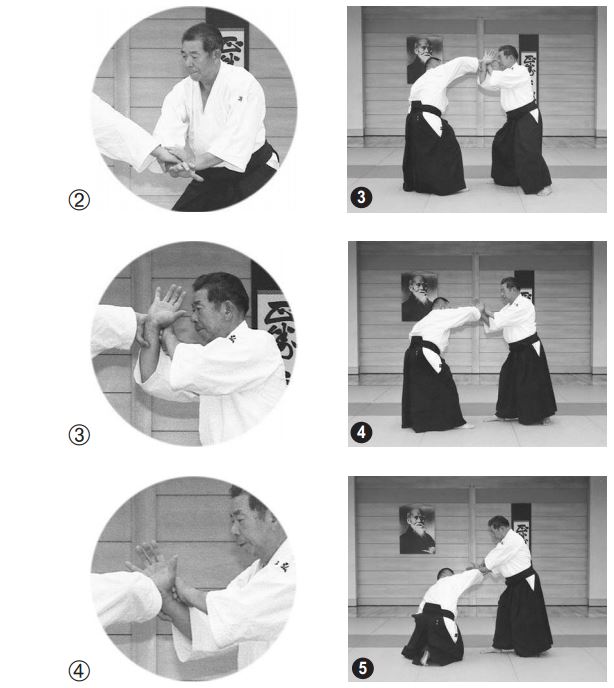
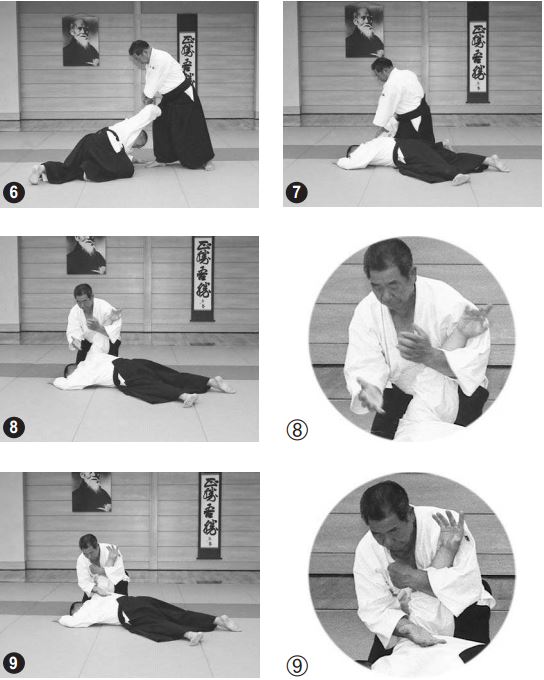
Training notes: Ai hanmi katatedori nikyo

nilyo 2Nikyo techniques involve the application of a painful pronating or adductive wristlock to subdue or pin an attacker.  They are a common feature in the syllabus of most Aikido schools.

Nikyo techniques can be used to address a wide variety of attacks.  They are particularly effective in circumstances where the uke attempts to grab the clothing or wrist of a nage (as a prelude to follow up strike).

Our dojo is a Fudoshin dojo operating under the guidance and mentorship of Chicko Xerri Sensei 6th Dan AKI (Aikikai).

In the below video Chicko Sensei  explains the sword movements and Aiki principles  which underpin the application of Ai hanmi katatedori nikyo. This form of nikyo is applied in response to an attack in the form of a cross hand grab.

Depending on the school, Ai hanmi katatedori nikyo is also referred to as Kosadori nikyo.


ADDITIONAL NOTES

  • Alternate application (1) Morihiro Saito Sensei

See below a photo demonstration (including description) and video of Morihiro Saito Sensei (9th Dan) explaining the fundamental elements of Kosadori nikyo as practised by O’sensei in the immediate post war period of his training life.

saito-nikyo

saito-nikyo-2

saito-nikkyo-3


  • Alternate (Ki no nagare) application (2) – London Aikido Club

In the below video Sensei Andy Hathaway demonstrates and provides instruction on Kosadori nikyo as practised at the London Aikido Club.


  • Alternate application (3) 

In the below video Sensei Andy Hathaway of the London Aikido Club demonstrates and provides instruction on an alternate takedown for Kosadori nikyo.


Alternate application (4) – Sensei Andy Sato


  • Brief Biography – Morihiro Saito Sensei (1928-2002)

saito_seiza_260Morihiro Saito Sensei’s  practice of Aikido spanned 56 years and he is one of the most important teachers in Aikido history.  Saito Sensei was a live-in student of O’sensei for more than 20 years at his home dojo in Iwama, Japan.

Saito Sensei spent his teaching life dedicated to preserving the technical style of Aikido as practised and shown to him by O’sensei in the post-war period.  Without his commitment to preserving the Aikido of the Founder and extensive efforts to record and document his teachings, much of the Aikido of O’sensei may have been lost.

Have a great week

Ian Grant
Doj Cho
Aikido Warrior Dojo


Breakfalls and Aikido – Are they really necessary?

Ueshiba 5The question of whether breakfalls are really necessary in Aikido is one that seems to attract very different opinions even amongst those who practice in the same school.

I have heard senior practitioners on many occasions argue that breakfalling is pointless, dangerous and really only has a place in demonstrations where the nage needs the uke to make them look good or “wow” the crowd.  I have also heard the converse argument to the effect that breakfalling is necessary to learn Aikido at advanced levels and is a critical skill to minimise the possibility of injury at the dojo.

bokken koshi nageThe reality probably lies somewhere in the middle of these arguments. It is also in part influenced by the holder’s perspective as to whether Aikido is primarily a system of self-defence, a health art, a physical manifestation to study philosophical expression, or all of these things and more.

At our dojo, self-projected high falls from techniques are banned. “One flung dung” throws are also not permitted (i.e. techniques where the nage takes no responsibility for being the uke‘s safety anchor). We also have the philosophy of “severe technique – soft throw”.

OLYMPUS DIGITAL CAMERANotwithstanding, breakfalls are part of our regular practice and dojo culture.  Aspects of these falls are practised and studied at every class.  There are 2 fundamental reasons for this and both are game changers when it comes to the decision to include breakfalls in Aikido training.
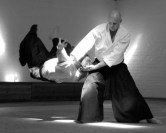
Peter KellyThe first is that breakfalling allows us to study the full spectrum of Aikido techniques, including, for example, traditional techniques such as hip, shoulder and drop throws.  Without breakfalling skills, many of these traditional techniques developed by O’sensei (the Founder of Aikido) would in effect be denied us.  This is because a breakfall is the only option to receive them.  While there is no doubt one can study Aikido by excluding traditional applications (and many do) – its just not what we are about.

Secondly, we also hold the view that for Aikido to have self-defence relevance, study of  “kuzushi” is fundamental (i.e. the need to completely break the balance of a uke to a OLYMPUS DIGITAL CAMERAexecute technique). Once a uke‘s balance is broken, it is critical that they have the full range of ukemi options at their disposal to allow them to land safely, including breakfalls. Admittedly, some Aikidoka regard kuzushi as being unimportant to their study of Aikido and even go as far as to suggest that it is contrary to their philosophical beliefs as to what Aikido is about.  However, as that is not the position we hold at the dojo – breakfalling skills again come into play.

In the below video, various techniques are shown where breakfalling skills have been called upon by dojo members over the year to safely receive a technique.

Have a great week

Ian Grant
Head Instructor
Aikido Warrior Dojo, Brisbane
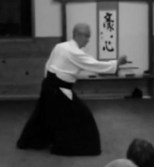
Static resistance training: Katadori kokyu nage

katadori kokyu nageDealing with grab attacks where the uke is holding or resisting with physical based strength is an important part of Aikido practice.

While as Aikidoka we train ourselves to use centred relaxed grips (i.e. “holding with ki”), the fact remains that in most self defence situations the attacker will typically be using strength based tactics.  Failure to include responses to strength and resistance based attacks in our regular practice would in effect make our training effectively useless from a martial perspective.

Significantly, when Aikido is used against strong grip static attacks, the movements tend to be more economical and less complex.  Centred sinking movements combined with taking balance by controlling the head or elbow are common.  Atemi (striking) is also more often than not a critical component. The Aikido in general becomes less pretty.

  • Katadori kokyu nage

In the below video, Master Koretoshi Maruyama gives instruction on how to perform the Aikido technique kokyu nage (breath throw) in response to a static shoulder grab (kata dori) where the attacker is holding with strength.


  • Application against a sleeve grab

Kokyu nage as demonstrated in the video can also be used to address an attack in the form of a sleeve grab – see Sodedori kokyunage.

  • Alternate form of katadori kokyu nage

As is often the case in Aikido, there is an alternate method of executing a kokyu nage against a strong shoulder grab.  In the 1950’s, O’sensei practiced the technique without taking the elbow and instead closed the gap between the uke and nage by executing a tenkan –  See katadori kokyu nage (post war version).

  • Other examples of Aikido for static resistance attacks

Static resistance training is a regular form of practice at our dojo.  For examples of other resistance based training that we undertake see – Working with resistance: static hand grabs.

Have a great weekend.

Ian Grant
Head Instructor
Aikido Warrior Dojo

Jo dori and jo nage – O’sensei style

osensei-saitoTraining in the use of a wooden staff (a jo) for self defence purposes (jo nage) is an integral part of the syllabus for most  schools of Aikido.  Aikido practice also typically includes training in disarming techniques (called jo dori or jo tori) where the attacker (uke) is the one armed with the jo.  

Interestingly, O’Sensei’s technical manuals do not refer to jo nage or jo tori.  However, the 1936 manual Budo does include broadly comparable weapons such as the bayonet and spear. Those of us interested in O’sensei’s approach to jo nage and jo tori fortunately have access to the extensively recorded works of Morihiro Saito Sensei (9th Dan). Saito Sensei  (1928 -2002) dedicated his life to preserving O’Sensei’s Aikido as taught to him (much of it as a one on one student) over a 23 year period in Iwama, Japan.

In the below video recorded in 1986 and made publicly available by Aikido Journal, Saito Sensei Sensei provides detailed instruction on jo nage  and jo dori as directly taught to him by the Founder of Aikido. The instruction covers a wide variety of techniques (with a heavy emphasis on kokyu ho forms).  As is typical of Saito Sensei, his instruction is candid, insightful and martially focussed.  Some of the key differences between the Aikido practised by its creator and later ‘less -martial” incantations are also touched on.

Have a great weekend

Ian Grant
Dojo Cho
Aikido Warrior Dojo