Aikido Australia

Training Notes – Ryotedori kokyunage and koshinage

Peter KellyThis video training note examines ryotedori kokyu nage and koshi nage applications.  The video extract is from from a class given by Peter Kelly Sensei (7th Dan, Aikido Yuishinkai) at the Aikido Warrior Dojo on 17 May 2014.

Peter Sensei’s interpretation of koshi nage (hip throw) is heavily influenced by the approach taken by Yoshio Kuroiwa Sensei. Peter Sensei makes the following comment in this regard:

Yoshio Kuroiwa Sensei always taught with a stick to teach lines and internal power vectors and triangulation. He was very martial, an ex boxer. Great understanding of movement. I have tried very hard to follow his style of Koshi. If it’s easy and smooth, no can defence.”

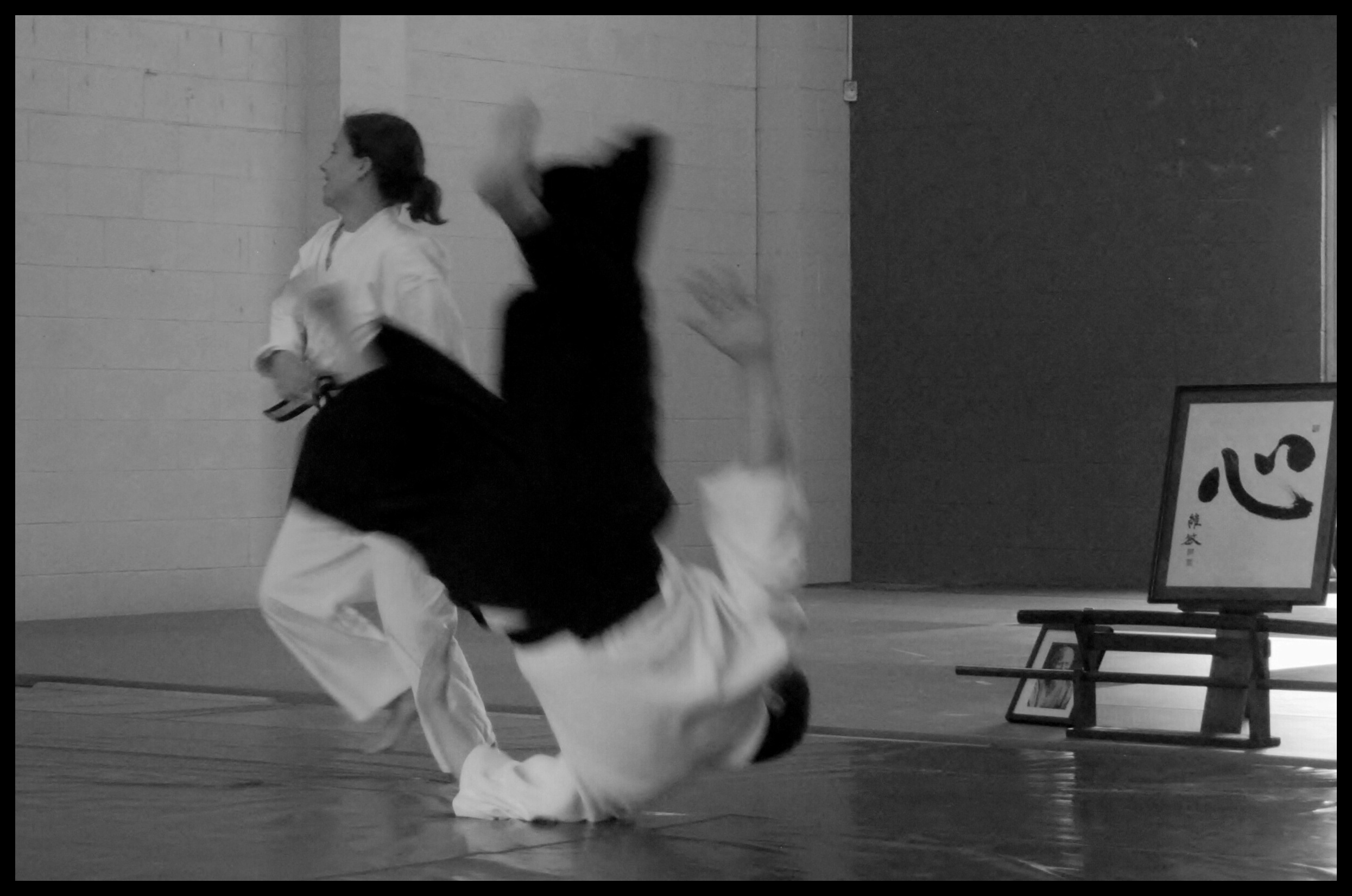
In the video extract Peter Sensei notes that O’Sensei often joked that he could do koshinage all day and not get tired.  The ukemi challenges associated with koshinage are also explored.

Ian Grant
Head Instructor
Aikido Warrior Dojo


Visiting Guest Instructor – Peter Kelly Sensei – 17 May 14

Peter KellyAikido Warrior Dojo will be hosting a special class on Saturday 17 May 2014 (2.30 pm – 5.00pm) by Peter Kelly Sensei.

Peter Sensei has recently been appointed by Master Koretoshi Maruyama as the technical advisor for Aikido Yuishinkai in Australia.  Peter Sensei is also the Chief Instructor of The Aikido School of Excellence in Tasmania.

Peter Sensei will be covering a range of principles and techniques relevant to Aikido Yushinkai, with particular emphasis on those relevant to the new syllabus and our school’s revised direction.

The cost of the class is $10 and all Aikido Yuishinkai practitioners are welcome to attend. For persons who have not trained at Aikido Warrior Dojo previously, please arrive 30 minutes before the class commences for registration.

Address details for the dojo may be found on our home page (see here).

Ian Grant
Head Instructor
Aikido Warrior Dojo
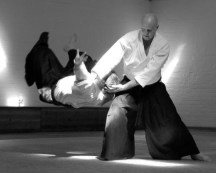
Aikido without kuzushi – It’s like pizza without cheese

For Aikido to be practised with any element of martial integrity, the ability to employ kuzushi when applying a technique is a critical skill.

I would go as far as to say that in the absence of employing kuzushi it would be almost impossible to successfully apply any Aikido technique against a structurally centred and non-compliant aggressor of equal size and strength.

For those not familiar with the term kuzushi, it is most commonly used in a martial context as a reference to unbalancing the person who is initiating the attack (uke).  In other words, it involves bringing the uke’s center of gravity beyond their base of support and hence removing their ability to regain uncompromised balance.  While in this unbalanced position, it becomes very difficult for the uke to resist or counter the application of an appropriate Aikido technique.

While it all sounds so simple, learning to employ kuzushi is far from easy in practice. Amongst other things, it requires relaxed sensitivity, timing, and the ability to redirect an attacker’s energy.  If that isn’t challenging enough, kuzushi also needs to be employed at the time of first contact with the uke and then maintained throughout the application of the technique.

Unfortunately, I note there are a number of Aikido commentators around the web that appear to be concerned there is a trend in modern Aikido to de-emphasise and in some cases disregard the important role of kuzushi. I certainly hope these concerns are unfounded.

Excluding kuzushi from our practice would effectively render Aikido useless from a martial perspective.  For me, Aikido without kuzushi is like pizza without cheese. It’s not something I’m interested in trying.

Ian Grant
Head Instructor
Aikido Warrior Dojo


How to do a forward roll?

Roll 1For many people, learning to forward roll is probably one of the most challenging and frustrating parts of Aikido training.  I read recently that fear of rolling is one of the major reasons that people avoid taking up Aikido.  It is also apparantly one of the major reasons people leave.

Over the years, I have had the misfortune of witnessing way too many Aikido practitioners mistake a forward roll as some form of straight over the head circus tumble.  The end result is always the same – injury followed by fear.  This is particularly so if you try to circus tumble out of a correctly applied Aikido technique.

One of the most effective forward rolling methods that I have seen is that developed and applied by Donovan Waite Sensei (7th Dan).  This method of rolling is what is taught at our dojo.  Major benefits include that is more gentle on the body, easier to learn, and importantly martially effective.

For further information on falling arts in aikido – see our video library

Ian Grant
Dojo Cho
Aikido Warrior Dojo