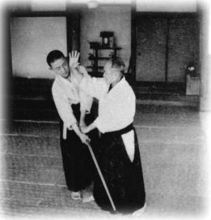
Striking techniques (atemi waza) are an integral part of aikido practice. While atemi is typically used in modern Aikido as a means to set up a throwing technique, it may also be used as method of ending a confrontation on its own.
In the below video Master Koretoshi Maruyama, Founder of Aikido Yuishinkai, provides instruction on how to use atemi as a sole response to addressing a downward direct strike to the forehead (shomenuchi) where the attacker is armed with a wooden sword (bokken).
The video was recorded in 2005 at Byron Bay, Australia.
Have a great week.
Ian Grant
Head Instructor
Aikido Warrior Dojo, Brisbane
In the below video Yoshimitsu Yamada Sensei (8th Dan Aikikai) demonstrates and provides instruction for the Aikido technique gokyo (No 5 wrist technique).
The instruction shows how to use gokyo to defend against a knife attack where the uke thrusts the knife to the side of the nage’s neck while holding it in the same way as an ice pick (yokomenuchi sakate mocha). The instruction (other than the pin) is equally applicable to addressing a standard yokomenuchi attack where the uke is unarmed.
ADDITIONAL NOTES
Alternate standing pin and disarm
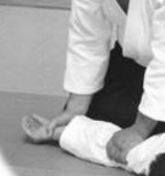
Kneeling pin if there is no weapon
Alternate entry if uke attacks with shomenuchi strike to forehead
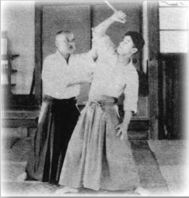
Master Morihei Ueshiba (O’sensei), the Founder of Aikido, produced 2 instructional manuals for his martial art in the 1930’s.
Evident in both manuals is the time and effort taken to not only write but also make visual representations to support the instruction. For example, in one of the manuals there are 166 techniques, all of which are accompanied by hand drawings to assist the reader.
In the 2nd manual, the instructional aspects are supported by photographs. However, even this would have been painstakingly long process given the relative primitive state of photography at the time.
Unfortunately, and one might even say bizarrely, neither of the manuals appear to be a major reference point for modern aikido practice with the exception of Iwama Aikido. I have heard a number of reasons given for this. However, they also seem to share the common ground that O’Sensei’s pre-war Aikido (or Aikido Budo as it was then labelled) was very different to post-war, hence making the manuals historically interesting but largely irrelevant.
I have long struggled with this argument as it doesn’t align with personal experience. For example, we frequently use the manuals as reference points to inform our practice in our dojo and have found them to be very relevant and insightful in our study of O’Sensei’s Aikido through Aikido Kenkyukai.
In fact I would go as far to say that in substance O’Sensei’s prewar Aikido share many similarities with his post war Aikido. The main differences being that in his later years O’sensei seems to have stopped teaching the more complex pins. Other changes could be described as refinements and at most, alternative variations.
However, don’t take my word for it. Look at the below video and make up your own mind.
In the meantime, I think we at Aikido Warrior Dojo will continue to hold the only written technical teachings of the Founder of Aikido in the highest regard.
Ian Grant
Dojo Cho
Aikido Warrior Dojo
Acknowledgement: The above video was not made by Aikido Warrior Dojo, but by a person who goes by the You tube name of Marius V. While I have never met Marius V, I would like to acknowledge and thank him for his extraordinary work in producing the video.
While by no means the most commonly practised “drop” technique, seoi otoshi has nonetheless been part of Aikido since its early days. A question often asked whenever seio otoshi is practised in the dojo is what is the difference between a seoi otoshi (shoulder drop) and a seoi nage (shoulder throw)?
Given the fact that both techniques involve the loading of the uke onto the back of the nagi (which is what “seoi”means), the confusion between the techniques is understandable. Its is also a technically trite (albeit correct) response to merely state that seoi nage is something more associated with Judo than Aikido.
From a technical perspective, the distinguishing feature of a seio otoshi is that the nage drops to one or both knees and stays there until the completion of the technique. By comparison, in seoi nage the nage completes the technique from a standing position. Further, a technique is still a seoi nage notwithstanding that the nage may have dropped to one or both knees and then returned to a standing position to complete it.
The below video includes demonstrations of both seio otoshi and seio nage by seniors at our dojo. The video is a compilation from various sources, including gradings and taninzugake (free form) practice.
Although part of the broader Aikido syllabus, one of our favourite techniques to practice at the dojo is koshi nage(hip throw). In fact, there would rarely be a class where this technique does not appear in some form.
Like many Aikido techniques, the origins of koshi nage trace back to the battlefield. With this in mind, we recently resolved to study the technique in the context of paired weapons practice, specifically bokken (wooden sword) vs bokken and jo (staff) vs bokken. Below is a video recording of our first efforts in this regard.
The informally recorded demonstrations are intentionally experimental and involve subtle differences in terms of hand placement on the weapon, form of ukemi, method of moving off-line, atemi, feet position and balance breaking. All in all a very useful and informative learning exercise.
As a qualifier when viewing the video, please note that our dojo is not a sword or jo school and we are not about learning to “fight” with these weapons. For us, the purpose of paired weapons practice is to magnify errors in our Aikido technique and to give us the opportunity to apply Aikido principles in different situations.
 Striking techniques (atemi waza) are an integral part of aikido practice. While atemi is typically used in modern Aikido as a means to set up a throwing technique, it may also be used as method of ending a confrontation on its own.




 Aikido Warrior Dojo
You must be logged in to post a comment.