Training – Weapons arts

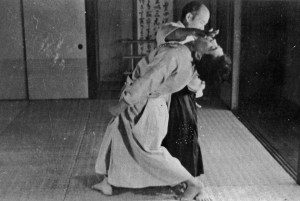
Budo (1938) – Tanto dori munetsuki kokyu nage

iriminageIn 1938 Master Morihei Ueshiba, the Founder of Aikido, finalised the 2nd of his 3 technical texts.  Simply titled “Budo“, the text contains a sampling of techniques from a wide range of attacks, including grabs, strikes and attacks from different weapons.  “Budo” is an important reference point for our practice at Aikido Warrior Dojo.

The below video features a photographic demonstration of tanto tori munetsuki kokyu nage (Technique 32) as it appears in “Budo“.  The technique is very similar to irimi nage with the notable exception that in the demonstrated technique the nage’s hand is placed under the uke’s chin.   Also included is a demonstration of the technique by Morihiro Saito Sensei who was a direct student of the Founder for more than 20 years.


Ian Grant
Dojo Cho
Aikido Warrior Dojo
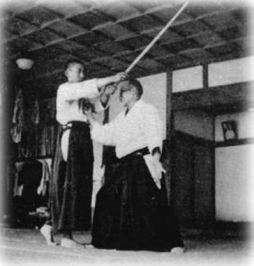
 

Budo (1938) – Tachi dori shomenuchi kokyu nage

bokken 1(a)In 1938 Master Morihei Ueshiba, the Founder of Aikido, finalised the 2nd of his 3 technical texts.  Simply titled “Budo“, the text contains a sampling of techniques from a wide range of attacks, including grabs, strikes and attacks from different weapons.

Budo” is an important reference point for our practice at Aikido Warrior Dojo. The techniques and principles referred to therein are regularly practised.

Interestingly, the Founder only included 3 tachi dori techniques in his 2nd text.  Further, 2 of the 3 techniques are variations of tachi dori shomenuchi kokyu nage.  In the first version (Technique 28) the nage enters to the uke’s right and in the second (Technique 29) enters to the uke‘s left.  Notably, in both techniques the Founder always enters on the same side as his forward foot (thereby ensuring he does not move under the vertically cutting blade).

The below videos feature photographic demonstrations of  both versions of bokken tori shomenuchi kokyu nage as they appear in “Budo”.  Also included are demonstrations of the techniques by Morihiro Saito Sensei who was a direct student of the Founder for more than 20 years.

  • Bokken tori shomenuchi kokyu nage (Technique 28)


  • Bokken tori shomenuchi kokyu nage (Technique 29)

For comparative purposes, the following video includes both the pre-war (Budo) version of the subject technique and also the post war version. Both versions are practised at our dojo.


Have a great week.

Ian Grant
Dojo Cho
Aikido Warrior Dojo
 

Training notes: Tanto dori – Munetsuki hiji kime

In the below video, Dojo senior Jeremy Gehrke demonstrates the Aikido technique – Munetsuki hiji kime.  The technique is applied in the context of a traditional knife attack to the abdomen.


ADDITIONAL NOTES

  • Alternate version 

In the below video clip, Mike Jones Sensei from NY Aiki kai demonstrates an alternate version of tanto tori munetsuki hiji kime.  In this version the nage remains standing at the completion of the technique (similar to a traditional kokyu nage ending ).  The principles being applied, however, are the same and equally applicable to the featured video demonstration (above).

Also included in the video are combined elbow and choke retraining techniques for addressing an attack with a tanto.  These techniques are also practised at our dojo.

Have a great week

Ian Grant
Dojo Cho
Aikido Warrior Dojo


Training notes: Jo nage shiho nage

saito osenseiThe below video was recorded at a recent class at our dojo where we studied a form of Aikido practice referred to as jo nage.  In this type of practice the nage (i.e. the person applying the technique) is armed with a wooden staff (a jo).

The jo nage technique being explored is the traditional version of shiho nage (4 directions throw).  Both the omote and ura forms are demonstrated.


ADDITIONAL NOTES

  • Jo nage shiho nage – more detailed look

saito_seiza_260For more detailed instruction the traditional form of jo nage shiho nage see the below a video of  Morihiro Saito Sensei (1928-2002) providing instruction on the technique.

Saito Sensei’s practice of Aikido spanned 56 years and he is one of the most important teachers in Aikido history.  Saito Sensei was a live-in student of O’sensei for more than 20 years at his home dojo in Iwama, Japan.


Have a great weekend.

Ian Grant
Head Instructor
Aikido Warrior Dojo


“Free Wielding Sword” (Bokken Kata 2) – Aikido Yuishinkai

In the below video Master Koretoshi Maruyama, Founder of Aikido Yuishinkai, gives a demonstration of one of the three major bokken katas practised in Aikido Yuishinkai  – “Free Wielding Sword” (Bokken Kata 2).  For further detail on key aspects of the kata see videos in the “Detailed Notes” below.


DETAILED NOTES

  • Overview of kata


  • The first four cuts


  • Kyu and ju cuts


  • Ju san and ju hachi cuts


  • Ju roku cut 


All the best

Ian Grant
Head Instructor
Aikido Warrior Dojo