Training – Unarmed techniques

Training Notes – Ryotedori kokyunage and koshinage

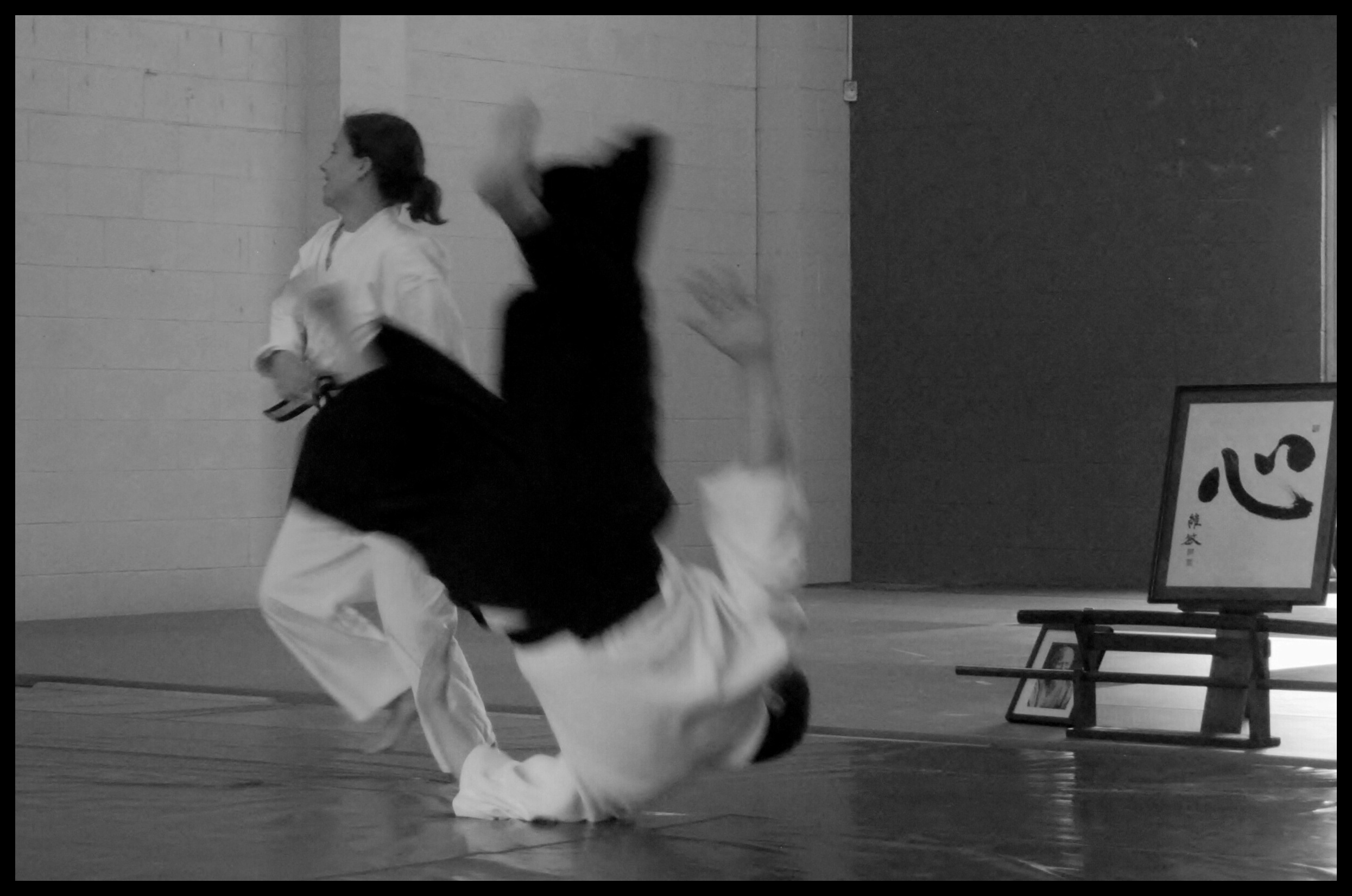
Peter KellyThis video training note examines ryotedori kokyu nage and koshi nage applications.  The video extract is from from a class given by Peter Kelly Sensei (7th Dan, Aikido Yuishinkai) at the Aikido Warrior Dojo on 17 May 2014.

Peter Sensei’s interpretation of koshi nage (hip throw) is heavily influenced by the approach taken by Yoshio Kuroiwa Sensei. Peter Sensei makes the following comment in this regard:

Yoshio Kuroiwa Sensei always taught with a stick to teach lines and internal power vectors and triangulation. He was very martial, an ex boxer. Great understanding of movement. I have tried very hard to follow his style of Koshi. If it’s easy and smooth, no can defence.”

In the video extract Peter Sensei notes that O’Sensei often joked that he could do koshinage all day and not get tired.  The ukemi challenges associated with koshinage are also explored.

Ian Grant
Head Instructor
Aikido Warrior Dojo


Training Notes – Morotedori kokyu ho

OsenseiMorote tori kokyu ho was one of the three techniques O’Sensei taught at all of his classes.  At basic level, the technique is practised against a uke who is offering  resistance.  O”Sensei considered that the regular practice of morotedori kokyu ho was essential to build an “aiki body“.

Given the high emphasis that the Founder placed on morote tori kokyu, it is regularly practised at our dojo.

In the below videos Morihiro Saito Sensei (9th Dan) demonstrates morotedori kokyu ho at kihon (basic) and ki no nagare (free flowing) levels.


ADDITIONAL NOTES

  • Technical details – Basic (kihon) level – Morihiro Saito Sensei


  • Morotedori kokyu ho – ki no nagare

In the below video, Saito Sensei demonstrates how to apply Morotedori kokyu ho at a higher level free flowing technique.  This level of application should not be attempted until mastery of the basic version has been achieved.


  • Hanmi

In the following video, Saito Sensei explains in more detail the hanmi principles underlying morotedori kokyu ho.


  • Correct way to grab


  • Morotedori kokyu ho – Peter Kelly Sensei 

In the below video, Peter Kelly Sensei, Aikido Yuishinkai Tasmania, provides training tips on morote tori kokyu ho.  Peter Sensei describes the movement as follows:

The basic premis is a double spiral, both the hara and the arm. The left hand atemi to the abdomen helps get the pelvis in the correct position to not use strength in the hand which is twisted and held down with alot of resistance. The resistance helps to generate powerful hips and body.”   


  • Morotedori kokyu ho (ura)

In the below video Saito Sensei demonstrates how Morotedori kokyu ho is applied if the nage commences the exercise with a tenkan movement.


  • An alternate approach

In the following video, Takashi Kuroki Sensei of Nishio Aikido gives instruction on an alternate approach to Morotedori kokyu ho.  This approach is also practiced at our dojo.


Ian Grant
Dojo Cho
Aikido Warrior Dojo

Aikido without kuzushi – It’s like pizza without cheese

For Aikido to be practised with any element of martial integrity, the ability to employ kuzushi when applying a technique is a critical skill.

I would go as far as to say that in the absence of employing kuzushi it would be almost impossible to successfully apply any Aikido technique against a structurally centred and non-compliant aggressor of equal size and strength.

For those not familiar with the term kuzushi, it is most commonly used in a martial context as a reference to unbalancing the person who is initiating the attack (uke).  In other words, it involves bringing the uke’s center of gravity beyond their base of support and hence removing their ability to regain uncompromised balance.  While in this unbalanced position, it becomes very difficult for the uke to resist or counter the application of an appropriate Aikido technique.

While it all sounds so simple, learning to employ kuzushi is far from easy in practice. Amongst other things, it requires relaxed sensitivity, timing, and the ability to redirect an attacker’s energy.  If that isn’t challenging enough, kuzushi also needs to be employed at the time of first contact with the uke and then maintained throughout the application of the technique.

Unfortunately, I note there are a number of Aikido commentators around the web that appear to be concerned there is a trend in modern Aikido to de-emphasise and in some cases disregard the important role of kuzushi. I certainly hope these concerns are unfounded.

Excluding kuzushi from our practice would effectively render Aikido useless from a martial perspective.  For me, Aikido without kuzushi is like pizza without cheese. It’s not something I’m interested in trying.

Ian Grant
Head Instructor
Aikido Warrior Dojo


Class Training Notes: 12/1/ 2013

Well Saturday was a scorcher in terms of the weather and I must say I was surprised how many of us decided to hit the mat.  I can’t recall the last time I trained in such heat.  The fact that we all stuck in there until the end (including a rather energetic round of taninzugake) is either a testament to our dedication or madness.   Anyhow – on with the notes.

Ukemi

This week we looked in more detail at the backward roll (ushiro ukemi).

As most people will attest, backward rolling when you first start out can be something of a challenge.
Roll 1In essence a backward roll is nothing more than a forward roll executed in reverse. The problem is if you have poor form in your forward roll (e.g. you circus tumble) and then attempt to execute that poor form in reverse, the chances of successfully executing the roll are close to nil.  There is also the possibility of injuring your neck in the failed attempt.

Below is a link to a You Tube video demonstrating step-by-step how to forward and backward roll by Donovan Waite Sensei (7th Dan).  I would highly recommend anyone who is learning to backward roll or just seeking some pointers on how to improve their backward (or forward) rolling to closely study this video clip.  Further, it’s an excellent resource that caters for those interested in beginner or advanced ukemi.

Link: Aikido Ukemi – Meeting the mat

kaeshi waza

This week we practised kaeshi waza in the context of reversing the execution of katatedori shihonage tenkan (i.e. same side one hand hold – four direction throw).  The significance of this practice was to demonstrate how relatively easy it is to reverse a katatedori technique if the ukes balance is not taken at the moment of first physical contact with the nage (the person executing the technique).

For those interested in looking at this kaeshi waza technique again, you may wish to check out the first part of the following You Tube clip: Kaeshi waza 1 (at o:40 mark).

Katatedori

Katatedori techniques were the theme this week with a particular emphasis on unbalancing the uke (the attacker) at first contact.  This takes considerable practice.

In class we looked at how to unbalance a uke by making contact with the uke’s grab prior to that expected by the uke and, in addition, unexpectedly offering no clash at the time of the early contact.  A You Tube  video that neatly demonstrates and explains this concept is Aikido  Kuzushi Katsu Hayabi  Effortless Activation.

For those who keep a record of such things, the techniques practised this week were Katatedori ikkyo ura and Katatedori irimi kokynage.

Kokydosa

Craig Boyd Sensei kindly agreed to provide us with an instructional session on full contact kokydosa with a standing nage.  I find this type of training quite interesting as it really steps up your sensitivity and hones your awareness of your center.  One thing that I did notice was that when we eventually went back to practising standard kokydosa, the practise from the nage’s perspective felt absolutely effortless.

I would like to particularly thank Craig Sensei for sharing his knowledge of this rather novel form of practice with us.  It’s really interesting stuff and also a reminder of the rich Samurai heritage that predated the formation of Aikido.

Weapons kata

With gradings set for 26 January 2013, Gary and Zac gave excellent demonstrations of the “sword of nine ways” and “Shooting star” weapons katas.

Skills acquired through committed weapon practice translate directly and positively to improving our unarmed techniques. Benefits of weapons practice include the development of ki extension, correct posture, calmness of mind, foot work, atemi (striking), moving from one’s centre, coordination, focus and calmness of mind.

Big thanks to Craig Sensei, Gary and Zac for their contributions in this part of the class, which also served as a tool for looking at some of the ceremonial aspects of our martial art, particularly in a grading context.

Look forward to seeing you all next week.

Ian
No-touch Aikido techniques: Separating fact and fantasy

There are plenty of examples on You Tube where a “martial arts master” appears to take an Obi-Wan Kanobi moment and use an invisible blast to project one or more students across the room.  Let me blunt from the outset, I’m a non-believer.

I must confess, I did visit an unaffiliated Aikido dojo some years ago where the possibility of shooting long distance “ki blasts” seemed to be seriously discussed.  I should add no one in the room could actually demonstrate such blasts, but the very fact some of them hoped to one day was enough for me never to return.

This is not to say that I don’t believe in the efficacy of so called no-touch Aikido techniques.  In fact, the truth is quite the contrary.  It’s just that these techniques have nothing to do with Star Wars let the force be with you” like blasts.

I should also add that I have on many occasions been the recipient of Aikido no-touch techniques. Based on this experience, I can assure the reader they are quite effective and have nothing to do with science fiction or mystic rays.

Essentially what happens is that the nage (i.e. the person doing the technique) neutralises the uke’s attack by executing a strike in such a way that the uke has the option of taking a fall instead of being hit. This takes considerable skill on the part of the nage, both in terms of timing and delivery. Specifically, the strike has to be fast enough such that it cannot be deflected, but slow enough so that the uke has the option of taking the fall to get out of the way of the incoming blow.

In real life, an untrained attacker will most likely be hit rather than choose to fall to avoid the strike. The nage must therefore also be trained in delivering the strike (which in fact is typically more a cut) so as to not suffer injury to their hand or arm when delivering it.

In a dojo setting, a uke well versed in ukemi (falling) is also critical. In essence the uke must respond to the strike as if it were a throw – something requiring some practice to do well.

See below a photograph sequence taken at the former Mizu Aikido Dojo.  The demonstrated no-touch technique is being used to neutralise an attacking force in the form of a two armed grab (ryotemochi).

Aran Seq

So there you go – no touch techniques really exist.

Ian Grant