Training – Unarmed techniques

Munetsuki kokyu nage – Aikido Yuishinkai

kokyu nage munetsukiIn the below video Master Koretoshi Maruyama, Founder of Aikido Yuishinkai, demonstrates and provides instruction for one of the versions of munetsuki kokyu nage The technique is  categorised as a “breath throw” and is practised as a response to a strike or thrust to the stomach (munetsuki).

From a superficial mechanical perspective, the technique appears deceptively straightforward. In reality, however, it can be quite challenging to successfully perform.  It requires substantive skills in entering, timing, sinking, maintaining centre pole and moving as a single relaxed unit.

Further, like most more advanced Aikido techniques the uke’s balance is not taken by movements of the nage’s upper body, but by the correct movement of the nage’s lower half of their body. The nage’s hand on the uke’s arm is merely the connection point.

One of the training advantages that we have found at the dojo with this particular version of munetsuki kokyu nage is that the internal skills and aikido principles necessary to perform it offer a “gateway” to learning other advanced techniques, including for example munetsuki kaitenage.


Have a great weekend.

Ian Grant
Dojo Cho
Aikido Warrior Dojo


Yokomenuchi shiho nage

Osensei shihonage (6)Shiho nage (4 directions throw) is one of the most important, if not the most important pillar technique in Aikido training. It contains within it the root of every Aikido technique and there is no doubt its proper execution relies on the nage applying all of the fundamental principles that underlie Aikido practice.

In the below video Morihiro Saito Sensei Sensei demonstrates the omote and ura forms of the Aikido technique  Yokomenuchi shiho nage. This form of shiho nage is practised in response to an attack in the form of a side downward blow to the temple area (yokomenuchi).


ADDITIONAL NOTES

  • Technical notes – Morito Suganuma Sensei 

In the below video Morito Suganuma Sensei (8th dan Aikikai) demonstrates and provides instruction for Yokomenuchi shiho nage.  The instruction incudes both the omote and ura applications.


  • Initial setup –  Technical notes


  • Omote application (1) – Technical notes – London Aikido Club

In the following video Sensei Andy Hathaway of the London Aikido Club gives detailed instruction on the traditional application of Yokomenuchi shiho nage (omote) as practised by the Founder of Aikido in the immediate post-war period.  


  • Omote application (2) – Technical notes – Yoshimitsu Yamada Sensei


  • Ura application – technical notes – Yoshimitsu Yamada Sensei


  • Alternate application (1) – Christian Tissier Sensei

In the below video Christian Tissier Sensei (8th Dan Aikikai) demonstrates an alternate application of shiho nage yokomenuchi where the nage directly enters to respond to the attack.


  • Alternate application (2) – Aikido Yushinkai

In the below video, Peter Kelly Sensei, Aikido Yuishinkai, demonstrates and provides instruction for an alternate application of yokomenuchi shiho nage.  The video was recorded at a mini seminar at our Dojo in 2015.


Have a great weekend.

Ian Grant
Dojo Cho
Aikido Warrior Dojo

Training notes – Munetsuki shiho nage

budo-shihonage-640Shiho nage (4 directions throw) is considered to be one of the most important pillar techniques in Aikido training. The name of the technique stems from the fact that a skilled nage can throw the uke in any of 4 directions.

In the below video Peter Kelly Sensei, Chief Instructor – Aikido Yuishinkai Australia, demonstrates and provides instruction on the application of shiho nage to address a strike to the torso (munetsuki shiho nage).

Peter Sensei focuses on the initial entry for the technique which in essence utilises sword based movements and associated body structure to completely take the uke’s balance (kuzushi) at the point of first contact.  When done correctly the effect on the uke is that any attempt to resist the technique only serves to hasten their loss of balance.


Have a great week.

Ian Grant
Head Instructor
Aikido Warrior Dojo

Atemi waza – Munetsuki strikes

MunetsukiIn Aikido, strikes (atemi) are often used to set up techniques, as well as being an end in themselves.

In the below video Koretoshi Maruyama Sensei demonstrates and provides instruction on how strikes to the torso (munetsuki) are executed in Aikido Yuishinkai.

The demonstrated method of munetsuki generates its power through the lower limbs to take full advantage of what is sometimes referred to in Aikido as the vertical-horizontal plane.  In most simple terms – one sinks to move forward.

The result is that the strike is backed by the entire body of the nage rather just the activation of the muscle groups in the upper arm.  It also allows the nage’s body to naturally move off the line of an incoming direct attack and facilitates extra strike reach than would normally be expected (see below video).


For further videos and discussion of atemi waza in Aikido training on this site see – Atemi arts (striking)

Have a great week.

Ian Grant
Dojo Cho
Aikido Warrior Dojo


Training notes: Ai hanmi katatedori nikyo

nilyo 2Nikyo techniques involve the application of a painful pronating or adductive wristlock to subdue or pin an attacker.  They are a common feature in the syllabus of most Aikido schools.

Nikyo techniques can be used to address a wide variety of attacks.  They are particularly effective in circumstances where the uke attempts to grab the clothing or wrist of a nage (as a prelude to follow up strike).

Our dojo is a Fudoshin dojo operating under the guidance and mentorship of Chicko Xerri Sensei 6th Dan AKI (Aikikai).

In the below video Chicko Sensei  explains the sword movements and Aiki principles  which underpin the application of Ai hanmi katatedori nikyo. This form of nikyo is applied in response to an attack in the form of a cross hand grab.

Depending on the school, Ai hanmi katatedori nikyo is also referred to as Kosadori nikyo.


ADDITIONAL NOTES

  • Alternate application (1) Morihiro Saito Sensei

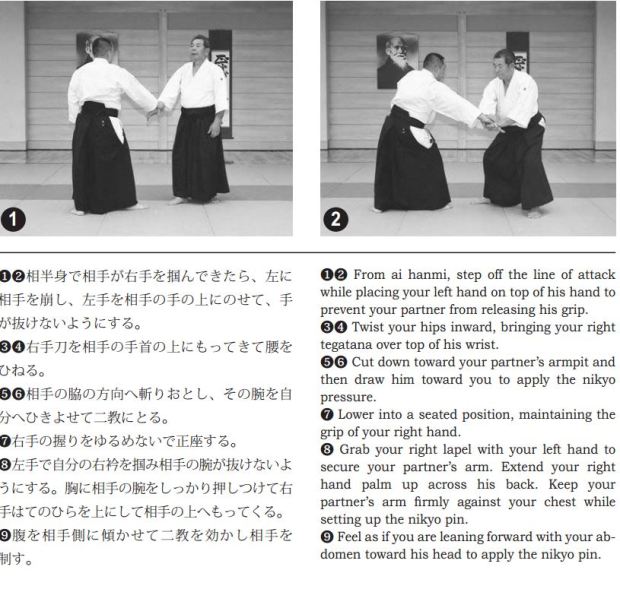
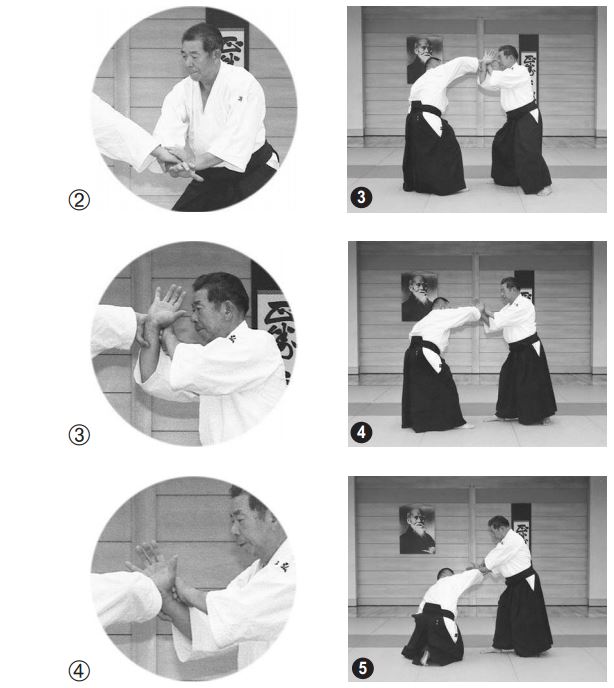
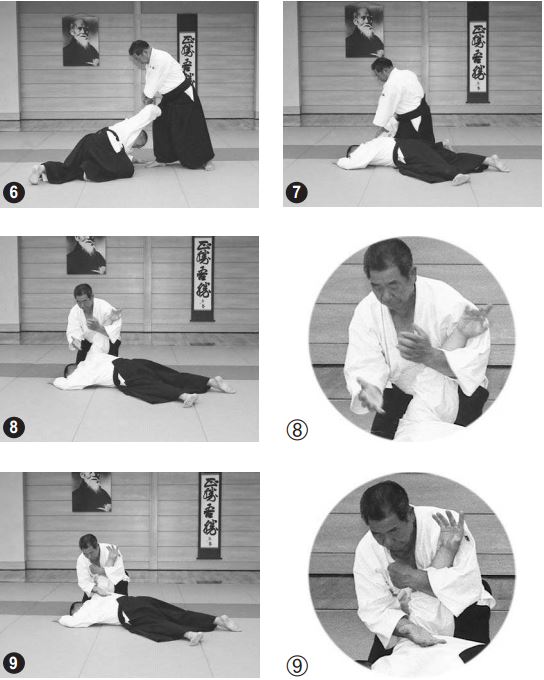
See below a photo demonstration (including description) and video of Morihiro Saito Sensei (9th Dan) explaining the fundamental elements of Kosadori nikyo as practised by O’sensei in the immediate post war period of his training life.

saito-nikyo

saito-nikyo-2

saito-nikkyo-3


  • Alternate (Ki no nagare) application (2) – London Aikido Club

In the below video Sensei Andy Hathaway demonstrates and provides instruction on Kosadori nikyo as practised at the London Aikido Club.


  • Alternate application (3) 

In the below video Sensei Andy Hathaway of the London Aikido Club demonstrates and provides instruction on an alternate takedown for Kosadori nikyo.


Alternate application (4) – Sensei Andy Sato


  • Brief Biography – Morihiro Saito Sensei (1928-2002)

saito_seiza_260Morihiro Saito Sensei’s  practice of Aikido spanned 56 years and he is one of the most important teachers in Aikido history.  Saito Sensei was a live-in student of O’sensei for more than 20 years at his home dojo in Iwama, Japan.

Saito Sensei spent his teaching life dedicated to preserving the technical style of Aikido as practised and shown to him by O’sensei in the post-war period.  Without his commitment to preserving the Aikido of the Founder and extensive efforts to record and document his teachings, much of the Aikido of O’sensei may have been lost.

Have a great week

Ian Grant
Doj Cho
Aikido Warrior Dojo