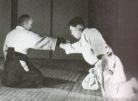
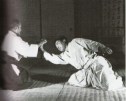
O’Sensei

Bokken exercise – Mawashi uchi

Morihei-Ueshiba-Bokken-211x300The practice of bokken (wooden sword) arts is an integral part of Aikido training in Aikido Yuishinkai.  Amongst other things, solo and paired bokken practice plays an important role in helping develop key skills for unarmed arts.  These skills include foot work, distance, timing, centred movement, correct posture and striking.

At our dojo we take an integrated  approach to the role of the bokken in our studies. For example, when we practice unarmed arts we look at the inherent bokken movements contained within the particular technique.  Conversely, when practising with the bokken, this is always done with a focus on the skill groups we are trying to develop to aid our unarmed practice.  The benefit of taking this approach is that it continually gives our training context.

In the below video Master Koretoshi Maruyama, Founder, Aikido Yuishinkai provides instruction on the fundamental foot work and cutting movements for the bokken exercise mawashi uchi.  Also included  in the video is a demonstration by Peter Kelly Sensei (Chief Instructor Australia) and Alistair Williams Sensei of the paired practice application of the exercise.

Have a great weekend

Ian Grant
Head Instructor
Aikido Warrior Dojo


Training notes: Jo nage kotegaeshi

Maruyama 3In the below video Koretoshi Maruyama Sensei (Aikido Yuishinkai) demonstrates and provides instruction for the Aikido technique kotegaeshi (outer wrist turn) where the nage is armed with a wooden staff (a jo).

Maruyama Sensei particularly emphasises in the video the importance of focusing on the centre point of the jo as measured between the distance of the uke‘s hands.  It is only by focussing movement of the jo at this point that the nage is able to not only retain control of the jo, but also move the uke’s centre so that the conditions for a successful throw are possible.


ADDITIONAL NOTES

  • Demonstration by Master Morihei Ueshiba 

In the below video, the Founder of Aikido, Master Morihei Ueshiba (O’sensei), performs jo nage kotegaeshi in free form practice (taninzugake).  The recording was made in 1952.   O’sensei was 69 years old.


Have a great week.

Ian Grant
Dojo Cho
Aikido Warrior Dojo


Moments in breakfall

OLYMPUS DIGITAL CAMERAUkemi (the art of receiving technique) is something we take very seriously at the dojo.  It is not only a critical skill to ensure our safety, but also plays an important role in developing  fundamental skills associated with balance, using relaxed power, correct body movement and flexibility.  Further, it is impossible to learn how to execute a technique unless you have someone willing to receive it.

In every class, there is always a segment dedicated to learning and improving our abilities to receive technique.

In the below video, which was taken at various classes during the year, dojo seniors can be seen using Aikido breakfalls to safely receive technique.  Breakfalls are one of a number of ukemi options that are available to Aikido practitioners when receiving a throw. Another commonly used option, depending on the circumstances, is rolling away.

Have a great week

Ian Grant
Head Instructor
Aikido Warrior


Training notes: Yokemunuchi aiki nage

Yokemunuchi aiki nage is a technique that has a long history in Aikido.  There are numerous videos of O’sensei performing it dating back to the 1930’s.

In the below video, Aikido Warrior Dojo seniors are recorded practising and experimenting with yokemunuchi aiki nage, including associated ukemi (falling skills).  The experiments include adding atemi and kiai to determine the effect on the uke and the impact on receiving the technique.

ADDITIONAL NOTES

  • Yokemunuchi aiki nage – The fundamentals

In the below video Koretoshi Maruyama Sensei demonstrates and provides instruction for the Aikido technique yokomenuchi aiki nage.

Have a great week.

Ian Grant
Dojo Cho
Aikido Warrior Dojo


Training notes: Yokomenuchi kotegaeshi

morihiro-saito-kotegaeshiYokomenuchi kotegaeshi is an Aikido technique which uses an outward wrist turn (kotegaeshi) as a defence against a strike to the side of the head (yokomenuchi).

In the below video Morihiro Saito Sensei (1928-2002) provides instruction on yokomenuchi kotegaeshi as practised by O’Sensei (the Founder of Aikido) in the post-war period of his life.


ADDITIONAL NOTES

  • Initial set up – technical notes


  • Additional technical instruction (1) – Kumitachi – Saito Sensei

In the below video, Saito Sensei explains the sword movement underpinning yokomenuchi kotegaeshi.


  • Technical instruction (2) – Tanto – Saito Sensei

In the below video, Saito Sensei demonstrates and explains yokomenuchi kotegaeshi in the situation where the uke is attacks with a knife (tanto).


  • Alternate application (1) – Yoshimitsu Yamada Sensei

In the below video Yoshimitsu Yamada Sensei provides instruction on alternate versions of yokomenuchi kotegaeshi.


  • Alternate Application 2 – Andy Sato Sensei


  • Kuzushi at first contact

Like all Aikido techniques, it is essential the nage take the uke‘s balance at first contact (ie with the initial 2 handed cut). Failure to do this will allow the uke to counter the technique and undertake a follow up attack (eg. a strike or grapple).

  • Option for standing pin

standing pin


  • Yokomenuchi kotegaeshi – Zagi waza

In the below photos O’sensei demonstrates the application of yokomenuchi kotegaeshi where the nage and uke are both on their knees. This is referred to as zagi waza or suwari waza, depending on the school of Aikido.

K1

K2K3

  • K4


  • Brief Biography – Morihiro Saito Sensei (1928-2002)

saito_seiza_260Morihiro Saito Sensei’s  practice of Aikido spanned 56 years and he is one of the most important teachers in Aikido history.  Saito Sensei was a live-in student of O’sensei for more than 20 years at his home dojo in Iwama, Japan.

Saito Sensei spent his teaching life dedicated to preserving the technical style of Aikido as practised and shown to him by O’sensei in the post-war period.  Without his commitment to preserving the Aikido of the Founder and extensive efforts to record and document his teachings, much of the Aikido of O’sensei would have no doubt been lost.  The Aikido world owes him a great debt.

Ian Grant
Dojo Cho 
Aikido Warrior Dojo