Aikido Warrior

Yokomenuchi shiho nage

Osensei shihonage (6)Shiho nage (4 directions throw) is one of the most important, if not the most important pillar technique in Aikido training. It contains within it the root of every Aikido technique and there is no doubt its proper execution relies on the nage applying all of the fundamental principles that underlie Aikido practice.

In the below video Morihiro Saito Sensei Sensei demonstrates the omote and ura forms of the Aikido technique  Yokomenuchi shiho nage. This form of shiho nage is practised in response to an attack in the form of a side downward blow to the temple area (yokomenuchi).


ADDITIONAL NOTES

  • Technical notes – Morito Suganuma Sensei 

In the below video Morito Suganuma Sensei (8th dan Aikikai) demonstrates and provides instruction for Yokomenuchi shiho nage.  The instruction incudes both the omote and ura applications.


  • Initial setup –  Technical notes


  • Omote application (1) – Technical notes – London Aikido Club

In the following video Sensei Andy Hathaway of the London Aikido Club gives detailed instruction on the traditional application of Yokomenuchi shiho nage (omote) as practised by the Founder of Aikido in the immediate post-war period.  


  • Omote application (2) – Technical notes – Yoshimitsu Yamada Sensei


  • Ura application – technical notes – Yoshimitsu Yamada Sensei


  • Alternate application (1) – Christian Tissier Sensei

In the below video Christian Tissier Sensei (8th Dan Aikikai) demonstrates an alternate application of shiho nage yokomenuchi where the nage directly enters to respond to the attack.


  • Alternate application (2) – Aikido Yushinkai

In the below video, Peter Kelly Sensei, Aikido Yuishinkai, demonstrates and provides instruction for an alternate application of yokomenuchi shiho nage.  The video was recorded at a mini seminar at our Dojo in 2015.


Have a great weekend.

Ian Grant
Dojo Cho
Aikido Warrior Dojo
Atemi waza – Munetsuki strikes

MunetsukiIn Aikido, strikes (atemi) are often used to set up techniques, as well as being an end in themselves.

In the below video Koretoshi Maruyama Sensei demonstrates and provides instruction on how strikes to the torso (munetsuki) are executed in Aikido Yuishinkai.

The demonstrated method of munetsuki generates its power through the lower limbs to take full advantage of what is sometimes referred to in Aikido as the vertical-horizontal plane.  In most simple terms – one sinks to move forward.

The result is that the strike is backed by the entire body of the nage rather just the activation of the muscle groups in the upper arm.  It also allows the nage’s body to naturally move off the line of an incoming direct attack and facilitates extra strike reach than would normally be expected (see below video).


For further videos and discussion of atemi waza in Aikido training on this site see – Atemi arts (striking)

Have a great week.

Ian Grant
Dojo Cho
Aikido Warrior Dojo


Bokken exercise – Mawashi uchi

Morihei-Ueshiba-Bokken-211x300The practice of bokken (wooden sword) arts is an integral part of Aikido training in Aikido Yuishinkai.  Amongst other things, solo and paired bokken practice plays an important role in helping develop key skills for unarmed arts.  These skills include foot work, distance, timing, centred movement, correct posture and striking.

At our dojo we take an integrated  approach to the role of the bokken in our studies. For example, when we practice unarmed arts we look at the inherent bokken movements contained within the particular technique.  Conversely, when practising with the bokken, this is always done with a focus on the skill groups we are trying to develop to aid our unarmed practice.  The benefit of taking this approach is that it continually gives our training context.

In the below video Master Koretoshi Maruyama, Founder, Aikido Yuishinkai provides instruction on the fundamental foot work and cutting movements for the bokken exercise mawashi uchi.  Also included  in the video is a demonstration by Peter Kelly Sensei (Chief Instructor Australia) and Alistair Williams Sensei of the paired practice application of the exercise.

Have a great weekend

Ian Grant
Head Instructor
Aikido Warrior Dojo


Training notes: Ai hanmi katatedori nikyo

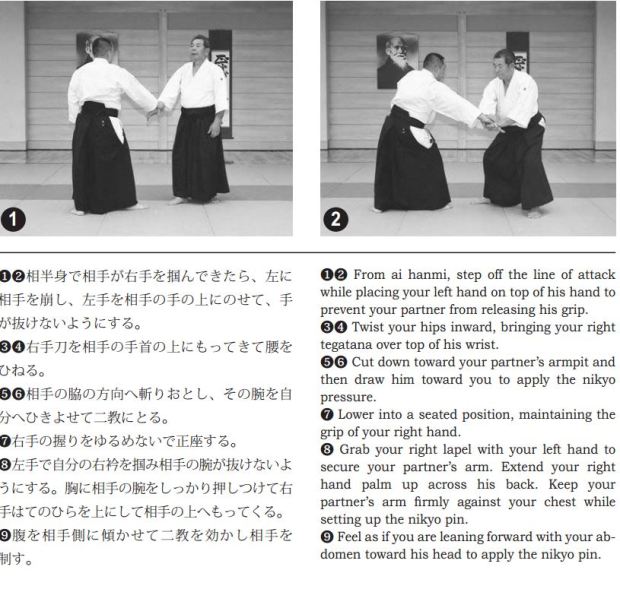
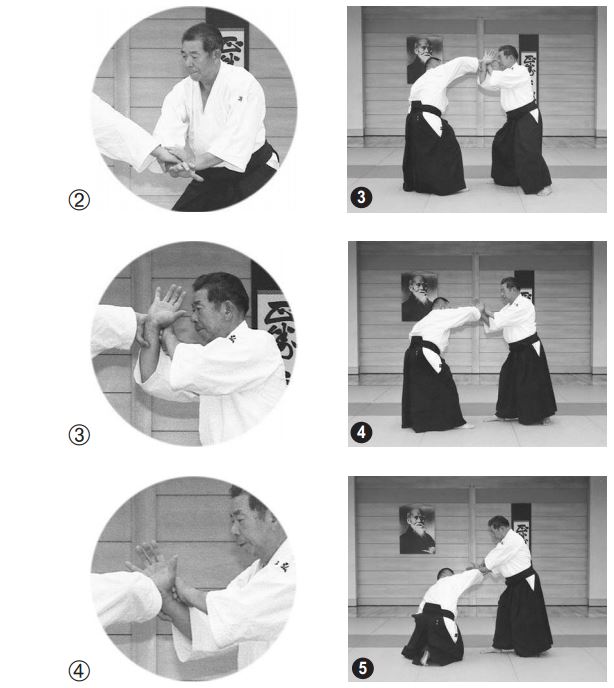
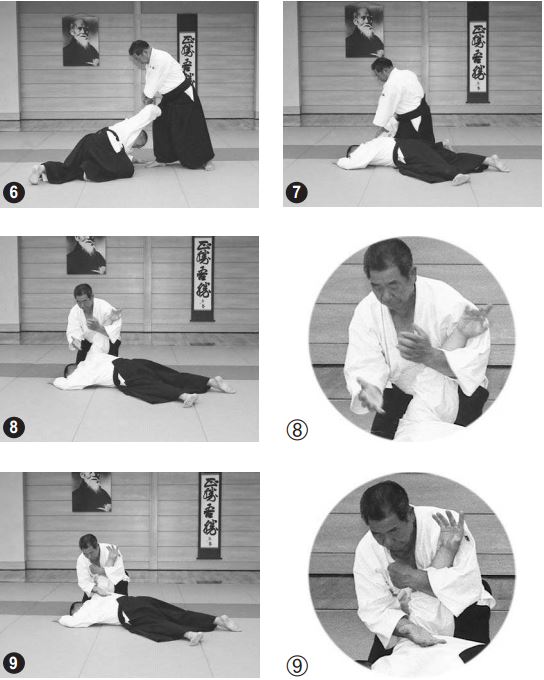
nilyo 2Nikyo techniques involve the application of a painful pronating or adductive wristlock to subdue or pin an attacker.  They are a common feature in the syllabus of most Aikido schools.

Nikyo techniques can be used to address a wide variety of attacks.  They are particularly effective in circumstances where the uke attempts to grab the clothing or wrist of a nage (as a prelude to follow up strike).

Our dojo is a Fudoshin dojo operating under the guidance and mentorship of Chicko Xerri Sensei 6th Dan AKI (Aikikai).

In the below video Chicko Sensei  explains the sword movements and Aiki principles  which underpin the application of Ai hanmi katatedori nikyo. This form of nikyo is applied in response to an attack in the form of a cross hand grab.

Depending on the school, Ai hanmi katatedori nikyo is also referred to as Kosadori nikyo.


ADDITIONAL NOTES

  • Alternate application (1) Morihiro Saito Sensei

See below a photo demonstration (including description) and video of Morihiro Saito Sensei (9th Dan) explaining the fundamental elements of Kosadori nikyo as practised by O’sensei in the immediate post war period of his training life.

saito-nikyo

saito-nikyo-2

saito-nikkyo-3


  • Alternate (Ki no nagare) application (2) – London Aikido Club

In the below video Sensei Andy Hathaway demonstrates and provides instruction on Kosadori nikyo as practised at the London Aikido Club.


  • Alternate application (3) 

In the below video Sensei Andy Hathaway of the London Aikido Club demonstrates and provides instruction on an alternate takedown for Kosadori nikyo.


Alternate application (4) – Sensei Andy Sato


  • Brief Biography – Morihiro Saito Sensei (1928-2002)

saito_seiza_260Morihiro Saito Sensei’s  practice of Aikido spanned 56 years and he is one of the most important teachers in Aikido history.  Saito Sensei was a live-in student of O’sensei for more than 20 years at his home dojo in Iwama, Japan.

Saito Sensei spent his teaching life dedicated to preserving the technical style of Aikido as practised and shown to him by O’sensei in the post-war period.  Without his commitment to preserving the Aikido of the Founder and extensive efforts to record and document his teachings, much of the Aikido of O’sensei may have been lost.

Have a great week

Ian Grant
Doj Cho
Aikido Warrior Dojo


Dojo shodan grading – Neil Neilsen Sensei

When it comes to milestones in an Aikido practitioner’s journey, testing for shodan is one of the biggest. With this in mind, I had the privilege today to convene a shodan testing panel for one of our dojo’s founding members – Neil Neilsen.

One of the great aspects  of the culture at our dojo is that grading milestones are a community event. It’s important to all of us that those being tested not only pass but pass with “flying colours”.  Neil’s grading was no different with everyone banding together to help him train for his test though the Christmas/New Year break.

As for the actual grading event, Neil readily exceeded the technical testing requirements and continually opted to do the “extra mile”. When it came to the 3 person attacker component (sanningake), for example, he resolved to take 4 attackers.

Similarly, after completing the formal requirements in the syllabus, and despite being understandably tired, he requested to have his ukemi tested (a dojo tradition).  This essentially involved him being the uke in 6 consecutive taninzugake (free form practice), each with a different dojo senior.   Neil effortlessly took endless breakfalls and other complex ukemi as part of this.

The video below gives some of the grading moments captured by our resident photographer Eden.     


Congratulations to Neil on his grading and a huge thank you to all the ukes who participated. Big thank you also to Michael Sensei (Bald Hills Dojo) and Mike Nash Sensei (Aikido Republic) who joined us on the day to support Neil and participate in the grading.

Have a great weekend.

Ian Grant
Head Instructor
Aikido Warrior Dojo Brisbane