Aikido in Brisbane

Relaxed arm striking – it’s not pretty

Capture3Atemi (or striking) plays an important role in Aikido practice, particularly from a self-defence perspective. Without the use of atemi, or at least the threat of it, most techniques would have substantially less chance of success. This is particularly so when resistance and counter offensives are thrown into the mix. Further, at the highest levels of practice, many techniques in essence are pure atemi.

One of the interesting aspects of Aikido Yuishinkai practice is that it includes the use of relaxed arm (suwaisho) striking methods as a self-defence response to addressing “punch based” attack situations. Exercises to develop skills in vertical and horizontal relaxed arm strikes are practised at the commencement of every Aikido Yuishinkai class.

Capture2Vertical suwaisho strikes in particular are a surprisingly effective self-defence response.  They also have the advantage of being relatively easy to learn. This in part is because they can be applied just using heavy downward and forward energy, rather than relying on a “heaven man earth” body structure which is more difficult to acquire. They are also quite simple in their execution – which is critical in a real life situation. The fact that the downward strikes simultaneously defend the nage’s centreline is another a benefit.

That being said, vertical suwaisho strikes are not pretty to look at and are a million miles from the graceful artistry that is often seen in typical You Tube clips of Aikido. Also, when you are the uke in two partnered practice, it can be a quite confronting and an “in your face” experience to say the least. It feels a bit like being bombarded by a series of oncoming swinging clubs. Although not necessary for general practice, I would also (from experience) suggest giving your uke some protective arm and head gear if you decide to put vertical suwaisho to the test against a “full-on attack” – it will save some major bruises.

The below clip is a brief introduction to vertical suwaisho strikes given at a 2007 seminar in Tasmania by the Founder of Aikido Yuishinkai, Master Koretoshi Maruyama.  The uke is Sensei A Williams.

Ian Grant
Head Instructor
Aikido Warrior Dojo

Related articles
Training notes: Ai hanmi katate dori ikkyo

oSensei06Opposite side one-hand hold wrist grabs are typically one of the first basic attacks that a new student to Aikido is trained to address.  Although arguably not a particularly martial or common contemporary attack form, learning to neutralise and redirect an attack of this kind can nonetheless be surprisingly challenging both at static and free-flowing level.

Training to deal with wrist grabs is particularly useful for learning and reinforcing many of the basic principles that underpin our Art.  The less aggressive nature of the attack (compared to say a strike) allows the nage (i.e. the receiver of the attack) to more readily focus on such things as correct footwork, moving around the point of contact, basic balance breaking principles, correct posture and movement, maintaining centre and getting off-line.

Cross hand wrist grabs in Aikido practice are referred to as Ai hanmi katate doriKosadori or Katate kosa dori.  The name used depends on the school and some use the terms interchangeably.  Generally speaking, ki aikido schools tend to use the term Katate kosa dori. 

In the below video, Mike Jones Sensei (New York Aikikai) demonstrates and provides instruction on the 2 basic forms (omote and ura) of the Aikido technique ikkyo when applied in response to a static cross hand grab. Further detail on how to apply the technique is provided in the Additional Notes section below.


ADDITIONAL NOTES

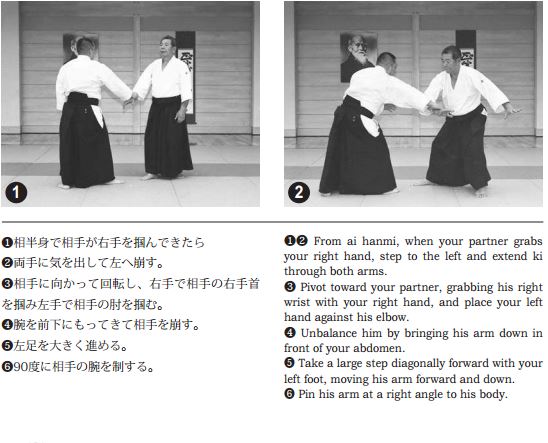
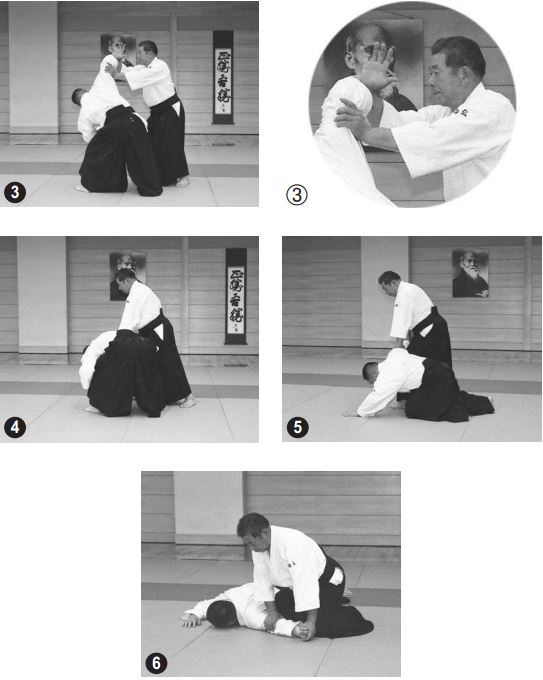
  • Kosadori ikkyo omote (Basic) – Morihiro Saito Sensei 

See below a photo demonstration (including description) and accompanying video by Morihiro Saito Sensei (9th Dan) of the key elements that make up the basic form of Kosadori ikkyo omote. 

kosadori-ikkyo-1kosadori-ikkyo-2

*Source: “Morihori Saito’s Complete Guide to Aikido” (2015)

  • Kosadori ikkyo omote (Basic) – London Aikido Club 

The below video provides important training tips by Sensei Andy Hathaway (London Aikido Club) for performing Ai hanmi katate dori/ kosadori ikkyo (omote).


  • Kosadori ikkyo (ki no nagare) – Aikido Warrior Fudoshin Dojo

In the below video seniors from our dojo demonstrate the way we typically practise kosadori ikkyo at ki no nagare (free flowing) level. Notably, the application incorporates a direct entry movement combined with an atemi intent (i.e. an elbow strike) to break the balance of the uke.   As demonstrated in the video, this method of application is more easily learnt by first practising it from shomenuchi ikkyo.


  • Ai hamni katate dori/kosadori ikkyo (ura) – London Aikido Club

The below videos provides important training tips by Sensei Andy Hathaway (London Aikido Club) for performing the traditional version ura version of Ai hamni katate dori/kosadori ikkyo.


Have a great week

Ian Grant
Head Instructor
Aikido Warrior Dojo, Brisbane


Training notes: Katatedori sumi otoshi

Otoshi (or drop) techniques feature prominently in a variety of martial arts, including Aikido, Judo and Jujitsu. Otoshi techniques are typically thought of as “hand throws” and when applied correctly generate a surprising amount of power that literally has the effect of dropping (some might say “driving”) the uke straight into the mat.

Ueshiba 5Sumi otoshi (corner drop) is probably the most common drop technique practised in Aikido. The particularly appealing features of this technique include its directness in execution and the fact that it is able to be used to in response to a wide variety of traditional attack situations.

However, while sumi otoshi looks deceptively simple on its face, in reality it requires considerable skill to apply  with any degree of martial integrity.  For example skills in kuzushi (i.e. off-balancing), timing, moving off-line and centred movement are essential.

In the below video, Mike Jones Sensei from  New York Aikikai provides instruction for sumi otoshi from an attack in the form of a same side hand grab (Katate dori).


ADDITIONAL NOTES

  • Alternate application

Donovan Waite Sensei (7th Dan Aikikai) in the following video demonstrates and provides training tips for an alternate application of  katatedori sumi otoshi, as well as the variation in the featured video.


  • Learning ukemi

In every technique ii is important to learn not only how to execute it, but also how to safely receive it (ukemi).  In the below video, Waite Sensei demonstrates how the nage can assist the uke in safely learning ukemi for the sumi otoshi.


  • Aikido Yuishinkai (Tasmania)

The demonstration is by Peter Kelly Sensei of Aikido Yuishinkai (Tasmania). The source material was kindly provided courtesy of Bill Hely.

Ian Grant
Dojo Cho
Aikido Warrior Dojo

Training notes: Zagi waza shomenuchi ikkyo

O sensei - Suwari WazaZagi waza (also referred to as suwari waza) is a form of Aikido practice performed from the initial position of nage and uke sitting opposite and facing each other while kneeling  (seiza). This type of practice is particularly useful for developing skills relevant to maintaining and taking balance, moving the body off-line and as a single unit, leverage principles, breath power and keeping centre line.

In our dojo, suwari waza is practiced at most classes. Initially, the typical form of practice is static in nature and involves the uke holding the nage’s wrists with each hand. This static form of practice is referred to as zagi waza kokyu ho. 

As we progress in our studies, other forms of attack are added to our zagi waza practice including responses to strikes.

In the below video, Chicko Xerri Sensei (6th Dan AKI Aikikai) explores some of the key Aiki principles underpinning the practice of zagi waza shomenuchi ikkyo.  There are many recordings of the Founder of Aikido demonstrating this particular form of zagi waza which is performed in the context of a downward strike to the temple (shomenuchi).


ADDITIONAL NOTES

  • Zagi waza shomenuchi ikkyo – technical notes

The below video features suwari waza when responding to a straight strike to the centre of the head (shomenuchi). The demonstrated technique (performed by Yoshimitsu Yamada Sensei) is suwari waza shomenuchi ikkyo.


  • Suwari waza shomenuchi ikkyo – Seishin no Shugyo Dojo, Tasmania 

The below demonstration is by Peter Kelly Sensei, Seishin no Shugyo Dojo, Tasmania. The source material was kindly provided courtesy of Bill Hely.

Ian Grant
Dojo Cho
Aikido Warrior Dojo

Training notes: Hanmi handachi shomenuchi kotegaeshi

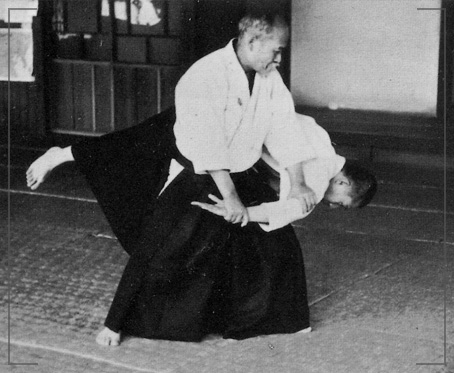
morihei-ueshiba-kobukan-c1935Hanmi handachi waza is a common form of Aikido practice whereby the nage is in a kneeling position and the uke  attacks while standing.   In this type of training the uke has the obvious advantage of both mobility and height. However, a skilled nage can still take the balance of the uke by taking advantage of their lower centre of gravity.

Training in hanmi handachi waza is particularly beneficial as it develops skills in taking a ukes balance with only minimal lower body movement.  The training also assists in understanding the importance of centre and use of the centre line in Aikido practice.

The below video extract of Master Koretoshi Maruyama demonstrates the application of kotegaeshi  (outward wrist turn) in hanmi handachi waza to address a straight blow to the centre of the head (i.e. shomenuchi).

Points of note in the demonstration include:

  • The nage is at an approximate 45 degree angle to the uke and not facing head on;
  • The nage’s initial movement is itself a shomenuchi cutting movement through the uke’s centreline;
  • The nage does not attempt to directly clash or in anyway block the uke’s downward strike;
  • The nage draws the attack into their centre and then uses their centre and centre line as the mechanism and line of movement, respectively, to execute the finish of the technique;
  • The balance of the uke is completely taken (i.e kuzushi) from the moment of first contact.
  • The technique is executed to take advantage of the “missing third leg” position to the rear of the uke.

Ian Grant
Head Instructor
Aikido Warrior Dojo