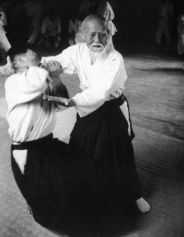
 Morote tori kokyu ho was one of the three techniques O’Sensei taught at all of his classes. At basic level, the technique is practised against a uke who is offering resistance. O”Sensei considered that the regular practice of morotedori kokyu ho was essential to build an “aiki body“.
Given the high emphasis that the Founder placed on morote tori kokyu, it is regularly practised at our dojo.
In the below videos Morihiro Saito Sensei (9th Dan) demonstrates morotedori kokyu ho at kihon (basic) and ki no nagare (free flowing) levels.
ADDITIONAL NOTES
- Technical details – Basic (kihon) level – Morihiro Saito Sensei
- Morotedori kokyu ho – ki no nagare
In the below video, Saito Sensei demonstrates how to apply Morotedori kokyu ho at a higher level free flowing technique. This level of application should not be attempted until mastery of the basic version has been achieved.
In the following video, Saito Sensei explains in more detail the hanmi principles underlying morotedori kokyu ho.
- Morotedori kokyu ho – Peter Kelly Sensei
In the below video, Peter Kelly Sensei, Aikido Yuishinkai Tasmania, provides training tips on morote tori kokyu ho. Peter Sensei describes the movement as follows:
“The basic premis is a double spiral, both the hara and the arm. The left hand atemi to the abdomen helps get the pelvis in the correct position to not use strength in the hand which is twisted and held down with alot of resistance. The resistance helps to generate powerful hips and body.”
- Morotedori kokyu ho (ura)
In the below video Saito Sensei demonstrates how Morotedori kokyu ho is applied if the nage commences the exercise with a tenkan movement.
In the following video, Takashi Kuroki Sensei of Nishio Aikido gives instruction on an alternate approach to Morotedori kokyu ho. This approach is also practiced at our dojo.
Ian Grant
Dojo Cho
Aikido Warrior Dojo
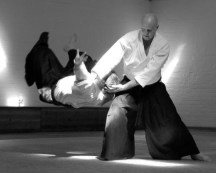
 The below video examines the structural similarities between a forward roll and a breakfall and includes a training exercise whereby students learn to appreciate that a breakfall in substance is nothing more than a roll. The video is from a class given by Peter Kelly Sensei, Chief Instructor, Aikido Yuishinkai Australia, at our dojo on 17 May 2014.


 Aikido Warrior Dojo
You must be logged in to post a comment.