O’Sensei

Budo (1938): Tachi dori shomen giri kotegaeshi

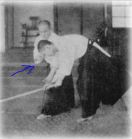
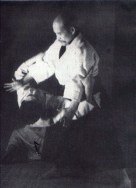
Bokken kotegaishi 2 osenseiIn 1938 Master Morihei Ueshiba, the Founder of Aikido, finalised the 2nd of his 3 technical texts.  Simply titled “Budo“, the text contains a sampling of techniques from a wide range of attacks, including grabs, strikes and attacks from different weapons.

Budo” is an important reference point for our practice at Aikido Warrior Dojo. The techniques and principles referred to therein are regularly practised.

Interestingly, the Founder only included 3 tachi dori techniques in his 2nd text.  One of these was tachi dori showmen giri kotegaeshi.

The below video features a photographic demonstration tachi dori shomen giri kotegaeshi as it appears in “Budo”.  Also included are demonstrations of the technique by Morihiro Saito Sensei who was a direct student of the Founder for more than 20 years.


ADDITIONAL NOTES

  • O’sensei’s explanation of tachi dori shomen giri kotegaeshi (1938)

In O’sensei’s manual “Budo” (1938), there is substantive instruction given for tachi dori shomen giri kotegaeshi.  In edited form, it reads as follows:

As soon as your opponent cuts, move with the speed of the gods and enter deeply to the right with irimi tankan.  Strike your opponents right wrist with your left te-gatana (hand sword), remain aware of possible attackers to the rear and strike your opponent’s face with your right fist…

Apply …kotegaeshi .. and down your opponent.  In this case it is necessary to control his hand and sword with the little and ring fingers of your right hand.  Next turn your opponent round to the left, pin him face down, take the sword and hold it to his neck

  • Hand position for take down and wrist pin

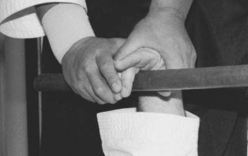
The traditional hand position on the bokken for the takedown to the mat and wrist pin is shown in the pictures below.  Note the hilt of the bokken is grabbed with the nage’s right little finger and ring finger. The nage’s left thumb is at the base of the uke’s right ring finger.
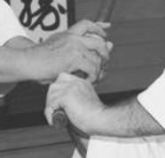
Bokken kotegaeshi 2JPG

Bokken kotegaeshi


  • Atemi

strike kotegaeshiAt the completion of the irimi tenkan movement there is the option of atemi in the form of striking the uke’s face with your right hand.

Practice of atemi in this way is a most useful practice tool to assist in learning the correct positioning for the technique.

 Have a great week.

Ian Grant
Head Instructor
Aikido Warrior Dojo
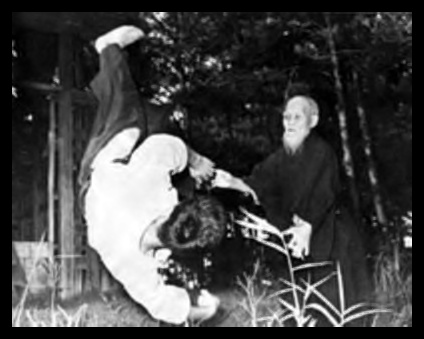
 

Training notes: Ushiro ryotedori kokyu nage

In the below video Morihiro Saito Sensei  demonstrates and provides instruction for the pre and post war versions of the aikido technique ushiro ryotedori kokyu nage.

The technique is  categorised as a “breath throw” and is practised as a response to a traditional attack where both hands of the nage are grabbed from behind with the intent to either place a knee in the nage’s back or drag the nage backwards.

Depending on the school of Aikido the technique is sometimes referred to as ushiro tekubidori zenpo nage/kokyu nage.


ADDITIONAL NOTES

  • Alternate attack form

Ushiro ryotedori kokyu nage, like all Aikido applications, can be practised from a static form (typically under resistance) or in a dynamic free flowing form (often referred to as ki no nagare). 

In the following video, the Founder of Aikido, Master Morihei Ueshiba (O’sensei) demonstrates a dynamic version of  ushiro ryotedori kokyu nage  whereby the uke directly attacks from behind and out of the nage’s line of sight (see video below).  We also train this version at our dojo.


  • Alternate application

In the below video Sensei Andy Hathaway of the London Aikido Club demonstrates an alternate kokyu nage application.


  • Ki aikido approach

In the below video the Koretoshi Maruyama Sensei demonstrates and teaches the subject technique as practised in Aikido Yuishinkai. This approach (including the bounce) is typical of many ki aikido schools inspired by the teachings of Koichi Tohei Sensei.

Have a great weekend.

Ian Grant
Dojo Cho
Aikido Warrior Dojo


Aikido Warrior Dojo – Moments in Aiki

10653835_10152773559605928_4157188167238557708_nSee below a montage of video clips and photos from classes at our dojo over the last 12 months (with the odd exception).

Our dojo is an Aikido Yuishinkai affiliated dojo and is committed to studying Aikido as envisaged by its Founder Master Morihei Ueshiba (O’sensei).  Master Koretoshi Maruyama established  Aikido Yuishinkai in 1996.  He was a direct student of the Founder of Aikido and was given his teaching licence by O’Sensei in 1967.

Have a great week

Ian Grant
Head Instructor
Aikido Warrior Dojo
Munetsuki kokyu nage – Aikido Yuishinkai

kokyu nage munetsukiIn the below video Master Koretoshi Maruyama, Founder of Aikido Yuishinkai, demonstrates and provides instruction for one of the versions of munetsuki kokyu nage The technique is  categorised as a “breath throw” and is practised as a response to a strike or thrust to the stomach (munetsuki).

From a superficial mechanical perspective, the technique appears deceptively straightforward. In reality, however, it can be quite challenging to successfully perform.  It requires substantive skills in entering, timing, sinking, maintaining centre pole and moving as a single relaxed unit.

Further, like most more advanced Aikido techniques the uke’s balance is not taken by movements of the nage’s upper body, but by the correct movement of the nage’s lower half of their body. The nage’s hand on the uke’s arm is merely the connection point.

One of the training advantages that we have found at the dojo with this particular version of munetsuki kokyu nage is that the internal skills and aikido principles necessary to perform it offer a “gateway” to learning other advanced techniques, including for example munetsuki kaitenage.


Have a great weekend.

Ian Grant
Dojo Cho
Aikido Warrior Dojo


Training notes – Munetsuki shiho nage

budo-shihonage-640Shiho nage (4 directions throw) is considered to be one of the most important pillar techniques in Aikido training. The name of the technique stems from the fact that a skilled nage can throw the uke in any of 4 directions.

In the below video Peter Kelly Sensei, Chief Instructor – Aikido Yuishinkai Australia, demonstrates and provides instruction on the application of shiho nage to address a strike to the torso (munetsuki shiho nage).

Peter Sensei focuses on the initial entry for the technique which in essence utilises sword based movements and associated body structure to completely take the uke’s balance (kuzushi) at the point of first contact.  When done correctly the effect on the uke is that any attempt to resist the technique only serves to hasten their loss of balance.


Have a great week.

Ian Grant
Head Instructor
Aikido Warrior Dojo