Morihiro Saito Sensei

Training Notes: Ushiro ryotedori kotegaeshi

kotegeashi is an outward wrist turn and traditionally is broadly categorised in Aikido as a kaiten (open and turn) technique.

In the below video Morihiro Saito Sensei demonstrates how kotegaeshi may be applied in circumstances where the uke has pinned the nage’s hands behind their back.

Depending on the Aikido style, the technique is referred to as Ushiro ryotedori kotegaeshi or Ushiro tekubidori kotegaeshi .


ADDITIONAL NOTES

  • How to release the grip – Pictorial illustration


  • Additional details 

In the below video, Sensei Andy Hathaway of the London Aikido Club explores the Aiki principles underpinning Ushiro ryotedori kotegaeshi .  Hathaway Sensei emphasises the importance of getting off-line and the use of balance breaking principles to effectively execute the technique. These principles are particularly important where the uke has a strong grip on the wrists.


  • Ki aikido approach

In the below video, Koretoshi Maruyama Sensei demonstrates how ushiro ryotedori kotegaeshi  is practised in  Aikido Yuishinkai.  The method of practice is typical of that found in many ki aikido schools inspired by the teachings of Koichi Tohei Sensei.


Have a great week.

Ian Grant
Head Instructor
Aikido Warrior Dojo

Training notes: Katatedori kokyu ho

OSenseiTaiNoHenkoIn the below videos Morihiro Saito Sensei (1928-2002) demonstrates the basic  version of Katatedori kokyu ho.

The application is performed from a single hand grab (katatedori) and is categorised as a breath exercise (kokyu ho) or breath throw (kokyu nage).

Kokyu ho exercises are used in Aikido to assist in developing internal power.  They can also be techniques in themselves (kokyu nage) or form key aspects of other techniques.  At higher levels of practice kokyu ho principles form part of every technique.


ADDITIONAL NOTES

  • Technical details


  • Katatedori kokyu ho – Alternate application (1)

In the following video Donovan Waite Sensei (7th Dan Aikikai) demonstrates an alternate application of katatedori kokyu nage.  Waite Sensei’s instruction emphasises the importance of connection.  Also of note in this version of the technique is the use of the elbow to effect balance and the pushing away of the uke to complete the technique.


  • Alternate application (2) – Peter Brady Shihan

In the below video, Peter Brady Shihan (7th Dan Aikikai) provides instruction for an alternate application of Katatedori kokyu ho.


  • Alternate application (3) – Donovan Waite Sensei


  • Alternate application (4) – Peter Kelly Sensei 

The below video was recorded at our dojo on 12 August 2015 as part of a special class given by Peter Kelly Sensei of Aikido Yuishinkai (Tasmania) on kokyu ho applications in Aikido practice.


Have a great week.

Ian Grant
Head Instructor
Aikido Warrior Dojo, Brisbane

Training Notes – Katatedori nikyo

nikyo (1)Nikyo techniques involve the application of a painful pronating or adductive wristlock to subdue or pin an attacker.  They are a common feature in the syllabus of most Aikido schools.

Nikyo techniques can be used to address a wide variety of attacks.  They are particularly effective in circumstances where the uke attempts to grab the clothing or wrist of a nage (as a prelude to follow up strike).

In the below video Morihiro Saito Sensei (9th Dan) explains the fundamental principles that underpin the application of katatedori nikyo. This form of nikyo is applied in response to an attack in the form of a same side grab.


ADDITIONAL NOTES

  • Katatedori nikyo – Fundamentals

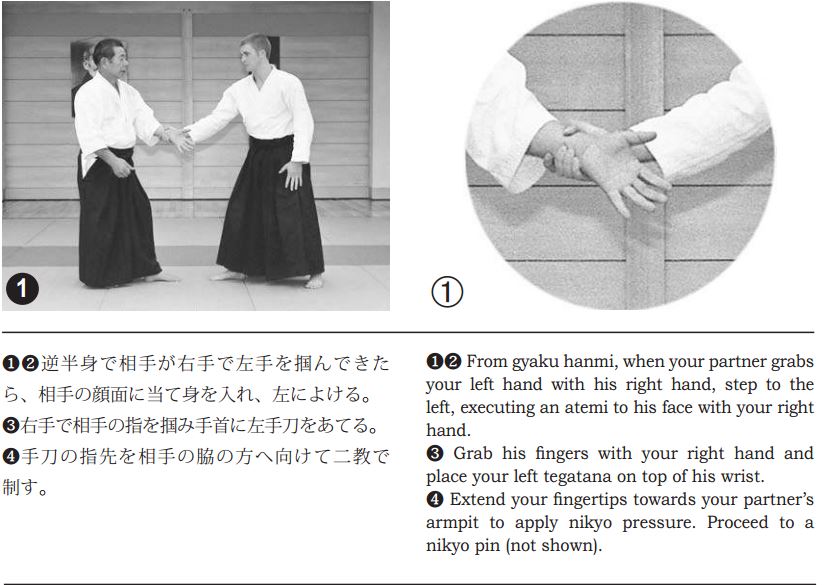
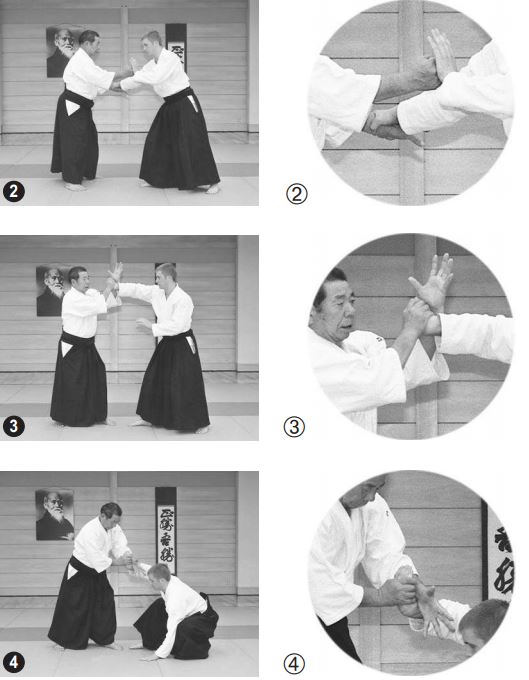
See below a photo demonstration (including description) by Morihiro Saito Sensei (9th Dan) of the fundamental elements of katatedori nikyo as practised by O’sensei in the immediate post war period of his training life.

katatedori-nikyo-1katatedori-nikyo-2


  • Katatedori nikyo – Alternate application (1)

See below a photo demonstration (including description) by Morihiro Saito Sensei (9th Dan) of an alternate form of katatedori nikyo which was also practised by O’sensei in the immediate post war period of his training life.

katatedori-nikyo-1a

katatedori-nikyo-2a


  • Katatedori nikyo – Alternate application (2)


  • Avoiding the potential to be kicked in the kneecap 

The method of application in the below video overcomes a common problem sometimes seen with nikyo in that the uke can readily kick the nage in the knee cap to escape. Also included are some suggested exercises to assist in the learning process.


  • Brief Biography – Morihiro Saito Sensei (1928-2002)

saito_seiza_260Morihiro Saito Sensei’s  practice of Aikido spanned 56 years and he is one of the most important teachers in Aikido history.  Saito Sensei was a live-in student of O’sensei for more than 20 years at his home dojo in Iwama, Japan.

Saito Sensei spent his teaching life dedicated to preserving the technical style of Aikido as practised and shown to him by O’sensei in the post-war period.  Without his commitment to preserving the Aikido of the Founder and extensive efforts to record and document his teachings, much of the Aikido of O’sensei would have no doubt been lost.  The Aikido world owes him a great debt.

Have a great week.

Ian Grant
Dojo Cho
Aikido Warrior Dojo, Brisbane


Training notes – Ushiro ryotedori ikkyo (2) – Ki no nagare

In the below video, Christian Tissier Shihan (8th Dan Aikikai) demonstrates the omote and ura versions of the Aikido technique ushiro ryotedori ikkyo.

The demonstrations are completed in a dynamic free flowing form whereby the uke commences the attack by proceeding to the front of the nage, grabbing the nage’s wrist and then moving to the rear (with a view to also grabbing the nage’s second wrist).

This form of practice is referred to in some schools as ki no nagare.  In ki aikido schools it is sometimes referred to as ryutai.


ADDITIONAL NOTES

  • Movement and Sword principles

In the below video Chicko Xerri Sensei  (6th Dan Aki Aiki kai) explores the sword principles that underpin the higher level practice of ushiro techniques.  The exploration is particularly applicable to ikkyo applications.

Our dojo is part of the Aikido Kenkyukai Fodoshin Dojos (Australia).  Chicko Sensei is the Shihan for our school.


  • Balance breaking principles – Kuzushi

In the below video produced by Senshin Center Aikido Dojo, balance breaking principles applicable to ushiro attacks are explored. Kuzushi is unfortunately something that is sometimes overlooked in Aikido. The fact remains, however, that it is near impossible to throw a centred uke unless they are either cooperating or overpowered by a significantly larger nage.


  • Alternate application (1) – Chicko Xerri Sensei – AKI Fudoshin Aikido

In the below video Chicko Xerri Sensei explores an alternate option for addressing a ushiro attack whereby the uke is not permitted to move to the rear of the nage. Chicko sensei emphasises the important aiki principle of creating a space to move before attempting an aikido application.


  • Alternate application (2) – Chicko Xerri Sensei – AKI Fudoshin Aikido

In the below video Chicko Xerri Sensei explores a further option for addressing ushiro attacks.  The option readiy sets up the circumstances for an ikkyo application.


  • Ki Aikido

In the below video, Koretoshi Maruyama Sensei provides instruction on Ushiro tekubidori ikkyo as practised in Aikido Yuishinkai.  The method of application is typical of the approach taken by ki aikido schools.


All the best

Ian Grant
Head Instructor
Aikido Warrior Dojo


Munetsuki irimi nage – Learning from O’Sensei

See below a short video taken at the dojo where we explored munetsuki irimi nage as illustrated in O’Sensei‘s 1938 text “Budo“.


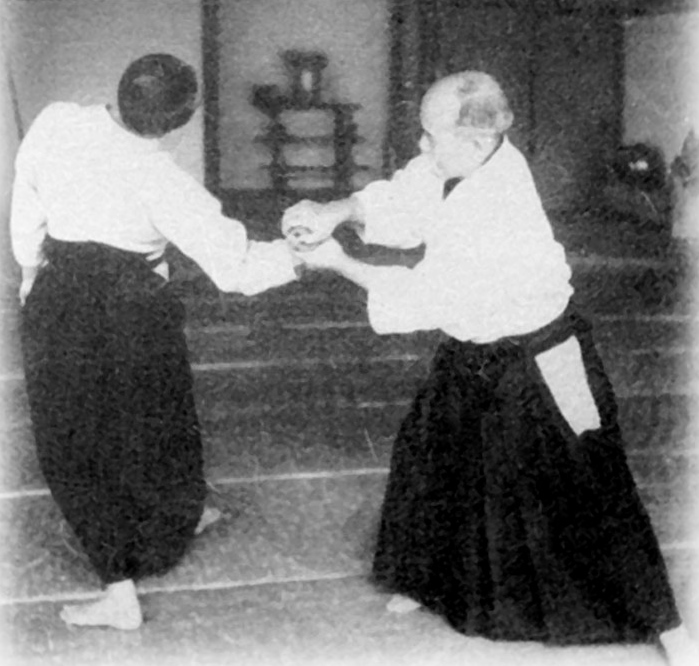
Although difficult to see in the below photo demonstrations featuring  O’Sensei, a key technical aspect of the technique is the placement of the nage’s hand on the upper part of the uke’s shoulder.  As the technique is executed, this hand eventually ends up immediately below the nage’s armpit.  Relaxed and centred execution of the technique is essential to avoid any clash and achieve the necessary off-balancing of the uke.

4

For the uke, receiving the technique feels a bit like hitting a “wall of feathers”. As you would have noticed in the video, we also played with adding extra atemi. It makes receiving the ukemi a bit more challenging in terms of uke sensitivity but is well worth the experiment.

Big thanks to dojo senior Peter Marendy for joining me in the demo and to Eden for filming it.

ADDITIONAL NOTES

  • Munetsuki irimi nage – A deeper look 

In the below videos Morihiro Saito Sensei (1928-2002) provides instruction on the traditional version of  munetsuki irimi nage as practised by O’Sensei (the Founder of Aikido) in the immediate post-war period of his life. Notably the method of execution is the same as that outlined in the “Budo” text.

  • Brief Biography – Morihiro Saito Sensei (1928-2002)

saito_seiza_260Morihiro Saito Sensei’s  practice of Aikido spanned 56 years and he is one of the most important teachers in Aikido history.  Saito Sensei was a live-in student of O’sensei for more than 20 years at his home dojo in Iwama, Japan.

Saito Sensei spent his teaching life dedicated to preserving the technical style of Aikido as practised and shown to him by O’sensei in the post-war period.  Without his commitment to preserving the Aikido of the Founder and extensive efforts to record and document his teachings, much of the Aikido of O’sensei would have been lost.

All the best

Ian Grant
Dojo Cho
Aikido Warrior Dojo