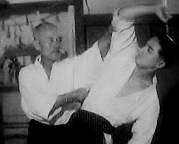
Morihiro Saito Sensei

Training notes: Shomenuchi ikkyo

Ikkyo Osensei 2In the below video Morihiro Saito Sensei (9th Dan) demonstrates the Aikido technique shomenuchi ikkyo (omote and ura).

In the demonstrated technique, which is based on The Founder’s instruction in the text “Budo” (1938), the nage initiates the application by applying a vertical strike to the face of the uke.

Pinning techniques are referred to as osae waza in Aikido practice. Ikkyo is the “first technique” in osae waza.


ADDITIONAL NOTES

  • Technical instruction – Omote and ura applications – Morihiro Saito Sensei


  • Shomenuchi ikkyo (omote) – Takemusu Aikido Vol 1.

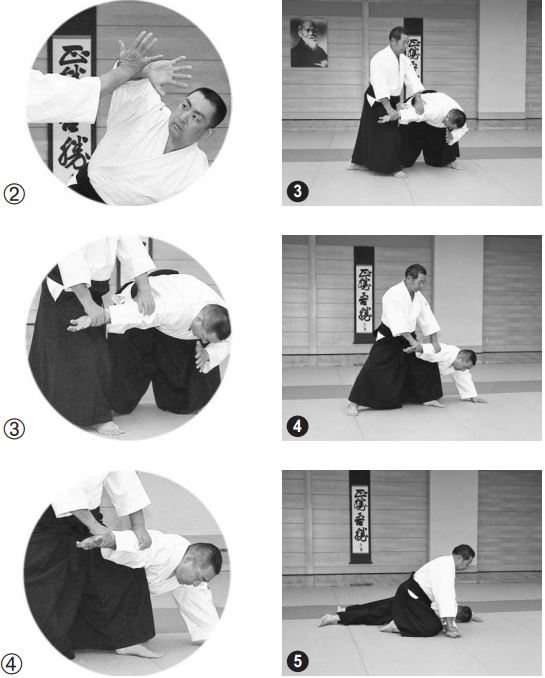
In the below pictorial demonstration, Morihiro Saito provides instruction on the basic omote application of the technique. Notably in the basic application the nage strikes first.

ikkyo-1-omoteikkyo-2


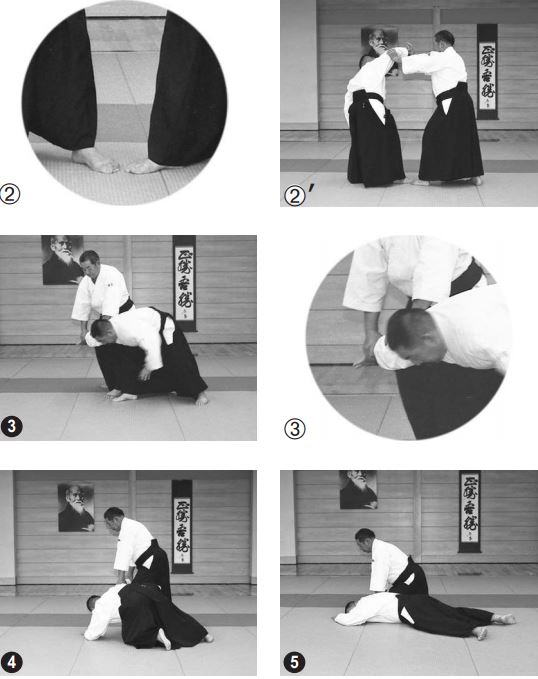
Shomenuchi ikkyo (ura) – Takemusu Aikido, Vol. 1 

In the below pictorial demonstration, Morihiro Saito provides instruction on the basic ura application of the technique. Notably in the basic application outlined below the nage strikes first.

However, the basic ura version is also able to be applied if the nage initiates the strike first.    In the Founder’s 1938 manual it states “When your opponent strikes first with shomen, turn around the attack with irimi tankan, use your right hand to receive the blow and then control your opponent as described..”.

shomen-ikkyo-ura-1shomen-ikkyo-ura-2


  • Ikkyo pin

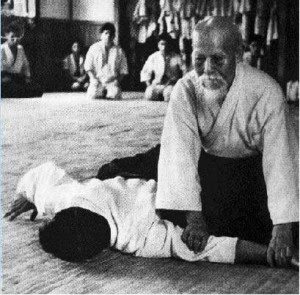
The pin for this technique is often seen done with a form of nikyo pin.  This is not in fact the correct pin.  In the below picture, O’sensei demonstrates the pin for shomenuchi ikkyo.

Osensei ikkyo-pinikkyo in 2 o sensei_1-300x295


In his 1933 text “Budo“, Master Morihei Ueshiba (O’sensei) also states that “when pinning your opponent to the ground it is essential that his arm be at a right angle to his body” (see picture).

  • Uke’s arm remains horizontal and in front of nage’s centre

The uke’s arm remains horizontal in the second part of the technique.  The uke’s hand should not be higher than their shoulder or vice versa. The uke’s arm always remains in front of the nage’s centre.

This is the case regardless of whether the technique is performed standing or where uke and nage are both kneeling (suwari waza).

  • Footwork for ki no nagare practice

In the following video Chicko Sensei uses the sword to demonstrate the footwork for entering for omote applications in (ki no nagare) free flowing practice. Ura footwork is also explained.


  • Shomenuchi ikkyo – Other Aiki principles for ki no nagare practice

In the below video Chicko Xerri Sensei (6th Dan AKI Aikikai) provides instruction on some of the key Aiki principles that underpin practice of  Shomenuchi ikkyo for free flowing practice (ki no nagare).

Our dojo is part of the Fudoshin Australia Group of dojos  operating under the guidance and mentorship of Chicko Sensei.

The technical aspects underpinning dynamic practice of shomenuchi ikkyo are further explored in the below instructional video featuring Yoshimitsu Yamada Sensei (8th Dan Aikikai).  The uke is a young Donovan Waite Sensei (7th Dan ).

  • Alternate atemi application – Aikido Warrior Fudoshin Dojo

In the below video students from our dojo demonstrate an application of the technique where the elbow is used by the nage to strike and take the initial balance of the uke.


  • Demonstration by Morihei Ueshiba, Founder of Aikido 


  • Shomenuchi ikkyo – Zagi Waza

In the below video Chicko Xerri Sensei explains the Aiki principles for shomenuchi ikkyo when it is practised from zagi waza/suwari waza (ie where both nage and uke are kneeling).


Ian Grant
Dojo Cho
Aikido Warrior Fudoshin Dojo, Brisbane


Munetsuki kotegaeshi – Aikido Yuishinkai

In the below video Master Koretoshi Maruyama, Founder of Aikido Yuishinkai, demonstrates and provides instruction for the Aikido technique munetsuki kotegaeshi as practised in Aikido Yuishinkai.  


Ian Grant
Head Instructor
Aikido Warrior Dojo


Striking options in Aikido practice

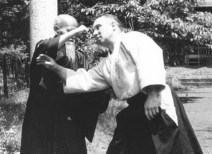
morihei-ueshiba-gozo-shioda-1940-croppedStriking arts  (atemi) are an integral part of aikido practice.  It is often stated that as much as 70% of Aikido is about atemi.  Some sources suggest that this percentage should be more like 90%.

While atemi waza can be an end in itself,  it is also used in Aikido to do any or all of the following:

  • setting up a technique by taking the nage’s balance; or
  • diverting the uke’s attention;  or
  • completing a technique.

atemi o-sensei-atemiIn the below videos, Morihiro Saito Sensei (1928-2002) demonstrates some of the striking options practised by Master Morihei Ueshiba (the Founder of Aikido) in the post war period of his training. Consistent with our commitment to study the Aikido of the Founder, the demonstrated striking options form an important part of the training that we undertake at the dojo.

For ease of reference, the videos are arranged based on classification of technique.

ATEMI OPTIONS

  • Atemi waza – Irimi nage


  • Atemi waza – Kokyu nage


  • Atemi waza – Kotegeashi


  • Atemi waza – Nikyo


  • Atemi waza – Shiho nage


Have a great weekend

Ian Grant
Head Instructor
Aikido Warrior Dojo


Training notes: Morotedori irimi nage

3Irimi nage (or entering throw) is a technique unique to Aikido. Irimi means to enter physically and spiritually  into an attack while simultaneously sidestepping it.

In the below video Morihiro Saito Sensei (1928-2002) provides instruction on an application of irimi nage used to address a traditional attack in the form of a 2 hand grab on the nage’s arm (morotedori sometimes also called ryotemochi). This particular application was practised by O’Sensei (the Founder of Aikido) in the immediate post-war period of his life.


ADDITIONAL NOTES

  • Option for atemi (strike) 

Ryoto atemi


  • Morotedori irimi nage – Yoshimitsu Yamada Sensei 

In the below video Yoshimitsu Yamada Sensei (8th Dan Aikikai) demonstrates and provides instruction for morotedori irimi nage.  


  • Other Morotedori  techniques

See – Video library: Unarmed arts by attack type.


Have a great week

Ian Grant
Head Instructor
Aikido Warrior Dojo, Brisbane


Budo (1938): Tachi dori shomen giri kotegaeshi

Bokken kotegaishi 2 osenseiIn 1938 Master Morihei Ueshiba, the Founder of Aikido, finalised the 2nd of his 3 technical texts.  Simply titled “Budo“, the text contains a sampling of techniques from a wide range of attacks, including grabs, strikes and attacks from different weapons.

Budo” is an important reference point for our practice at Aikido Warrior Dojo. The techniques and principles referred to therein are regularly practised.

Interestingly, the Founder only included 3 tachi dori techniques in his 2nd text.  One of these was tachi dori showmen giri kotegaeshi.

The below video features a photographic demonstration tachi dori shomen giri kotegaeshi as it appears in “Budo”.  Also included are demonstrations of the technique by Morihiro Saito Sensei who was a direct student of the Founder for more than 20 years.


ADDITIONAL NOTES

  • O’sensei’s explanation of tachi dori shomen giri kotegaeshi (1938)

In O’sensei’s manual “Budo” (1938), there is substantive instruction given for tachi dori shomen giri kotegaeshi.  In edited form, it reads as follows:

As soon as your opponent cuts, move with the speed of the gods and enter deeply to the right with irimi tankan.  Strike your opponents right wrist with your left te-gatana (hand sword), remain aware of possible attackers to the rear and strike your opponent’s face with your right fist…

Apply …kotegaeshi .. and down your opponent.  In this case it is necessary to control his hand and sword with the little and ring fingers of your right hand.  Next turn your opponent round to the left, pin him face down, take the sword and hold it to his neck

  • Hand position for take down and wrist pin

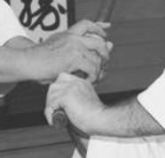
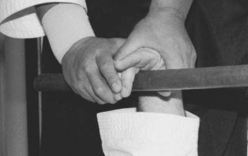
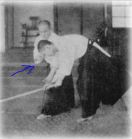
The traditional hand position on the bokken for the takedown to the mat and wrist pin is shown in the pictures below.  Note the hilt of the bokken is grabbed with the nage’s right little finger and ring finger. The nage’s left thumb is at the base of the uke’s right ring finger.

Bokken kotegaeshi 2JPG

Bokken kotegaeshi


  • Atemi

strike kotegaeshiAt the completion of the irimi tenkan movement there is the option of atemi in the form of striking the uke’s face with your right hand.

Practice of atemi in this way is a most useful practice tool to assist in learning the correct positioning for the technique.

 Have a great week.

Ian Grant
Head Instructor
Aikido Warrior Dojo