Master Koretoshi Maruyama

Aikido Warrior Dojo – Moments in Aiki

10653835_10152773559605928_4157188167238557708_nSee below a montage of video clips and photos from classes at our dojo over the last 12 months (with the odd exception).

Our dojo is an Aikido Yuishinkai affiliated dojo and is committed to studying Aikido as envisaged by its Founder Master Morihei Ueshiba (O’sensei).  Master Koretoshi Maruyama established  Aikido Yuishinkai in 1996.  He was a direct student of the Founder of Aikido and was given his teaching licence by O’Sensei in 1967.

Have a great week

Ian Grant
Head Instructor
Aikido Warrior Dojo

Kokyu dosa – Aikido Yuishinkai

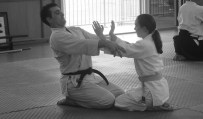
kokyu dosaKokyu dosa is an Aikido exercise in balance taking where both partners kneel facing each other.  The exercise is performed with the uke (the receiver of the technique) holding their partner’s wrists or elbows, during which the nage endeavours to take their uke’s balance.  Kokyu dosa in some schools is also referred to as suwari waza kokyu ho.

There are numerous benefits of kokyu dosa practice.  For newcomers to Aikido, it enables them in many cases to experience for the first time what being centred actually feels like.  The practice also allows Aikido principles, such as “centre line”, “centre pole” and relaxed unified movement, to be explored without the added complication of foot work.

Key lessons from the practice include the concept of moving around immovable  points of resistance.  Another is the idea of identifying and moving through “lines of tension” in the uke to take their centre and balance.

Consistent with the traditional approach to Aikido training of its Founder, Master Morihei Ueshiba, kokyu dosa is usually practiced  at our dojo at the end of each class.

In the below video Koretoshi Maruyama Sensei provides instruction on the basic form of kokyu dosa as practised in Aikido Yuishinkai.


Other forms kokyu dosa
For examples and training notes for other forms of kokyu dosa see:

Have a great week

Ian Grant
Head Instructor
Aikido Warrior Dojo, Brisbane
Munetsuki kokyu nage – Aikido Yuishinkai

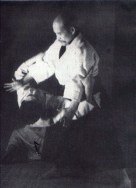
kokyu nage munetsukiIn the below video Master Koretoshi Maruyama, Founder of Aikido Yuishinkai, demonstrates and provides instruction for one of the versions of munetsuki kokyu nage The technique is  categorised as a “breath throw” and is practised as a response to a strike or thrust to the stomach (munetsuki).

From a superficial mechanical perspective, the technique appears deceptively straightforward. In reality, however, it can be quite challenging to successfully perform.  It requires substantive skills in entering, timing, sinking, maintaining centre pole and moving as a single relaxed unit.

Further, like most more advanced Aikido techniques the uke’s balance is not taken by movements of the nage’s upper body, but by the correct movement of the nage’s lower half of their body. The nage’s hand on the uke’s arm is merely the connection point.

One of the training advantages that we have found at the dojo with this particular version of munetsuki kokyu nage is that the internal skills and aikido principles necessary to perform it offer a “gateway” to learning other advanced techniques, including for example munetsuki kaitenage.


Have a great weekend.

Ian Grant
Dojo Cho
Aikido Warrior Dojo


Training notes – Munetsuki shiho nage

budo-shihonage-640Shiho nage (4 directions throw) is considered to be one of the most important pillar techniques in Aikido training. The name of the technique stems from the fact that a skilled nage can throw the uke in any of 4 directions.

In the below video Peter Kelly Sensei, Chief Instructor – Aikido Yuishinkai Australia, demonstrates and provides instruction on the application of shiho nage to address a strike to the torso (munetsuki shiho nage).

Peter Sensei focuses on the initial entry for the technique which in essence utilises sword based movements and associated body structure to completely take the uke’s balance (kuzushi) at the point of first contact.  When done correctly the effect on the uke is that any attempt to resist the technique only serves to hasten their loss of balance.


Have a great week.

Ian Grant
Head Instructor
Aikido Warrior Dojo

Bokken exercise – Mawashi uchi

Morihei-Ueshiba-Bokken-211x300The practice of bokken (wooden sword) arts is an integral part of Aikido training in Aikido Yuishinkai.  Amongst other things, solo and paired bokken practice plays an important role in helping develop key skills for unarmed arts.  These skills include foot work, distance, timing, centred movement, correct posture and striking.

At our dojo we take an integrated  approach to the role of the bokken in our studies. For example, when we practice unarmed arts we look at the inherent bokken movements contained within the particular technique.  Conversely, when practising with the bokken, this is always done with a focus on the skill groups we are trying to develop to aid our unarmed practice.  The benefit of taking this approach is that it continually gives our training context.

In the below video Master Koretoshi Maruyama, Founder, Aikido Yuishinkai provides instruction on the fundamental foot work and cutting movements for the bokken exercise mawashi uchi.  Also included  in the video is a demonstration by Peter Kelly Sensei (Chief Instructor Australia) and Alistair Williams Sensei of the paired practice application of the exercise.

Have a great weekend

Ian Grant
Head Instructor
Aikido Warrior Dojo