martial arts

Aikido hip throws for rear chokes – Ushiro kubishime koshi nage

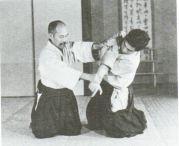
koshi nageUshiro kubishime koshi nage is a traditional Aikido technique which uses a hip throw (koshi nage) as  a defence against a choke attack from the rear (ushiro kubishime).

Aikido hip throws have their origins in a battlefield techniques and not all Aikido schools and dojos train in them.  At Aikido Warrior Dojo, they are a standard inclusion in our training and form part of our commitment to study the Aikido of O’sensei.

bokken koshi nageThey were first introduced into our dojo in early 2014 after permission was granted by Peter Kelly Sensei, Chief Instructor, Aikido Yuishinkai Australia for us to train in them. Since that time we have slowly included a wide range of koshi nage techniques into our standard training repertoire, including ushiro kubishime koshi nage

In the below video Morihiro Saito Sensei (1928-2002) provides instruction on Ushiro kubishime koshi nage as practised by O’Sensei (the Founder of Aikido) in the post-war period of his life.


  • Training notes for other koshi nage techniques

See: Unarmed arts by technique – scroll down to “koshi nage” (list is in alphabetical order )

  • Brief Biography – Morihiro Saito Sensei (1928-2002)

saito_seiza_260Morihiro Saito Sensei’s  practice of Aikido spanned 56 years and he is one of the most important teachers in Aikido history.  Saito Sensei was a live-in student of O’sensei for more than 20 years at his home dojo in Iwama, Japan.

Saito Sensei spent his teaching life dedicated to preserving the technical style of Aikido as practised and shown to him by O’sensei in the post-war period.  Without his commitment to preserving the Aikido of the Founder and extensive efforts to record and document his teachings, much of the Aikido of O’sensei would have no doubt been lost.  The Aikido world owes him a great debt.

Ian Grant
Head Instructor
Aikido Warrior Dojo

Training notes: Shomenuchi irimi nage

3Irimi nage (or entering throw) is a technique that is unique to Aikido.  Typically it is initially taught as a response to an overhead strike to the temple (shomenuchi).  However, it can be applied against most attack types, including those where the uke is armed with a weapon.

In the below videos Morihiro Saito Sensei (1928-2002) provides instruction on the traditional version of  shomenuchi irimi nage as practised by O’Sensei (the Founder of Aikido) in the immediate post-war period of his life.

The traditional version of irimi nage is a training favourite at our dojo and there would rarely be a training week where some aspect of it is not studied.

  • Basic application (nage initiates)


  • Intermediate applications (nage initiates – uke turns to continue attack)


  • Advanced applications (uke initiates)


ADDITIONAL NOTES

  • Alternate application (1) – Andy Sato Sensei


  • Brief Biography – Morihiro Saito Sensei (1928-2002)

saito_seiza_260Morihiro Saito Sensei’s  practice of Aikido spanned 56 years and he is one of the most important teachers in Aikido history.  Saito Sensei was a live-in student of O’sensei for more than 20 years at his home dojo in Iwama, Japan.

Saito Sensei spent his teaching life dedicated to preserving the technical style of Aikido as practised and shown to him by O’sensei in the post-war period.  Without his commitment to preserving the Aikido of the Founder and extensive efforts to record and document his teachings, much of the Aikido of O’sensei would have no doubt been lost.  The Aikido world owes him a great debt.

Have a great weekend

Ian Grant
Head Instructor
Aikido Warrior Dojo
Tachi dori yokomenuchi udekime nage – Aikido Yuishinkai

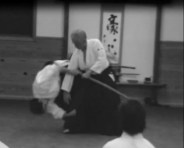
udekimeiIn the below video  Koretoshi Maruyama Sensei demonstrates and provides instruction for the Aikido technique udekime nage (arm extension throw). The technique is demonstrated as a defence to a diagonal strike to the head (yokomenuchi) where the uke is armed with a bokken.

Depending on the style of Aikido, udekime nage is sometimes classified as a form of kokyu nage (breath throw) technique


Other examples of  udekime nage

Have a great week.

Ian Grant
Dojo Cho
Aikido Warrior Dojo


Training notes: Munadori juji nage

In the below video, Morihiro Saito Sensei (9th Dan) demonstrates 2 versions of the Aikido technique juji nage  (crossed arms throw) in response to a front lapel  grab (munedori).


ADDITIONAL NOTES

  • Hand position (standard version)

munadori-hand-position


  • Munadori juji nage – London Aikido Club

In the below video Sensei Andy Hathaway of the London Aikido Club demonstrates and discusses important aiki training points for Munadori juji nage, including use of the hips, shifting weight, breaking the munadori grip and atemi opportunities.


  • Munadori juji nage – kokyu ho variation

In this second video by the London Aikido Club, Sensei Andy Hathaway teaches a  variation of  Munadori juji nage based on traditional kokyu ho principles for dealing with munadori attacks.


  • Munadori juji nage – Suwari waza

In the below munadori juji nage is demonstrated with both the nage and uke facing each other while on their knees.  This is referred to a zagi waza or suwari waza, depending on the Aikido style.


The kneeling version of  munedori juji nage has a long history in Aikido.  It dates back to the 1930’s and is included in both of O’Sensei’s technical manuals from that period.

In O’sensei’s 1938 demonstration the uke is pinned with one hand thereby allowing O’Sensei the option of applying an additional atemi to the uke‘s torso.  It also places the nage in the more advantageous position to deal with additional attackers if need be.

Jujinage 1Juji nage 2Juji nage 3


Have a great week

Ian Grant
Dojo Cho
Aikido Warrior Dojo


Jo dori and jo nage – O’sensei style

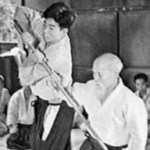
osensei-saitoTraining in the use of a wooden staff (a jo) for self defence purposes (jo nage) is an integral part of the syllabus for most  schools of Aikido.  Aikido practice also typically includes training in disarming techniques (called jo dori or jo tori) where the attacker (uke) is the one armed with the jo.  

Interestingly, O’Sensei’s technical manuals do not refer to jo nage or jo tori.  However, the 1936 manual Budo does include broadly comparable weapons such as the bayonet and spear. Those of us interested in O’sensei’s approach to jo nage and jo tori fortunately have access to the extensively recorded works of Morihiro Saito Sensei (9th Dan). Saito Sensei  (1928 -2002) dedicated his life to preserving O’Sensei’s Aikido as taught to him (much of it as a one on one student) over a 23 year period in Iwama, Japan.

In the below video recorded in 1986 and made publicly available by Aikido Journal, Saito Sensei Sensei provides detailed instruction on jo nage  and jo dori as directly taught to him by the Founder of Aikido. The instruction covers a wide variety of techniques (with a heavy emphasis on kokyu ho forms).  As is typical of Saito Sensei, his instruction is candid, insightful and martially focussed.  Some of the key differences between the Aikido practised by its creator and later ‘less -martial” incantations are also touched on.

Have a great weekend

Ian Grant
Dojo Cho
Aikido Warrior Dojo