 Training in how to safely receive technique (ukemi) is something that is particularly emphasised at our dojo. In every class time is set aside to develop and refine our ukemi skills. Everyone participates, however, the level and intensity of the practice varies consistent with each student’s experience and skills.
One form of ukemi practice that we have a lot of fun doing is what we call “free form ukemi training”. Basically the uke repeatedly receives different variations of the same technique which, depending on the variation, result in unpredictable and different falling outcomes.
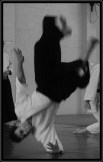 Ryotadori seoi otoshi is a favourite technique for this sort of training. Subtle changes in the application of the technique result in the uke having to unpredictably roll or breakfall from the left or right hand side while in an unbalance position. They also result in alterations in the space between the uke and nage, as well as the extent to which the some or all of the nage’s body operates to sever the uke’s connection to the ground.
The use of ryotadori seoi otoshi for this sort of training is demonstrated in the video below.
ADDITIONAL NOTES
- Video Library: Falling and uke arts
For further videos and posts on ukemi training, including how to forward roll, see Video Library: Falling and uke arts.
- Ryotadori seoi otoshi – the basic elements
In the below video, Peter Kelly Sensei, International Instructor for Aikido Yuishinkai, demonstrates the shape and footwork for ryotadori seoi otoshi as practised in our school. As noted in the lead-in commentary for the featured video, in order to produce different ukemi outcomes for training purposes, participants made subtle (and maybe at times not so subtle) amendments to the execution of the technique.
- Training methods for learning to breakfall
For examples of training methods that we use to develop our breakfalling skills (one aspect of ukemi) see the below video. More detailed information on ukemi training can be found in the Video Library: Falling and uke arts.
Have a great week.
Ian Grant
Head Instructor
Aikido Warrior Dojo



 Aikido Warrior Dojo
You must be logged in to post a comment.