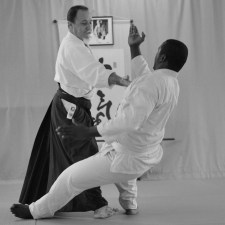
In the below video Chicko Xerri Sensei explores the Aiki concept of moving offline while at the same time a maintaining a natural posture. This method of movement typified the expression of Aikido demonstrated by Master Morihei Ueshiba (The Founder of Aikido) in the later parts of his life.
ADDITIONAL NOTES
Exercises and applied practice
In the below video Aikido Warrior Dojo seniors demonstrate exercises and practical applications to develop skills in moving off-line while maintaining natural posture.
Chicko Xerri Sensei – Brief Bio
Our dojo is a Fudoshin dojo operating under the guidance and mentorship of Chicko Xerri Sensei, 6th dan AKI (Aikikai), Tokyo. Chicko Sensei has been practising and teaching Aikido for more than 40 years and is endorsed by Doshu Ueshiba.
In the below video Chicko Xerri Sensei explores the Aiki concept of moving off-line to create an opportunity to defeat or diffuse an attack.
ADDITIONAL NOTES
Chicko Xerri Sensei – Brief Bio
Our dojo is a Fudoshin dojo operating under the guidance and mentorship of Chicko Xerri Sensei, 6th dan AKI (Aikikai), Tokyo. Chicko Sensei has been practising and teaching Aikido for more than 40 years and is endorsed by Doshu Ueshiba.
In the below videos Morihiro Saito Sensei (1928-2002) provides instruction on the traditional version of munetsuki kotegaeshi as practised by O’Sensei (the Founder of Aikido) in the immediate post-war period of his life. Munetsuki kotegaeshi is traditionally categorised as a “turn and transform” (kaiten) technique and is practised as a response to a strike or thrust to the stomach (munetsuki).
Munetsuki kotegaeshi is sometimes mistakenly considered a beginners technique on the basis that it often appears in early gradings in many schools. In reality, however, nothing could be further from the truth.
In fact the technique can be quite challenging to effectively perform, particularly against a centred and responsive uke who either resists or is skilled in countering. Effective application of kotegaeshi (regardless of the attack) requires significant skills in entering, timing, sinking, maintaining centre, space, balance breaking and moving as a single relaxed unit.
ADDITIONAL NOTES
Hand position for kotegaeshi
The below photo and drawing show the hand position for executing kotegaeshi. In our school the wrist is not twisted to the side.
From a martial perspective, atemi (striking) is an important part of Aikido practice. Depending on the source, between 70% and 90% of Aikido requires an application of atemi principles.
In the below video, Morihiro Saito Sensei demonstrates the atemi for munetsuki kotegaeshi.
Alternate standing pin
Kuzushi and balance taking principles
In Aikido the uke’s balance is typically not taken by movements of the nage’s upper body, but by the correct movement of the nage’s lower half of their body, particularly the hips. In munetsuki kotegaeshi, for example, the nage’s hand on the uke’s wrist is merely the connection point. However, it is the movement and sinking of the nage’s hips that breaks the uke’s balance.
In the below video, Morihiro Saito Sensei, demonstrates how the correct use of the hips and sinking can be used to take the balance of the uke at first contact in munetsuki kotegaeshi.
Munetsuki kotegaeshi – Ai-hamni stance
In the below video made by the London Aikido Club, munetsuki kokyu nage is examined from a traditional kokyu ho perspective.
The London Aikido Club studies the Aikido of Morihiro Saito Sensei and generously shares many of its teachings on the web. Those interested in the study of traditional Aikido as taught by the Founder in the post war period of his life may wish to check out the London Aikido Club’s You tube channel.
Application options
In the below video Christian Tissier Sensei (8th Dan Aikikai) explains the 3 options available for applying kotegaishi and the circumstances that favour one option in preference to another.
Morihiro Saito Sensei’s practice of Aikido spanned 56 years and he is one of the most important teachers in Aikido history. Saito Sensei was a live-in student of O’sensei for more than 20 years at his home dojo in Iwama, Japan.
Saito Sensei spent his teaching life dedicated to preserving the technical style of Aikido as practised and shown to him by O’sensei in the post-war period. Without his commitment to preserving the Aikido of the Founder and extensive efforts to record and document his teachings, much of the Aikido of O’sensei from the post war period would have been lost.
In the below video, S Crane Sensei demonstrates and provides instruction for the Aikido technique hiji nage (elbow throw). The technique is demonstrated in the context of strike to the nage’s torso (referred to as tsuki or mune tsuki).
The hiji nage techniques are sometimes classified as kokyu nage (breath throws) or juji nage (crossed arm throws) techniques depending on the school.
ADDITIONAL NOTES
Tsuki hiji nage – Technical aspects
In the below video Sensei Andy Hathaway provides instruction on important technical aspects of Tsuki hiji nage as practised at the London Aikido Club. For more excellent technical videos by the London Aikido Club, see their channel on You Tube.
Alternate application
Peter Kelly Sensei demonstrates an alternate application of the technique as practised in Aikido Yuishinkai Tasmania. The video was recorded at a class kindly given by Peter Sensei at our dojo on 12 August 2015.
In the below video, Christian Tissier Shihan (8th Dan Aikikai) demonstrates the omote and ura versions of the Aikido technique ushiro ryotedori ikkyo.
The demonstrations are completed in a dynamic free flowing form whereby the uke commences the attack by proceeding to the front of the nage, grabbing the nage’s wrist and then moving to the rear (with a view to also grabbing the nage’s second wrist).
This form of practice is referred to in some schools as ki no nagare. In ki aikido schools it is sometimes referred to as ryutai.
ADDITIONAL NOTES
Movement and Sword principles
In the below video Chicko Xerri Sensei (6th Dan Aki Aiki kai) explores the sword principles that underpin the higher level practice of ushiro techniques. The exploration is particularly applicable to ikkyo applications.
Our dojo is part of the Aikido Kenkyukai Fodoshin Dojos (Australia). Chicko Sensei is the Shihan for our school.
Balance breaking principles – Kuzushi
In the below video produced by Senshin Center Aikido Dojo, balance breaking principles applicable to ushiro attacks are explored. Kuzushi is unfortunately something that is sometimes overlooked in Aikido. The fact remains, however, that it is near impossible to throw a centred uke unless they are either cooperating or overpowered by a significantly larger nage.
In the below video Chicko Xerri Sensei explores an alternate option for addressing a ushiro attack whereby the uke is not permitted to move to the rear of the nage. Chicko sensei emphasises the important aiki principle of creating a space to move before attempting an aikido application.
In the below video Chicko Xerri Sensei explores a further option for addressing ushiro attacks. The option readiy sets up the circumstances for an ikkyo application.
Ki Aikido
In the below video, Koretoshi Maruyama Sensei provides instruction on Ushiro tekubidori ikkyo as practised in Aikido Yuishinkai. The method of application is typical of the approach taken by ki aikido schools.
 Chicko Xerri Sensei – Brief Bio


 Aikido Warrior Dojo
You must be logged in to post a comment.