Aikido

How to do a forward roll?

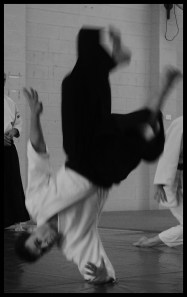
Roll 1For many people, learning to forward roll is probably one of the most challenging and frustrating parts of Aikido training.  I read recently that fear of rolling is one of the major reasons that people avoid taking up Aikido.  It is also apparantly one of the major reasons people leave.

Over the years, I have had the misfortune of witnessing way too many Aikido practitioners mistake a forward roll as some form of straight over the head circus tumble.  The end result is always the same – injury followed by fear.  This is particularly so if you try to circus tumble out of a correctly applied Aikido technique.

One of the most effective forward rolling methods that I have seen is that developed and applied by Donovan Waite Sensei (7th Dan).  This method of rolling is what is taught at our dojo.  Major benefits include that is more gentle on the body, easier to learn, and importantly martially effective.

For further information on falling arts in aikido – see our video library

Ian Grant
Dojo Cho
Aikido Warrior Dojo


Are gradings important?

From time to time, one hears a hearty debate between dojo students as to the merits of grading in Aikido.  Indeed there has been many an article on Aikido and other martial arts websites about the benefits or otherwise of gradings in traditional martial arts.


These debates typically discuss such matters as the need for uniform standards, the origins of grading systems, commercial influences that may impinge on integrity of the grading process, martial arts elitism and like matters.  What is often overlooked, is the personal benefits that gradings offer the student.

Ian Black belt HQSome years back, my Sensei at the time sent me an email that really brought it home to me as to why I should always step up to grade whenever invited.  The correspondence came about after I was invited to test for my Aikido 3rd kyu grading (green belt) and was having personal doubts as to whether I was ready.

The email included the most eloquent and persuasive statement that I have yet heard as to the personal benefits that gradings offer the Aikido student.  It went as follows:

Preparing for grading makes you review what you are learning.  And puts a little pressure on yourself.  I see it like this …  A plant in a pot will grow to a certain height. Only when it is transplanted into a larger pot will it continue to grow.”

Celebrity Aikidoka

Martial arts training has been an ongoing trend amongst celebrities dating back to the early 70’s.  Elvis Presley, Madonna, Jennifer Aniston, Patrick Swayze, Steve McQueen, Mel Gibson, Robert Downey Jr and Christian Bale, to name only a few, have all prolifically trained in one or more martial arts over the years.

While the striking arts tend to dominate celebrity choices for martial practice, a number of high profile actors and singers have reportedly trained in Aikido.  They include:

  • Steven Seagal  (7th Dan)

Without doubt, Steven Seagal is the most widely known actor/singer Aikidoka on the planet.  In an interview in 2001, Seagal Sensei made the following observations about Aikido and its self-defence applications.

Steven-Seagal-Aikido-002[1]It’s theoretically based on harmony rather than blocking, kicking and punching. We allow the other person to attack and use his own attack against him by becoming one with his movement and utilizing anatomical weak points, joint blocks and throws, etc.

In a life and death situation the harder the technique becomes. Often times, the attacker creates the life and death situation, because the harder they come the harder they fall. These techniques will work on anybody but you really have to learn them. Aikido is not a quick art to learn.”

  • Sean Connery (Nidan)

In 1996 during an interview with Jay Leno on the Tonight Show, the James Bond star reportedly not only stated that he was a Nidan in Aikido but also that he broke his wrist while practising with Steven Seagal.

  • Jerry Seinfeld

Aikido…I studied that for a while, the martial art. I love that. That’s a wonderful subject. Very good in marriage. I would suggest Aikido training for anyone thinking of getting married” (Quote from interview with Parade Magazine).

  • John Denver

Country music legend and environmentalist, John Denver, was reportedly a dedicated Aikidoka who trained under Tom Crum Sensei.

  • Joan Baez (Shodan).

Folk music legend, Joan Baez, is a black belt in Aikido.  Photographs of her training can readily be found on the Internet. Ms Baez made the following comment in an interview for the Washington Post when responding to public criticism she had received for her protest activities:

I don’t care an eyedrop about the criticism…Aikido is carrying over into my life. A few years ago I would have been waking up at night. Not now.”

Ian Grant

Avoiding injury in Aikido training

It is only natural for anyone interested in taking up a martial art to be concerned about the potential for injury.  Fortunately, serious injuries in Aikido are quite rare.

Ian Grant (a) On its face this probably seems strange given that Aikido is a full contact martial art which amongst other things involves techniques where the attacker almost always ends up being sent to the ground.  The outcome can largely be attributed to the higher emphasis on safe practice advocated by the vast majority of dojo’s.

While safe practice is a without doubt everyone’s responsibility in the dojo, there are many simple things that an individual can do to minimise their chance of injury during training practice.  These include the following:

  • Always warm up

Make sure you get to class in time to participate in the preliminary warm up exercises.  If for some reason are late, take responsibility and do some warm up exercises prior to starting active practice.

  • Make learning ukemi (the art of falling) a priority

It cannot be emphasised enough that learning to fall and roll correctly out of techniques (i.e. ukemi) is absolutely critical to the practice of Aikido.  Practitioners who for whatever reason decide not to learn ukemi not only place themselves in a position where it almost impossible to become proficient in our martial art, but also place themselves at high risk of harm.

  • Learn to relax

Always easier said than done when you first start, but if you can maintain a relaxed state of mind and body during practice, your chance of injury significantly decreases.  Remember its much easier to snap a twig than a pillow.

  • Listen to the Sensei (teacher)

Your safety is the Sensei’s priority.  If the Sensei points out that a particular technique has the potential for risk take note of this and the stated ways of avoiding it.

  • Be aware of your surrounds

When practising techniques, remain aware that others are also sharing the mat – in short do not set yourself up to be thrown on another person.  Conversely, do not linger on the mat after receiving a technique.

  • Be honest about your abilities

Don’t train beyond your abilities.  If you need your partner to slow down or take it easy because you are getting out of your depth – be upfront.  Further, if your training partner for some reason is starting to rely on physical strength rather than technique or for any reason is getting rough, speak up and bring it to their attention.

  • Practise more than once a week

I recently read a report that a research study undertaken for a master’s thesis found that persons who practice Aikido less than twice a week or more than 5 times a week experienced a significantly higher injury rate than those who practised between 2-5 times a week. This is something you may wish to keep in mind when planning your training schedule.

  • Other factors 

In a study by Phillip Smith published in the Spring 2009 Edition of the Journal of Sports Therapy it was found that there appears to be no correlation between injuries in Aikido and any of the following factors –

  • grade of the student;
  • age of the student; or
  • years of practice.

Ian Grant
Head Instructor
Aikido Warrior Dojo