In our School, taninzugake (or free form practice) is commonly practiced at the end of each class. This type of practice allows the nage to respond to the selected attack type by using any technique they so choose. The attack type in the video is yokomenuchi, which is a side blow to the head.
In the below video Master Koretoshi Maruyama, Founder of Aikido Yuishinkai, provides instruction on one of the many forms of kokyu nage (breath throw) that can be used in response to a yokomenuchi attack (i.e. a circular blow to the side of the head).
Despite its simplicity of mechanical movement, Yokomenuchi kokyu nage, is a deceptively challenging techniquethat takes practice and understanding of applied kokyu (breath power) principles to successfully perform. Notably, any attempt to “muscle” the technique neutralises it.
In terms of martial application, it is essential that the uke’s balance be completely taken at first contact. Failure to do this places the nage in a precariously disadvantaged strategic position, particularly if the uke delivers a centred attack and follows through with a second strike or grapple .
Nikyo techniques involve the application of a painful pronating or adductive wristlock to subdue or pin an attacker. They are a common feature in the syllabus of most Aikido schools.
Nikyo techniques can be used to address a wide variety of attacks. They are particularly effective in circumstances where the uke attempts to grab the clothing or wrist of a nage (as a prelude to follow up strike).
In the below video Morihiro Saito Sensei (9th Dan) explains the fundamental principles that underpin the application of katatedori nikyo. This form of nikyo is applied in response to an attack in the form of a same side grab.
ADDITIONAL NOTES
Katatedori nikyo – Fundamentals
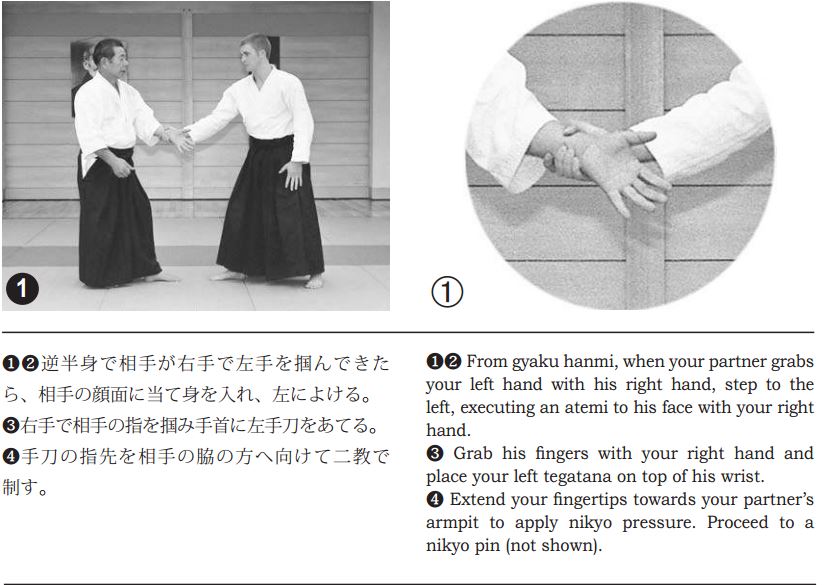
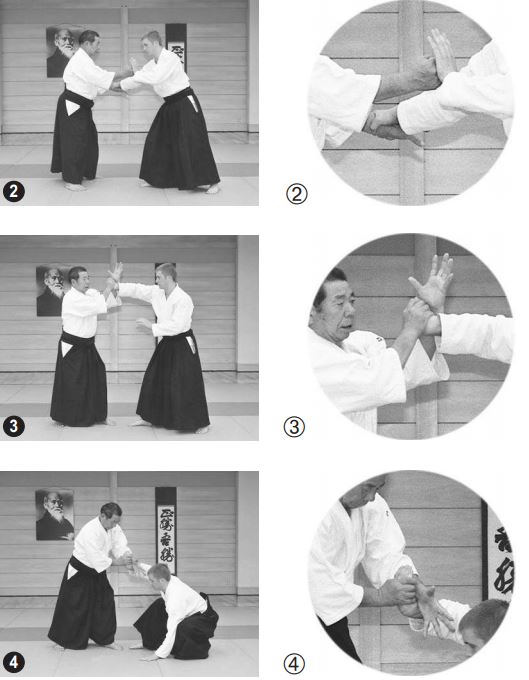
See below a photo demonstration (including description) by Morihiro Saito Sensei (9th Dan) of the fundamental elements of katatedori nikyo as practised by O’sensei in the immediate post war period of his training life.
Katatedori nikyo – Alternate application (1)
See below a photo demonstration (including description) by Morihiro Saito Sensei (9th Dan) of an alternate form of katatedori nikyo which was also practised by O’sensei in the immediate post war period of his training life.
Katatedori nikyo – Alternate application (2)
Avoiding the potential to be kicked in the kneecap
The method of application in the below video overcomes a common problem sometimes seen with nikyo in that the uke can readily kick the nage in the knee cap to escape. Also included are some suggested exercises to assist in the learning process.
Morihiro Saito Sensei’s practice of Aikido spanned 56 years and he is one of the most important teachers in Aikido history. Saito Sensei was a live-in student of O’sensei for more than 20 years at his home dojo in Iwama, Japan.
Saito Sensei spent his teaching life dedicated to preserving the technical style of Aikido as practised and shown to him by O’sensei in the post-war period. Without his commitment to preserving the Aikido of the Founder and extensive efforts to record and document his teachings, much of the Aikido of O’sensei would have no doubt been lost. The Aikido world owes him a great debt.
While by no means the most commonly practised “drop” technique, seoi otoshi has nonetheless been part of Aikido since its early days. A question often asked whenever seio otoshi is practised in the dojo is what is the difference between a seoi otoshi (shoulder drop) and a seoi nage (shoulder throw)?
Given the fact that both techniques involve the loading of the uke onto the back of the nagi (which is what “seoi”means), the confusion between the techniques is understandable. Its is also a technically trite (albeit correct) response to merely state that seoi nage is something more associated with Judo than Aikido.
From a technical perspective, the distinguishing feature of a seio otoshi is that the nage drops to one or both knees and stays there until the completion of the technique. By comparison, in seoi nage the nage completes the technique from a standing position. Further, a technique is still a seoi nage notwithstanding that the nage may have dropped to one or both knees and then returned to a standing position to complete it.
The below video includes demonstrations of both seio otoshi and seio nage by seniors at our dojo. The video is a compilation from various sources, including gradings and taninzugake (free form) practice.
We have a number of 5th Kyu (yellow belt) gradings to look forward to in the next few weeks. With this in mind, I thought it might be helpful to put up some video training notes on one of the sometimes more challenging techniques in the 5th Kyu Aikido Yuishinkai syllabus – katadori ikkyo (ura).
The technique is performed in the context of a grabbing attack to the shoulder (katadori). While it is possible to end the technique with a projection, it is generally finished with a pin.
In the below video Master Koretoshi Maruyama, Founder of Aikido Yuishinkai, provides instruction on the basic levels (kotai and juntai) of katadori ikkyo (ura). These are the levels which are tested in a 5th Kyu grading in our school.
The video was recorded at a seminar in 2008 held at Aikido School of Excellence, Tasmania.




 Aikido Warrior Dojo
You must be logged in to post a comment.