All posts

Training notes: Ushiro tekubidori kaiten nage

kaiten 2 JPGIn modern Aikido kaiten techniques are typically referred to as “wheel throws” because the uke is projected in a wheel like shape. Traditionally, however, they were referred to as “open and turn” techniques.  In the text “Budo“, Master Morihei Ueshiba  describes kaiten as a turn and transform movement.

In the below video Master Koretoshi Maruyama demonstrates and provides instruction for ushiro tekubidori kaiten nage as practised in our school.  The technique is trained as a response to a traditional attack where both hands of the nage are grabbed from behind with the intent to place a knee in the nage’s back.

Depending on the school of Aikido, the technique is also sometimes referred to as ushiro ryotedori kaiten nage.


Additional notes

  • Similar beginning as ushiro tekubidori ikkyo

The beginning segments of ushiro tekubidori kaiten nage are the same (up to the downward cut movement) as ushiro tekubidori ikkyo at ryutai level. For notes on this technique, including the entry and set up see: Training notes: Ushiro tekubidori ikkyo (ryutai).

  • Other kaiten nage applications 

For training notes on other applications of kaiten nage see Video Library: Unarmed arts (by technique).  Technique groups (e.g. ikkyoirimi nage etc.) are ordered alphabetically.

  • Other ushiro tekubidori techniques 

For training notes on other Aikido techniques that are practised from a ushiro tekubidori attack, see Video Library: Unarmed arts (by attack type).  In the library, techniques are ordered alphabetically based on attack types (e.g. katadori, katatedoriushiro tekubidori etc.).

Have a great week.

Ian Grant
Head Instructor
Aikido Warrior Dojo
 

Training notes: Ushiro ryotedori kokyu nage

In the below video Morihiro Saito Sensei  demonstrates and provides instruction for the pre and post war versions of the aikido technique ushiro ryotedori kokyu nage.

The technique is  categorised as a “breath throw” and is practised as a response to a traditional attack where both hands of the nage are grabbed from behind with the intent to either place a knee in the nage’s back or drag the nage backwards.

Depending on the school of Aikido the technique is sometimes referred to as ushiro tekubidori zenpo nage/kokyu nage.


ADDITIONAL NOTES

  • Alternate attack form

Ushiro ryotedori kokyu nage, like all Aikido applications, can be practised from a static form (typically under resistance) or in a dynamic free flowing form (often referred to as ki no nagare). 

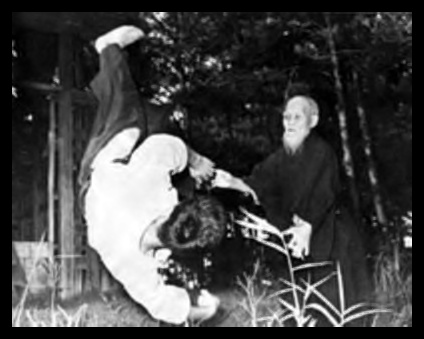
In the following video, the Founder of Aikido, Master Morihei Ueshiba (O’sensei) demonstrates a dynamic version of  ushiro ryotedori kokyu nage  whereby the uke directly attacks from behind and out of the nage’s line of sight (see video below).  We also train this version at our dojo.


  • Alternate application

In the below video Sensei Andy Hathaway of the London Aikido Club demonstrates an alternate kokyu nage application.


  • Ki aikido approach

In the below video the Koretoshi Maruyama Sensei demonstrates and teaches the subject technique as practised in Aikido Yuishinkai. This approach (including the bounce) is typical of many ki aikido schools inspired by the teachings of Koichi Tohei Sensei.

Have a great weekend.

Ian Grant
Dojo Cho
Aikido Warrior Dojo


Aikido Warrior Dojo – Moments in Aiki

10653835_10152773559605928_4157188167238557708_nSee below a montage of video clips and photos from classes at our dojo over the last 12 months (with the odd exception).

Our dojo is an Aikido Yuishinkai affiliated dojo and is committed to studying Aikido as envisaged by its Founder Master Morihei Ueshiba (O’sensei).  Master Koretoshi Maruyama established  Aikido Yuishinkai in 1996.  He was a direct student of the Founder of Aikido and was given his teaching licence by O’Sensei in 1967.

Have a great week

Ian Grant
Head Instructor
Aikido Warrior Dojo
Kokyu dosa – Aikido Yuishinkai

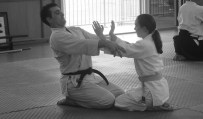
kokyu dosaKokyu dosa is an Aikido exercise in balance taking where both partners kneel facing each other.  The exercise is performed with the uke (the receiver of the technique) holding their partner’s wrists or elbows, during which the nage endeavours to take their uke’s balance.  Kokyu dosa in some schools is also referred to as suwari waza kokyu ho.

There are numerous benefits of kokyu dosa practice.  For newcomers to Aikido, it enables them in many cases to experience for the first time what being centred actually feels like.  The practice also allows Aikido principles, such as “centre line”, “centre pole” and relaxed unified movement, to be explored without the added complication of foot work.

Key lessons from the practice include the concept of moving around immovable  points of resistance.  Another is the idea of identifying and moving through “lines of tension” in the uke to take their centre and balance.

Consistent with the traditional approach to Aikido training of its Founder, Master Morihei Ueshiba, kokyu dosa is usually practiced  at our dojo at the end of each class.

In the below video Koretoshi Maruyama Sensei provides instruction on the basic form of kokyu dosa as practised in Aikido Yuishinkai.


Other forms kokyu dosa

For examples and training notes for other forms of kokyu dosa see:

Have a great week

Ian Grant
Head Instructor
Aikido Warrior Dojo, Brisbane

Munetsuki kokyu nage – Aikido Yuishinkai

kokyu nage munetsukiIn the below video Master Koretoshi Maruyama, Founder of Aikido Yuishinkai, demonstrates and provides instruction for one of the versions of munetsuki kokyu nage The technique is  categorised as a “breath throw” and is practised as a response to a strike or thrust to the stomach (munetsuki).

From a superficial mechanical perspective, the technique appears deceptively straightforward. In reality, however, it can be quite challenging to successfully perform.  It requires substantive skills in entering, timing, sinking, maintaining centre pole and moving as a single relaxed unit.

Further, like most more advanced Aikido techniques the uke’s balance is not taken by movements of the nage’s upper body, but by the correct movement of the nage’s lower half of their body. The nage’s hand on the uke’s arm is merely the connection point.

One of the training advantages that we have found at the dojo with this particular version of munetsuki kokyu nage is that the internal skills and aikido principles necessary to perform it offer a “gateway” to learning other advanced techniques, including for example munetsuki kaitenage.


Have a great weekend.

Ian Grant
Dojo Cho
Aikido Warrior Dojo