Peter Kelly Sensei

Training Notes: Ryotodori tenchi nage

In the below videos Morihiro Saito Sensei (1928-2002) provides instruction on the traditional versions of ryotedori tenchi nage as practised by O’Sensei (the Founder of Aikido) in the immediate post-war period of his life.  The technique is applied in the context of a 2 hand grab attack (ryotedori)


ADDITIONAL NOTES

  • A closer look at the basics – Kayla Feder Sensei

In the below video Kayla Feder Sensei (a direct student of Saito Sensei) provides instruction on ryotedori tenchi nage at (kihon or basic level).  Feder Sensei also shows the progression of the technique from basic to advanced applications. Feder Sensei kindly shares her insights into Aikido on a variety of social media forums.  Those looking for training tips of traditional Aikido applications are recommended to explore her many videos on  You tube.


  • Tenkan principles for ryotedori tenchi nage  

In the below video Christian Tissier sensei (8th Dan Aikikai) explains the aiki principles under pinning the tenkan application of ryotedori tenchi nage. Tissier sensei also explores the kokyu ho movement that may be used to effectively achieve kuzushi (destruction of balance) at the completion of the technique.


  • Direct entry application

In the below video, Peter Kelly Sensei, International Instructor, Aikido Yuishinkai, demonstrates provides instruction on tenchi nage (heaven and earth throw). The video was recorded at our dojo on 12 August 2015 as part of a special class given by Peter Sensei on kokyu ho applications in aikido practice.


  • Brief Biography – Morihiro Saito Sensei (1928-2002)

saito_seiza_260Morihiro Saito Sensei’s practice of Aikido spanned 56 years and he is one of the most important teachers in Aikido history. Saito Sensei was a live-in student of O’sensei for more than 20 years at his home dojo in Iwama, Japan.

Saito Sensei spent his teaching life dedicated to preserving the technical style of Aikido as practised and shown to him by O’sensei in the post-war period. Without his commitment to preserving the Aikido of the Founder and extensive efforts to record and document his teachings, much of the Aikido of O’sensei would have no doubt been lost. The Aikido world owes him a great debt.
 

Ian Grant
Head Instructor
Aikido Warrior Dojo

Training notes: Katatedori aiki otoshi

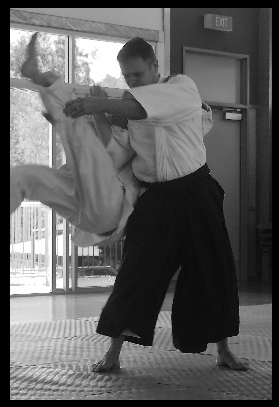
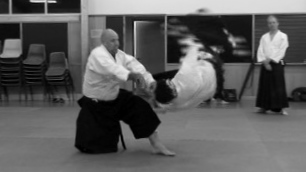
Aiki otoshi techniques are commonly referred to as blending drop” techniques.  While not as commonly practised as other forms of technique, they have a long history in Aikido.

In the below video Mike Jones Sensei from New York Aikikai demonstrates and provides instruction on the basic and advanced  versions of Katate dori aiki otoshi.  This form of aiki otoshi is practised from a same side wrist grab.

From a safety perspective, it recommended that the advanced form of aiki otoshi not be attempted except under the close guidance and instruction of an experienced instructor familiar with the technique, including how to receive it.


ADDITIONAL NOTES

  • Ukemi

On the following video Peter Kelly Sensei, Aikido Yuishinkai (Tasmania), provides instruction on the following:

  • How to safely receive Aiki otoshi as a uke?
  • How to teach the ukemi for the technique?
  • Correct form to lift and project the uke.

The video was recorded at Aikido Warrior Dojo, Brisbane on 12 August 2015.


  • Aiki otoshi from other attack forms

In the below archive video R Crane Sensei (5th Dan) demonstrates the application of aiki otoshi from other attack forms typically seen in Aikido.


All the best

Ian Grant
Dojo Cho
Aikido Warrior Dojo, Brisbane


Training notes: Jodan tsuki kokyu nage

Snapshot 1 (14-08-2015 5-52 PM)While direct strikes to the face (Jodan tsuki) tend to receive less emphasis in Aikido compared strikes to the torso (munetsuki), dealing with these sorts of attacks remains an important part of our regular practice.

In the below video, Peter Kelly Sensei, Aikido Yuishinkai  shows how to apply kokyu nage (breath throw) to address a Jodan tsuki attack. A key aspect of the demonstrated technique is a bokken like cut movement combined with a 180 degree (drop to one knee) turn.

The video was recorded at Aikido Warrior Dojo, Brisbane on 12 August 2015.

ADDITIONAL NOTES

  • Jodan Tsuki

jodantsuki


All the best

Ian Grant
Head Instructor
Aikido Warrior Dojo, Brisbane

Round up – Peter Kelly Sensei class – 12 August 2015

Following on from the Winter Aikido Yuishinkai Seminar this weekend, our Chief Instructor,  Peter Kelly Sensei, visited our dojo on Wednesday as guest instructor.

Peter Kelly seminar 1Given our dojo’s particular interest in studying applied kokyu ho applications, Peter Sensei took us through a wide variety of kokyu nage techniques.  Peter Sensei also examined kokyu nage in the context of a direct strike to the face (ganmen-tsuki), which is an attack we have just started exploring at the dojo in recent months.

For those not familiar with kokyu ho applications, they constitute what is often referred to as the 4th pillar of Aikido. Kokyu ho techniques in the early years of our budo were considered secret techniques not to be shared publicly outside the dojo.  The reason for this is that kokyu ho is the method of generating power in our Aikido throws and applications.  Further, while there is a whole of branch techniques in Aikido called kokyu nage, in reality all techniques at their essence require kokyu ho to translate them from cooperative to applied practice.

In addition to paired practice, Peter Sensei also provided instruction on solo heavy bokken exercises to help develop kokyu ho through vertical-horizontal plane movement. While too difficult to explain in a blog, the exercises will be added to the dojo’s regular bokken (wooden sword) exercises.

A huge thank you to Peter Sensei for taking the class.  It’s a major commitment from Peter  to visit Brisbane from Tasmania, not the least of which is time spent away from his family. I think I speak for everyone when I say how much we really appreciate everything Peter is doing to lead our school in its new direction.

Also thanks to Griffith Aikido Institute for arranging Peter’s seminar in Brisbane in the first place. Last but not least, thank you to everyone who attended.

Plenty of instructional videos to come in the next few weeks to make sure we don’t forget what we were shown.

All the best

Ian Grant
Head Instructor
Aikido Warrior Dojo, Brisbane

Training notes – Yokomenuchi shiho nage

Shiho nageShiho nage (4 directions throw) is one of the most important, if not the most important pillar technique in Aikido training. It contains within it the root of every Aikido technique and there is no doubt its proper execution relies on the nage applying all of the fundamental principles that underlie Aikido practice.

In the below video  Master Koretoshi Maruyama, Founder of Aikido Yuishinkai, gives detailed instruction and training tips on the basic kotai and juntai forms of yokomenuchi shiho nage as practised in our school.

Maruyama Sensei explains the fundamental principles underlying the application of the technique from both omote and ura entry points, including correct footwork, use of centreline, body posture, irimi, and how the movements underpinning the technique are based on the sword.

The video was recorded in 2008 at a seminar in Tasmania, Australia held at the Aikido School of Excellence.  In Aikido Yuishinkai, the demonstrated applications form part of the grading examinations for 4th and 5th Kyu.

All the best

Ian Grant
Head Instructor
Aikido Warrior Dojo

Related articles: