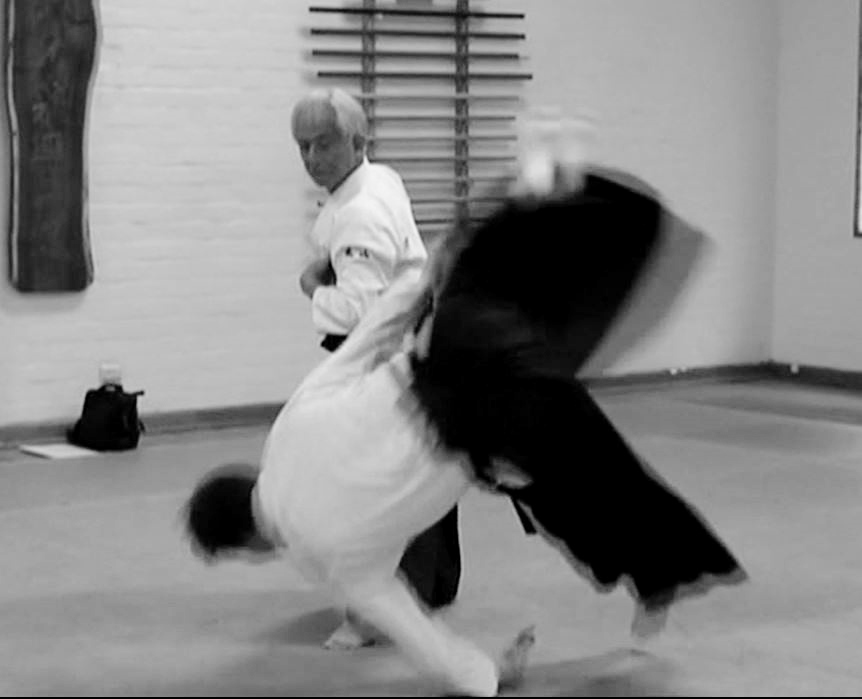
kokyu nage

Static resistance training: Katadori kokyu nage

katadori kokyu nageDealing with grab attacks where the uke is holding or resisting with physical based strength is an important part of Aikido practice.

While as Aikidoka we train ourselves to use centred relaxed grips (i.e. “holding with ki”), the fact remains that in most self defence situations the attacker will typically be using strength based tactics.  Failure to include responses to strength and resistance based attacks in our regular practice would in effect make our training effectively useless from a martial perspective.

Significantly, when Aikido is used against strong grip static attacks, the movements tend to be more economical and less complex.  Centred sinking movements combined with taking balance by controlling the head or elbow are common.  Atemi (striking) is also more often than not a critical component. The Aikido in general becomes less pretty.

  • Katadori kokyu nage

In the below video, Master Koretoshi Maruyama gives instruction on how to perform the Aikido technique kokyu nage (breath throw) in response to a static shoulder grab (kata dori) where the attacker is holding with strength.


  • Application against a sleeve grab

Kokyu nage as demonstrated in the video can also be used to address an attack in the form of a sleeve grab – see Sodedori kokyunage.

  • Alternate form of katadori kokyu nage

As is often the case in Aikido, there is an alternate method of executing a kokyu nage against a strong shoulder grab.  In the 1950’s, O’sensei practiced the technique without taking the elbow and instead closed the gap between the uke and nage by executing a tenkan –  See katadori kokyu nage (post war version).

  • Other examples of Aikido for static resistance attacks

Static resistance training is a regular form of practice at our dojo.  For examples of other resistance based training that we undertake see – Working with resistance: static hand grabs.

Have a great weekend.

Ian Grant
Head Instructor
Aikido Warrior Dojo
Training Notes: Yokomenuchi kokyu nage

Yokomenuchi kokyu nage 3In the below video Master Koretoshi Maruyama, Founder of Aikido Yuishinkai, demonstrates and provides instruction on the Aikido technique, yokomenuchi kokyu nage (irimi), as is practiced in our school.

The technique is performed as a response to a yokomenuchi strike, which is a side blow to the head.

Yokomenuchi kokyu nage is a particular useful technique for developing fundamental skills in timing, entering and directly meeting an attack without clashing.  We have also found at the dojo that with slight modifications, yokomenuchi kokyu nage (irimi) can be used to effectively deal with non-traditional strikes, including for example a hook punch.


ADDITIONAL NOTES

  • Origins of technique

Yokomenuchi kokyu nage (irimi) has a long history in Aikido. The technique appears as technique number 42 in O’senseis first technical manual “Budo Renshu” (1934).  The notable difference in this early version is that the nage cuts down through the uke‘s neck and also cuts down and then hold’s the wrist of the uke’s attacking arm.  (See O’senseis drawings below).

However, the kokyu ho principles necessary to effectively apply the technique remain the same.

Drawing (1) No 42

Drawing 2 no 42


Kokyu nage - OsenseiIn O’sensei’s 2nd manual “Budo” (1938) the roles of nage and uke for the technique are described as follows:

Uke: Deliver a yokomen strike with your right hand.  “Tori (i.e. nage): Step forward on your left foot and use your left te gatana (i.e. hand sword) to neutralise your opponent’s attack, simultaneously striking his face  (and down him).”


  • Kokyu ho principles underpinning technique

Kokyu ho exercises are something that we do a lot of at our dojo as a means of developing internal strength in our techniques.  Kokyu ho exercises were the traditional method used by O’sensei to develop “ki power” in his Aikido.

In the below video, Morihei Saito Sensei demonstrates and explains the kokyu ho exercise relevant to yokomenuchi kokyu nage (irimi).


Ian Grant
Head Instructor
Aikido Warrior Dojo, Brisbane


Training notes: Katatedori kokyu ho

OSenseiTaiNoHenkoIn the below videos Morihiro Saito Sensei (1928-2002) demonstrates the basic  version of Katatedori kokyu ho.

The application is performed from a single hand grab (katatedori) and is categorised as a breath exercise (kokyu ho) or breath throw (kokyu nage).

Kokyu ho exercises are used in Aikido to assist in developing internal power.  They can also be techniques in themselves (kokyu nage) or form key aspects of other techniques.  At higher levels of practice kokyu ho principles form part of every technique.


ADDITIONAL NOTES

  • Technical details


  • Katatedori kokyu ho – Alternate application (1)

In the following video Donovan Waite Sensei (7th Dan Aikikai) demonstrates an alternate application of katatedori kokyu nage.  Waite Sensei’s instruction emphasises the importance of connection.  Also of note in this version of the technique is the use of the elbow to effect balance and the pushing away of the uke to complete the technique.


  • Alternate application (2) – Peter Brady Shihan

In the below video, Peter Brady Shihan (7th Dan Aikikai) provides instruction for an alternate application of Katatedori kokyu ho.


  • Alternate application (3) – Donovan Waite Sensei


  • Alternate application (4) – Peter Kelly Sensei 

The below video was recorded at our dojo on 12 August 2015 as part of a special class given by Peter Kelly Sensei of Aikido Yuishinkai (Tasmania) on kokyu ho applications in Aikido practice.


Have a great week.

Ian Grant
Head Instructor
Aikido Warrior Dojo, Brisbane

Training notes – Yokomenuchi kokyu nage

Yokomenuchi kokyuIn the below video Master Koretoshi Maruyama, Founder of Aikido Yuishinkai, provides  instruction on one of the many forms of kokyu nage (breath throw) that can be used in response to a yokomenuchi attack (i.e. a circular blow to the side of the head).

Despite its simplicity of mechanical movement, Yokomenuchi kokyu nage, is a deceptively challenging technique that takes practice and understanding of applied kokyu (breath power) principles to successfully perform.  Notably, any attempt to “muscle” the technique neutralises it.

In terms of martial application, it is essential that the uke’s balance be completely taken at first contact.  Failure to do this places the nage in a precariously disadvantaged strategic position, particularly if the uke delivers a centred attack and follows through with a second strike or grapple .

Have a great week.

Ian Grant
Head Instructor
Aikido Warrior Dojo, Brisbane

Training notes – Ushirodori kokyu nage

Ushiro doriIn the below video Master Koretoshi Maruyama, Founder of Aikido Yuishinkai demonstrates and provides instruction on how to perform ushirodori kokyu nage.

In this particular application of kokyu nage (or breath throw), the nage’s arms are strongly pinned just above the elbow in a rear bear hug hold (ushiro dori).  The attack is also performed from a static position making it more challenging to escape from, particularly if the uke has a strength or size advantage.

The challenging nature of the attack makes ushirodori kokyu nage  an excellent learning vehicle to study how fundamental aikido principles can be used to take the balance of a uke who is not only centered but in a tactically superior position.

Have a great weekend

Ian Grant
Dojo Cho
Aikido Warrior Dojo, Brisbane