katatedori

Training Notes – Katatedori nikyo

nikyo (1)Nikyo techniques involve the application of a painful pronating or adductive wristlock to subdue or pin an attacker.  They are a common feature in the syllabus of most Aikido schools.

Nikyo techniques can be used to address a wide variety of attacks.  They are particularly effective in circumstances where the uke attempts to grab the clothing or wrist of a nage (as a prelude to follow up strike).

In the below video Morihiro Saito Sensei (9th Dan) explains the fundamental principles that underpin the application of katatedori nikyo. This form of nikyo is applied in response to an attack in the form of a same side grab.


ADDITIONAL NOTES

  • Katatedori nikyo – Fundamentals

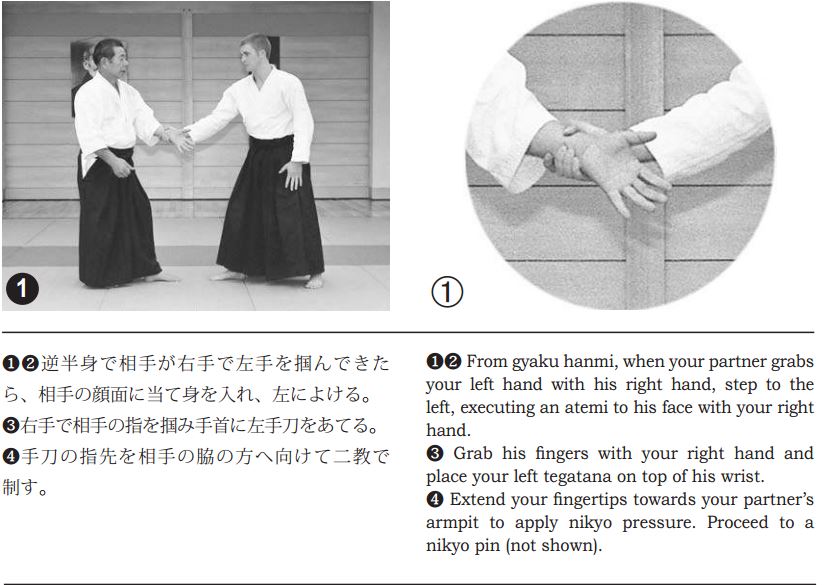
See below a photo demonstration (including description) by Morihiro Saito Sensei (9th Dan) of the fundamental elements of katatedori nikyo as practised by O’sensei in the immediate post war period of his training life.

katatedori-nikyo-1katatedori-nikyo-2


  • Katatedori nikyo – Alternate application (1)

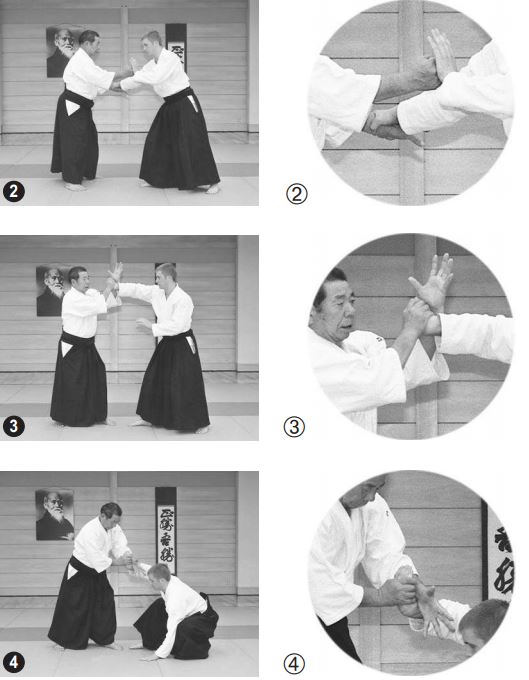
See below a photo demonstration (including description) by Morihiro Saito Sensei (9th Dan) of an alternate form of katatedori nikyo which was also practised by O’sensei in the immediate post war period of his training life.

katatedori-nikyo-1a

katatedori-nikyo-2a


  • Katatedori nikyo – Alternate application (2)


  • Avoiding the potential to be kicked in the kneecap 

The method of application in the below video overcomes a common problem sometimes seen with nikyo in that the uke can readily kick the nage in the knee cap to escape. Also included are some suggested exercises to assist in the learning process.


  • Brief Biography – Morihiro Saito Sensei (1928-2002)

saito_seiza_260Morihiro Saito Sensei’s  practice of Aikido spanned 56 years and he is one of the most important teachers in Aikido history.  Saito Sensei was a live-in student of O’sensei for more than 20 years at his home dojo in Iwama, Japan.

Saito Sensei spent his teaching life dedicated to preserving the technical style of Aikido as practised and shown to him by O’sensei in the post-war period.  Without his commitment to preserving the Aikido of the Founder and extensive efforts to record and document his teachings, much of the Aikido of O’sensei would have no doubt been lost.  The Aikido world owes him a great debt.

Have a great week.

Ian Grant
Dojo Cho
Aikido Warrior Dojo, Brisbane


Class Training Notes: 12/1/ 2013

Well Saturday was a scorcher in terms of the weather and I must say I was surprised how many of us decided to hit the mat.  I can’t recall the last time I trained in such heat.  The fact that we all stuck in there until the end (including a rather energetic round of taninzugake) is either a testament to our dedication or madness.   Anyhow – on with the notes.

Ukemi

This week we looked in more detail at the backward roll (ushiro ukemi).

As most people will attest, backward rolling when you first start out can be something of a challenge.

Roll 1In essence a backward roll is nothing more than a forward roll executed in reverse. The problem is if you have poor form in your forward roll (e.g. you circus tumble) and then attempt to execute that poor form in reverse, the chances of successfully executing the roll are close to nil.  There is also the possibility of injuring your neck in the failed attempt.

Below is a link to a You Tube video demonstrating step-by-step how to forward and backward roll by Donovan Waite Sensei (7th Dan).  I would highly recommend anyone who is learning to backward roll or just seeking some pointers on how to improve their backward (or forward) rolling to closely study this video clip.  Further, it’s an excellent resource that caters for those interested in beginner or advanced ukemi.

Link: Aikido Ukemi – Meeting the mat

kaeshi waza

This week we practised kaeshi waza in the context of reversing the execution of katatedori shihonage tenkan (i.e. same side one hand hold – four direction throw).  The significance of this practice was to demonstrate how relatively easy it is to reverse a katatedori technique if the ukes balance is not taken at the moment of first physical contact with the nage (the person executing the technique).

For those interested in looking at this kaeshi waza technique again, you may wish to check out the first part of the following You Tube clip: Kaeshi waza 1 (at o:40 mark).

Katatedori

Katatedori techniques were the theme this week with a particular emphasis on unbalancing the uke (the attacker) at first contact.  This takes considerable practice.

In class we looked at how to unbalance a uke by making contact with the uke’s grab prior to that expected by the uke and, in addition, unexpectedly offering no clash at the time of the early contact.  A You Tube  video that neatly demonstrates and explains this concept is Aikido  Kuzushi Katsu Hayabi  Effortless Activation.

For those who keep a record of such things, the techniques practised this week were Katatedori ikkyo ura and Katatedori irimi kokynage.

Kokydosa

Craig Boyd Sensei kindly agreed to provide us with an instructional session on full contact kokydosa with a standing nage.  I find this type of training quite interesting as it really steps up your sensitivity and hones your awareness of your center.  One thing that I did notice was that when we eventually went back to practising standard kokydosa, the practise from the nage’s perspective felt absolutely effortless.

I would like to particularly thank Craig Sensei for sharing his knowledge of this rather novel form of practice with us.  It’s really interesting stuff and also a reminder of the rich Samurai heritage that predated the formation of Aikido.

Weapons kata

With gradings set for 26 January 2013, Gary and Zac gave excellent demonstrations of the “sword of nine ways” and “Shooting star” weapons katas.

Skills acquired through committed weapon practice translate directly and positively to improving our unarmed techniques. Benefits of weapons practice include the development of ki extension, correct posture, calmness of mind, foot work, atemi (striking), moving from one’s centre, coordination, focus and calmness of mind.

Big thanks to Craig Sensei, Gary and Zac for their contributions in this part of the class, which also served as a tool for looking at some of the ceremonial aspects of our martial art, particularly in a grading context.

Look forward to seeing you all next week.

Ian