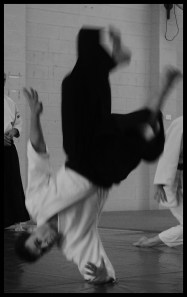
Aikido Warrior

Class Training Notes 19/1/2013

Another hot Saturday morning and another excellent turnout.  It’s always great to have guests drop in from other dojos.  This week we were fortunate to have Erwin Sensei (Nathan Dojo), Angela (Aikido Republic Dojo) and Neil (Aikido Republic Dojo) drop in for a visit.

Okay lets’ look at what we covered.

Third-third-third principle

The big emphasis this week was having regard to the third-third-third principle to maintain optimal balance. Under this principle, the distance between the feet is divided into thirds and the Aikido practitioner’s centre moves only within the middle third.  The principle applies regardless of whether you’re standing stationary (e.g. in hanmi) or moving.

The principle was explored in the Aiki Taiso (Exercises for Aikido arts) with particular reference to the Ikkyo, Sayu and Sayu choyaku exercises. It was also looked at in the context of applied techniques, including atemi (striking techniques).

Ukemi

Ukemi this week focussed on breakfalling.

I recently watched Erwin Sensei teach breakfalling by having the uke roll out multiples of times from a zenpo nage (projection technique), but each time rolling out smaller and smaller until they ultimately rolled out into a low breakfall.

I intended to cover this rather novel and natural approach to breakfalling in the class today.  It was an absolute bonus when Erwin Sensei decided to visit the dojo.  Big thanks to Erwin Sensei for agreeing to take this part of class and sharing his knowledge.

Yoko otoshi (side drop)

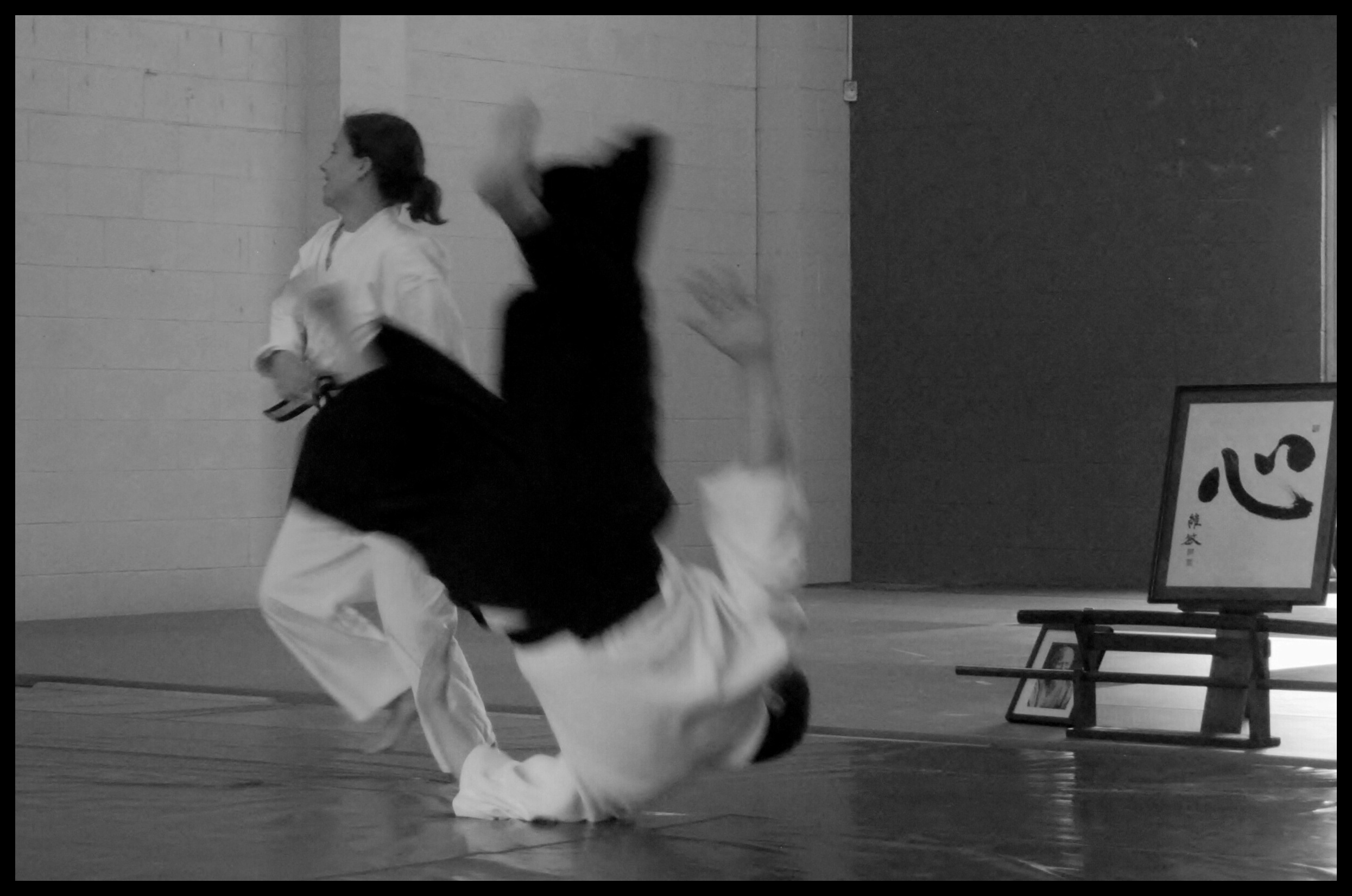
In terms of applied ukemi, the technique this week was yoko otoshi (side drop).  This technique really tests the uke’s ability to take ukemi from a strong projection.  The technique is also interesting as its one of the few sacrifice techniques in Aikido.

20100928081322(3)For those wishing to explore this some more, there are a few examples on You tube (e.g. see Aikido yoko otoshi).  You may also wish to search under uke waza which is the Judo equivalent to this technique.  Maruyama Sensei also covers the technique in one of his earlier instructional DVD’s (sorry no You Tube clips available).

Munetsuki techniques

At Susan’s request we covered menutsuki (punch to stomach or chest) techniques this week.  Techniques covered were as follows:

  • Menutsuki ushirodori (hold from behind)
  • Menutsuki koteagaeshi (outward wrist turn)
  • Menutsuki kirikaeshi (cut and return)
  • Menutsuki zenpo nage (forward projection) – using a single cut.

I particularly like menutsuki ushirodori – it’s simple, direct and effectiveIt’s one of those techniques that just seems to always work once you get the hang of the kuzushi (taking balance) part and the “wet blanket” feel when applying it.

Although slightly different from the munetsuki ushirodori we tend to do in our School, I found some interesting instruction on this technique in the following You Tube video.  What I like about this video is that it demonstrates the power that can be generated if the technique is done properly.

We also looked at responding to munetsuki strikes from the open side. To me, use of atemi (striking) is strongly advisable if the nage is going to avoid the possibility of a second strike from the uke’s other hand.  We looked at entering using Ikkyo atemi for this purpose (again employing third-third-third principle).

Taninzugake

With gradings coming up in a week’s time, taninzugake (multiple attacks) was a big part of the class.  Taninzugake is  particularly emphasised in our school as it gives students the opportunity to develop their techniques in free form practice.

I found this short taninzugake demonstration by Master Koretoshi Maruyama (the founder of Aikido Yuishinkai).  Those who haven’t seen it before may find it quite interesting.

All the best

Ian
Aikido without kuzushi – It’s like pizza without cheese

For Aikido to be practised with any element of martial integrity, the ability to employ kuzushi when applying a technique is a critical skill.

I would go as far as to say that in the absence of employing kuzushi it would be almost impossible to successfully apply any Aikido technique against a structurally centred and non-compliant aggressor of equal size and strength.

For those not familiar with the term kuzushi, it is most commonly used in a martial context as a reference to unbalancing the person who is initiating the attack (uke).  In other words, it involves bringing the uke’s center of gravity beyond their base of support and hence removing their ability to regain uncompromised balance.  While in this unbalanced position, it becomes very difficult for the uke to resist or counter the application of an appropriate Aikido technique.

While it all sounds so simple, learning to employ kuzushi is far from easy in practice. Amongst other things, it requires relaxed sensitivity, timing, and the ability to redirect an attacker’s energy.  If that isn’t challenging enough, kuzushi also needs to be employed at the time of first contact with the uke and then maintained throughout the application of the technique.

Unfortunately, I note there are a number of Aikido commentators around the web that appear to be concerned there is a trend in modern Aikido to de-emphasise and in some cases disregard the important role of kuzushi. I certainly hope these concerns are unfounded.

Excluding kuzushi from our practice would effectively render Aikido useless from a martial perspective.  For me, Aikido without kuzushi is like pizza without cheese. It’s not something I’m interested in trying.

Ian Grant
Head Instructor
Aikido Warrior Dojo


How to do a forward roll?

Roll 1For many people, learning to forward roll is probably one of the most challenging and frustrating parts of Aikido training.  I read recently that fear of rolling is one of the major reasons that people avoid taking up Aikido.  It is also apparantly one of the major reasons people leave.

Over the years, I have had the misfortune of witnessing way too many Aikido practitioners mistake a forward roll as some form of straight over the head circus tumble.  The end result is always the same – injury followed by fear.  This is particularly so if you try to circus tumble out of a correctly applied Aikido technique.

One of the most effective forward rolling methods that I have seen is that developed and applied by Donovan Waite Sensei (7th Dan).  This method of rolling is what is taught at our dojo.  Major benefits include that is more gentle on the body, easier to learn, and importantly martially effective.

For further information on falling arts in aikido – see our video library

Ian Grant
Dojo Cho
Aikido Warrior Dojo


Avoiding injury in Aikido training

It is only natural for anyone interested in taking up a martial art to be concerned about the potential for injury.  Fortunately, serious injuries in Aikido are quite rare.

Ian Grant (a) On its face this probably seems strange given that Aikido is a full contact martial art which amongst other things involves techniques where the attacker almost always ends up being sent to the ground.  The outcome can largely be attributed to the higher emphasis on safe practice advocated by the vast majority of dojo’s.

While safe practice is a without doubt everyone’s responsibility in the dojo, there are many simple things that an individual can do to minimise their chance of injury during training practice.  These include the following:

  • Always warm up

Make sure you get to class in time to participate in the preliminary warm up exercises.  If for some reason are late, take responsibility and do some warm up exercises prior to starting active practice.

  • Make learning ukemi (the art of falling) a priority

It cannot be emphasised enough that learning to fall and roll correctly out of techniques (i.e. ukemi) is absolutely critical to the practice of Aikido.  Practitioners who for whatever reason decide not to learn ukemi not only place themselves in a position where it almost impossible to become proficient in our martial art, but also place themselves at high risk of harm.

  • Learn to relax

Always easier said than done when you first start, but if you can maintain a relaxed state of mind and body during practice, your chance of injury significantly decreases.  Remember its much easier to snap a twig than a pillow.

  • Listen to the Sensei (teacher)

Your safety is the Sensei’s priority.  If the Sensei points out that a particular technique has the potential for risk take note of this and the stated ways of avoiding it.

  • Be aware of your surrounds

When practising techniques, remain aware that others are also sharing the mat – in short do not set yourself up to be thrown on another person.  Conversely, do not linger on the mat after receiving a technique.

  • Be honest about your abilities

Don’t train beyond your abilities.  If you need your partner to slow down or take it easy because you are getting out of your depth – be upfront.  Further, if your training partner for some reason is starting to rely on physical strength rather than technique or for any reason is getting rough, speak up and bring it to their attention.

  • Practise more than once a week

I recently read a report that a research study undertaken for a master’s thesis found that persons who practice Aikido less than twice a week or more than 5 times a week experienced a significantly higher injury rate than those who practised between 2-5 times a week. This is something you may wish to keep in mind when planning your training schedule.

  • Other factors 

In a study by Phillip Smith published in the Spring 2009 Edition of the Journal of Sports Therapy it was found that there appears to be no correlation between injuries in Aikido and any of the following factors –

  • grade of the student;
  • age of the student; or
  • years of practice.

Ian Grant
Head Instructor
Aikido Warrior Dojo