Aikido Warrior Dojo

Its marvellous what a difference atemi makes – Tsuki zenpo nage

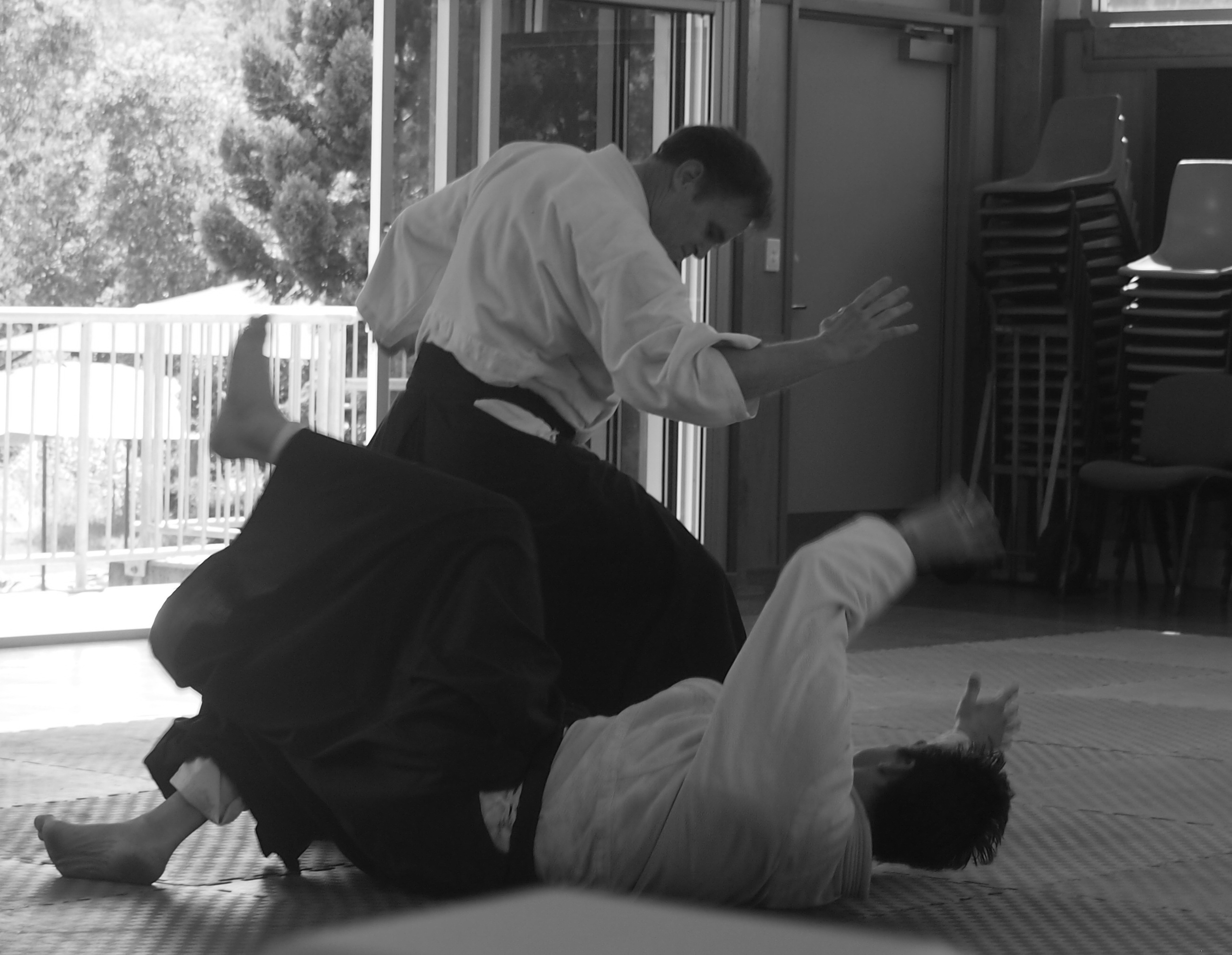
Tsuki zenpo nage is one of those techniques that for years had me baffled as to how it had any martial relevance  at all.  For those not familiar with the technique, it is more commonly seen in ki aikido dojos and basically involves the nage stepping to the side of a strike to the stomach, taking the uke’s arm and projecting them off.  The idea that a strike or thrust by a uke to a nage’s abdomen could ever result in the uke being able to be projected forward into an unavoidable roll-out in this manner always seem far fetched to me.  Further, I had never had anyone actually be able to do it to me without my full cooperation.  In the end I began to see the technique as nothing more than a rolling exercise.

Recently I came across a black and white video recorded sometime in the 90’s that included a range of hiji waza (elbow techniques).  To my surprise I recognised a hiji waza technique that was clearly tsuki zenpo nage in its martial form – Tsuki hiji nage.

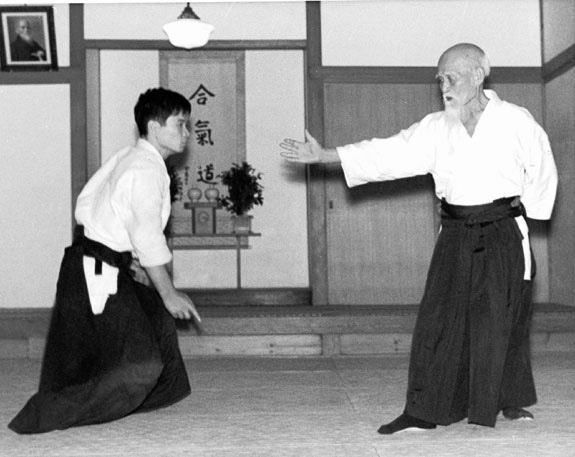
So how did it differ?  Firstly the nage commenced the technique with a double strike to the uke’s abdomen and temple to break the uke’s balance at first instance (see photo of O’sensei at right).

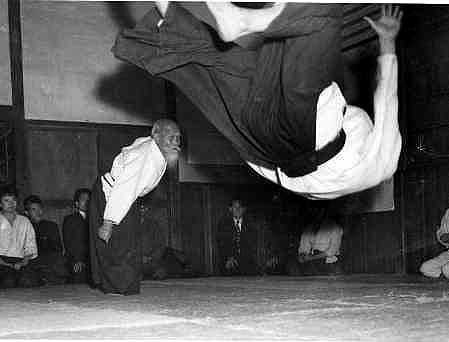
This then easily segued into a locking of the elbow joint which in turn enabled the nage to continue to take the uke’s balance and then project them forward into an unavoidable roll. Any other response by the uke (eg resisting the roll out) would risk serious elbow damage.

Notably in the more typical Tsuki zenpo nage the elbow locking, as well as the atemi, was completely omitted.

Unfortunately, what has happened here is an example of an Aikido application being watered down (presumably for safety or philosophical reasons) to the point it had become martially irrelevant.  By removing the atemi (strike) and the elbow lock, the essence of the technique had become completely lost turning it into no more than an aided rolling or blending exercise.

Far more concerning, however, is that many of the Aiki principles underpinning the technique (you know what we are actually supposed to be learning) had been completely stripped from its application.  These include balance breaking, entering while moving off-line, “heaven-man-earth”, and nage/uke sensitivity and connection, and ukemi responses from an off-balanced position.

In the below video seniors from our dojo can be seen practising  Tsuki zenpo nage with the atemi and elbow lock included in the application.  In some instances, the nage also takes the added precaution of üsing their hip to provide added assurance that kuzushi (balance breaking) is maintained throughout.


Have a great week

Ian Grant
Dojo Cho
Aikido Warrior Fudoshin Dojo, Brisbane


Training notes: Ai hanmi katatedori hiji nage

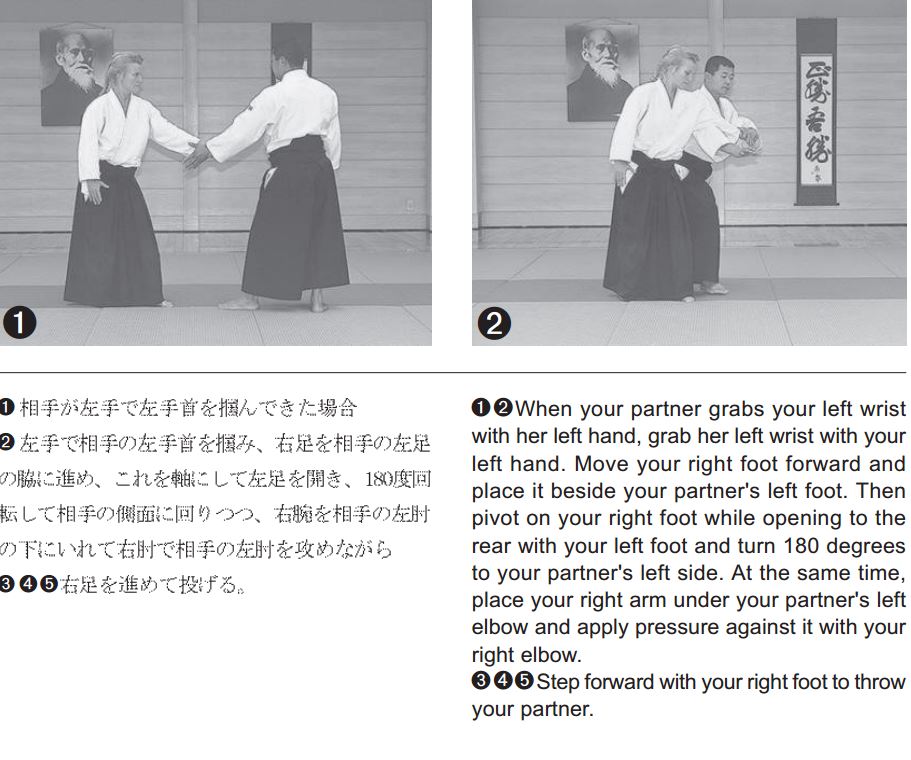
Hiji waza (elbow techniques) are always practised with a high degree of caution.  These forms of Aiki applications rely on pressure either being applied to the elbow joint or alternately locking the elbow joint to facilitate the balance taking necessary to execute the throw.

In the below video seniors from our dojo demonstrate one of the most basic forms of hiji waza – Ai hanmi katatedori hiji nage (sometimes also referred to as kosadori hiji nage).  This particular type of projection is practised from an attack in the form of an opposite single hand grab to the wrist.

Notably in some schools the technique is labelled as a form kokyu nage (breath throw).  This is most appropriate given the kokyu ho based movement underpinning the application.


ADDITIONAL NOTES

  • Demonstration – Morihiro Saito Sensei


  • Takemusu Aikido (volume 4)


  • Alternate projection application

In the below video S Crane Sensei demonstrates and provides instruction for an alternate elbow projection application referred to as Ai hanmi katatedori hiji kime.


Aiki Studies – Absorbing and redirecting an attack

In the below video Chicko Xerri Sensei explores some of the key Aiki principles and concepts for absorbing and redirecting an attack.  These principles and concepts include:

  •  Waiting until the attack is fully committed before attempting to defeat it;
  • Timing when addressing an attack;
  • Using equal energy contact in Aikido practice;
  • Responding to an attack by welcoming, absorbing and then creating technique.


  • chicko-senseiChicko Xerri Sensei – Brief Bio

Our dojo is a Fudoshin dojo operating under the guidance and mentorship of  Chicko Xerri Sensei, 6th dan AKI (Aikikai), Tokyo.  Chicko Sensei has been practising and teaching Aikido for more than 40 years and is endorsed by Doshu Ueshiba.

Have a great week

Ian Grant
Dojo Cho
Aikido Warrior Fudoshin Dojo


Aiki principles – Yokomen is shomen

yokomen-morihei-ueshiba-arm-extende1In the below video Chicko Xerri Sensei explores the Aiki principles underpinning a yokomen strike or cut in Aikido practice.

Yokomen is described in the Founders 2nd text, Budo (1938), as a “blow to the side of your partner’s head or down diagonally across (their) shoulder with your te-gatana (hand sword)”.

The importance of yokomen training in Aikido is also discussed in the text.  Of particular note is the statement that training in yokomen attacks “…contains the essence of all techniques“.


ADDITIONAL NOTES

  • Yokomenuchi basics – Mike Jones Sensei – NY Aikikai


  • chicko-senseiChicko Xerri Sensei – Brief Bio

Our dojo is a Fudoshin dojo operating under the guidance and mentorship of  Chicko Xerri Sensei, 6th dan AKI (Aikikai), Tokyo.  Chicko Sensei has been practising and teaching Aikido for more than 40 years and is endorsed by Doshu Ueshiba.

Have a great week

Ian Grant
Dojo Cho
Aikido Warrior Fudoshin Dojo


Learnings from the sword – Dealing with shoulder grabs

Ian Grant SenseiA key aspect of our practice at the dojo is to use traditional sword movements to enhance and improve our unarmed arts.  Our practice in this regard incorporates the use of a wide range of bokkens including the shoto (short sword), suburito and Musashi oar.

Exploring Aikido in this way is in line with comments made by Master Morihei Ueshiba (The Founder of Aikido) that Aikido at its essence is a form of taijutsu that incorporates traditional sword principles

In the below video Ian Grant and Jeremy Gehrke Sensei use the short sword to explore the Aiki principles associated with absorbing and redirecting an an attack in the form of a shoulder grab (katadori).


ADDITIONAL NOTES

  • Aiki principles and katadori

In the below video Chicko Xerri Sensei explores some of the key Aiki principles that underpin Aikido forms to address an attack from a shoulder grab. An integral part of the instruction in both videos is the use of the bokken to enhance understanding of the basic movements used in this type of practice.


  • chicko-senseiChicko Xerri Sensei – Brief Bio

Our dojo is a Fudoshin dojo operating under the guidance and mentorship of  Chicko Xerri Sensei, 6th dan AKI (Aikikai), Tokyo.  Chicko Sensei has been practising and teaching Aikido for more than 40 years and is endorsed by Doshu Ueshiba.

Have a great weekend

Ian Grant
Dojo Cho
Aikido Warrior Fudoshin Dojo