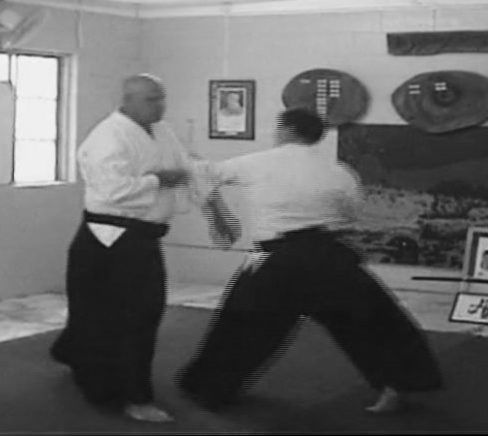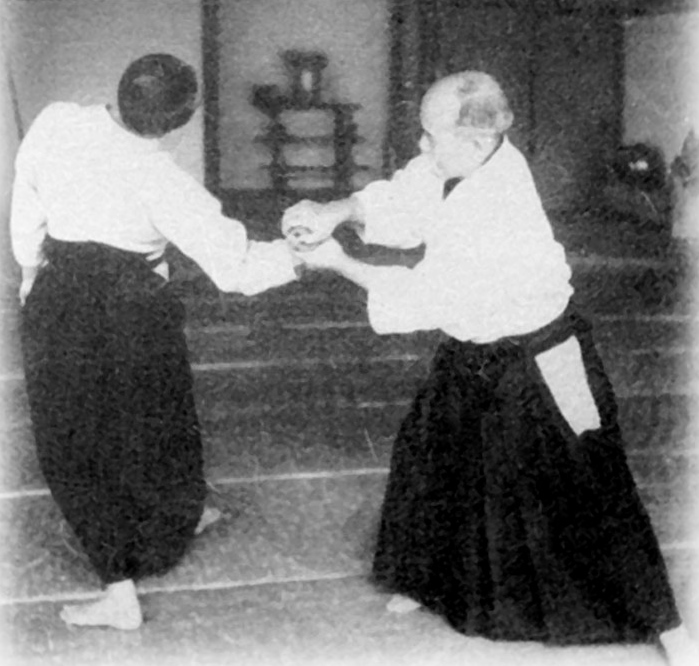
Aikido self-defence

Training Notes: Ushiro ryotedori kotegaeshi

kotegeashi is an outward wrist turn and traditionally is broadly categorised in Aikido as a kaiten (open and turn) technique.

In the below video Morihiro Saito Sensei demonstrates how kotegaeshi may be applied in circumstances where the uke has pinned the nage’s hands behind their back.

Depending on the Aikido style, the technique is referred to as Ushiro ryotedori kotegaeshi or Ushiro tekubidori kotegaeshi .


ADDITIONAL NOTES

  • How to release the grip – Pictorial illustration


  • Additional details 

In the below video, Sensei Andy Hathaway of the London Aikido Club explores the Aiki principles underpinning Ushiro ryotedori kotegaeshi .  Hathaway Sensei emphasises the importance of getting off-line and the use of balance breaking principles to effectively execute the technique. These principles are particularly important where the uke has a strong grip on the wrists.


  • Ki aikido approach

In the below video, Koretoshi Maruyama Sensei demonstrates how ushiro ryotedori kotegaeshi  is practised in  Aikido Yuishinkai.  The method of practice is typical of that found in many ki aikido schools inspired by the teachings of Koichi Tohei Sensei.


Have a great week.

Ian Grant
Head Instructor
Aikido Warrior Dojo
Training Notes: Yokomenuchi kokyu nage

Yokomenuchi kokyu nage 3In the below video Master Koretoshi Maruyama, Founder of Aikido Yuishinkai, demonstrates and provides instruction on the Aikido technique, yokomenuchi kokyu nage (irimi), as is practiced in our school.

The technique is performed as a response to a yokomenuchi strike, which is a side blow to the head.

Yokomenuchi kokyu nage is a particular useful technique for developing fundamental skills in timing, entering and directly meeting an attack without clashing.  We have also found at the dojo that with slight modifications, yokomenuchi kokyu nage (irimi) can be used to effectively deal with non-traditional strikes, including for example a hook punch.


ADDITIONAL NOTES

  • Origins of technique

Yokomenuchi kokyu nage (irimi) has a long history in Aikido. The technique appears as technique number 42 in O’senseis first technical manual “Budo Renshu” (1934).  The notable difference in this early version is that the nage cuts down through the uke‘s neck and also cuts down and then hold’s the wrist of the uke’s attacking arm.  (See O’senseis drawings below).

However, the kokyu ho principles necessary to effectively apply the technique remain the same.

Drawing (1) No 42

Drawing 2 no 42


Kokyu nage - OsenseiIn O’sensei’s 2nd manual “Budo” (1938) the roles of nage and uke for the technique are described as follows:

Uke: Deliver a yokomen strike with your right hand.  “Tori (i.e. nage): Step forward on your left foot and use your left te gatana (i.e. hand sword) to neutralise your opponent’s attack, simultaneously striking his face  (and down him).”


  • Kokyu ho principles underpinning technique

Kokyu ho exercises are something that we do a lot of at our dojo as a means of developing internal strength in our techniques.  Kokyu ho exercises were the traditional method used by O’sensei to develop “ki power” in his Aikido.

In the below video, Morihei Saito Sensei demonstrates and explains the kokyu ho exercise relevant to yokomenuchi kokyu nage (irimi).


Ian Grant
Head Instructor
Aikido Warrior Dojo, Brisbane


Training Notes: Irimi principles for munetsuki

Irimi munetsukiIn the below video, Peter Kelly Sensei, Aikido Yuishinkai,  examines the principles for effective entering (irimi) when dealing with a direct strike to the torso (munetsuki).

A key aspect of the instruction is how to avoid being tracked. This aspect of effective Aikido technique is unfortunately too-often neglected in training.  The fact remains, however, it is surprisingly easy for a uke to track a nage when executing a strike unless the nage meets the strike rather than attempts to avoid it.

There is no doubt that training to meet a strike requires significant repetitive practice to acquire the necessary “mechanical” and timing skills.  Even more challenging, however, is the psychological “rewiring” necessary to retrain our minds to initially enter into an oncoming strike rather than try to dodge or otherwise move away from it.  In the words of O’Sensei – “One should be prepared to receive ninety-nine percent of an enemy’s attack and stare death right in the face in order to illumine the path.”

Have a great week.

Ian Grant
Dojo Cho
Aikido Warrior Dojo, Brisbane

Training notes – Katadori kokyu nage (hiji nage)

In the below video, Koretoshi Maruyama sensei, Founder of Aikido Yuishinkai, provides training tips for Katadori kokyu nage as practised in his school.

A key aspect emphasised in the instruction is the use of the ude mawashi movement commonly seen in solo kata exercises to deflect the strike and take the uke to an off-balanced position. The unbalanced uke is then projected.

Recorded 2003 at Byron Bay, Austalia.

Have a great week

Ian Grant
Dojo Cho
Aikido Warrior Dojo


Working with resistance – Static hand grabs

A standard feature of our practice at the dojo is to train with static hand grabs where strong physical resistance is applied by the uke (the attacking partner). There are many benefits to this type of training, not the least of which is that we have found it to be an effective method of gaining a practical appreciation of the fundamental principles that underlie Aikido based movements and body structure.

morihei-ueshiba-noma-throwPlease be assured that I am not in any way derogating kotai (static) practice where the uke offers full cooperation or at most a dead weight. Far from it and in fact we also include this practice at the dojo. However, if one only practices in this way the risk is the development of an unstated understanding that Aikido can only operate in a static situation with a cooperative uke.

The below video is an informal demonstration of a number of Aikido options for dealing with static hand grab attacks where the attacker is using high levels of physical strength. The demonstrated techniques are performed slowly and with every effort made not to respond with physical strength solutions, but rather responses based on Aikido principles, including those associated with kokyu. The possibility of using atemi (striking) was intentionally excluded to make the exercises more difficult.

Please note the techniques and attack options are not intended to be exhaustive, merely illustrative. The attacks were selected randomly based on what popped into our heads at the time. The Aikido responses were similarly not pre-planned and were selected at random based on what “felt right” to each of us in each circumstance.

Finally, a huge thanks to Eden for dropping down to the dojo and recording the video. Also to my training partner, Jeremy, who graciously agreed to appear in the recording and basically “wing it”.

Ian Grant
Head Instructor
Aikido Warrior Dojo, Brisbane