Aikido in Tasmania

Training notes: Ryotedori yonkyo

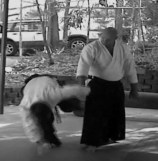
Yonklyo - Peter Kelly SenseiIn the below video, Peter Kelly Sensei, Chief Instructor Aikido Yuishinkai Australia, provides instruction on how to perform ryotedori yonkyo.

A key aspect of Peter Sensei’s instruction is the notion that yonkyo (No 4 wrist technique) is not at its essence intended to be a technique to control a uke by inflicting wrist pain.  Rather it is a method of hyper-extending the uke’s shoulder to control their centre.


ADDITIONAL NOTES

  • Hand position – Initial shoulder extension

Yonkyo 3 Yonkyo5


  • Yonkyo pin

Yonkyo pin

Yonkyo pin close up


  • Ryotedori kokyu nage

The set up for ryotedori yonkyo as (demonstrated in the video) is the same as for ryotedori kokyu nage.  For notes on ryotedori kokyu nage (including its set up) – see Training notes: Ryotedoru kokyu nage (and koshi nage).

  • Yonkyo basics

For notes on the basic principles of yonkyo (including video of Maruyama Sensei teaching the technique) see – Training Notes – Yonkyo (the basics)

Have a great week

Ian Grant
Head Instructor
Aikido Warrior Dojo


Bokken exercises: Kiri age

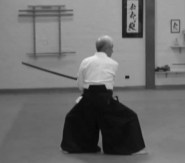
kiriageThe practice of bokken (wooden sword) arts is an integral part of Aikido training in Aikido Yuishinkai.  Amongst other things, solo and paired bokken practice plays an important role in helping develop key skills for unarmed arts.  These skills include foot work, distance, timing, centred movement, relaxed power and correct posture.

In the below video Master Koretoshi Maruyama, Founder, Aikido Yuishinkai demonstrates the fundamental foot work and cutting movements for the solo bokken exercise kiri age (vertical upper cut).

Aikido Warrior Dojo - Bokken kataOne of the key benefits of this exercise is that it facilitates internalisation of moving the body as a single entity rather than moving the arms disconnected from the body.  Those interested in studying advanced internal principles (e.g. yin  yang) in Aikido movement will also find the exercise of interest, particularly if they use a heavier bokken such as a “Musashi oar”.

From a purely mechanical and physical perspective, kiri age also helps develop powerful upper cut atemi (age tsuki) and is a great workout for the thighs and “glutes”.


Other bokken exercises

For other Aikido related bokken exercises see – Bokken arts library.

Have a great week.

Ian Grant
Head Instructor
Aikido Warrior Dojo


Training notes: Ushiro tekubidori kaiten nage

kaiten 2 JPGIn modern Aikido kaiten techniques are typically referred to as “wheel throws” because the uke is projected in a wheel like shape. Traditionally, however, they were referred to as “open and turn” techniques.  In the text “Budo“, Master Morihei Ueshiba  describes kaiten as a turn and transform movement.

In the below video Master Koretoshi Maruyama demonstrates and provides instruction for ushiro tekubidori kaiten nage as practised in our school.  The technique is trained as a response to a traditional attack where both hands of the nage are grabbed from behind with the intent to place a knee in the nage’s back.

Depending on the school of Aikido, the technique is also sometimes referred to as ushiro ryotedori kaiten nage.


Additional notes

  • Similar beginning as ushiro tekubidori ikkyo

The beginning segments of ushiro tekubidori kaiten nage are the same (up to the downward cut movement) as ushiro tekubidori ikkyo at ryutai level. For notes on this technique, including the entry and set up see: Training notes: Ushiro tekubidori ikkyo (ryutai).

  • Other kaiten nage applications 

For training notes on other applications of kaiten nage see Video Library: Unarmed arts (by technique).  Technique groups (e.g. ikkyoirimi nage etc.) are ordered alphabetically.

  • Other ushiro tekubidori techniques 

For training notes on other Aikido techniques that are practised from a ushiro tekubidori attack, see Video Library: Unarmed arts (by attack type).  In the library, techniques are ordered alphabetically based on attack types (e.g. katadori, katatedoriushiro tekubidori etc.).

Have a great week.

Ian Grant
Head Instructor
Aikido Warrior Dojo


Munetsuki kokyu nage – Aikido Yuishinkai

kokyu nage munetsukiIn the below video Master Koretoshi Maruyama, Founder of Aikido Yuishinkai, demonstrates and provides instruction for one of the versions of munetsuki kokyu nage The technique is  categorised as a “breath throw” and is practised as a response to a strike or thrust to the stomach (munetsuki).

From a superficial mechanical perspective, the technique appears deceptively straightforward. In reality, however, it can be quite challenging to successfully perform.  It requires substantive skills in entering, timing, sinking, maintaining centre pole and moving as a single relaxed unit.

Further, like most more advanced Aikido techniques the uke’s balance is not taken by movements of the nage’s upper body, but by the correct movement of the nage’s lower half of their body. The nage’s hand on the uke’s arm is merely the connection point.

One of the training advantages that we have found at the dojo with this particular version of munetsuki kokyu nage is that the internal skills and aikido principles necessary to perform it offer a “gateway” to learning other advanced techniques, including for example munetsuki kaitenage.


Have a great weekend.

Ian Grant
Dojo Cho
Aikido Warrior Dojo


Yokomenuchi shiho nage

Osensei shihonage (6)Shiho nage (4 directions throw) is one of the most important, if not the most important pillar technique in Aikido training. It contains within it the root of every Aikido technique and there is no doubt its proper execution relies on the nage applying all of the fundamental principles that underlie Aikido practice.

In the below video Morihiro Saito Sensei Sensei demonstrates the omote and ura forms of the Aikido technique  Yokomenuchi shiho nage. This form of shiho nage is practised in response to an attack in the form of a side downward blow to the temple area (yokomenuchi).


ADDITIONAL NOTES

  • Technical notes – Morito Suganuma Sensei 

In the below video Morito Suganuma Sensei (8th dan Aikikai) demonstrates and provides instruction for Yokomenuchi shiho nage.  The instruction incudes both the omote and ura applications.


  • Initial setup –  Technical notes


  • Omote application (1) – Technical notes – London Aikido Club

In the following video Sensei Andy Hathaway of the London Aikido Club gives detailed instruction on the traditional application of Yokomenuchi shiho nage (omote) as practised by the Founder of Aikido in the immediate post-war period.  


  • Omote application (2) – Technical notes – Yoshimitsu Yamada Sensei


  • Ura application – technical notes – Yoshimitsu Yamada Sensei


  • Alternate application (1) – Christian Tissier Sensei

In the below video Christian Tissier Sensei (8th Dan Aikikai) demonstrates an alternate application of shiho nage yokomenuchi where the nage directly enters to respond to the attack.


  • Alternate application (2) – Aikido Yushinkai

In the below video, Peter Kelly Sensei, Aikido Yuishinkai, demonstrates and provides instruction for an alternate application of yokomenuchi shiho nage.  The video was recorded at a mini seminar at our Dojo in 2015.


Have a great weekend.

Ian Grant
Dojo Cho
Aikido Warrior Dojo