Aikido in Brisbane

Ukemi options – Shiho nage

ShihonageUkemi (falling arts) is something that we give a lot of emphasis at our dojo.  Apart from the training insights it gives us into our Art, learning to safely receive technique is critical.

As we progress in our studies and begin to receive techniques in a more fluid training environment, the need to learn more options to receive techniques becomes paramount.  In short, we need to be able to safely fall regardless of the technique variation that is applied or the fact that it may not be strictly text book in execution.

By way of example, the below informal video shows seniors at our dojo receiving various forms of ukemi from yokomenuchi shiho nage (4 corners throw), including rolling and breakfalls.

Have a great day.

Ian Grant
Head Instructor
Aikido Warrior Dojo


Munetsuki irimi nage – Learning from O’Sensei

See below a short video taken at the dojo where we explored munetsuki irimi nage as illustrated in O’Sensei‘s 1938 text “Budo“.


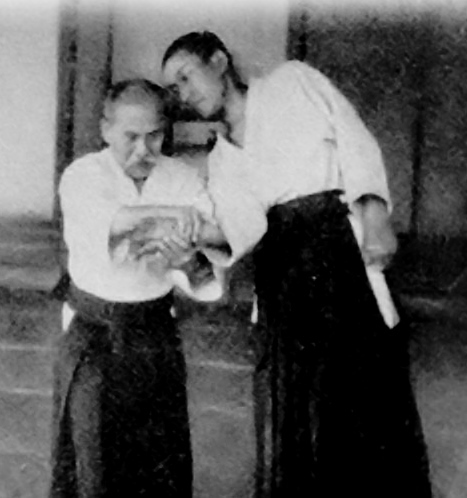
Although difficult to see in the below photo demonstrations featuring  O’Sensei, a key technical aspect of the technique is the placement of the nage’s hand on the upper part of the uke’s shoulder.  As the technique is executed, this hand eventually ends up immediately below the nage’s armpit.  Relaxed and centred execution of the technique is essential to avoid any clash and achieve the necessary off-balancing of the uke.

4

For the uke, receiving the technique feels a bit like hitting a “wall of feathers”. As you would have noticed in the video, we also played with adding extra atemi. It makes receiving the ukemi a bit more challenging in terms of uke sensitivity but is well worth the experiment.

Big thanks to dojo senior Peter Marendy for joining me in the demo and to Eden for filming it.

ADDITIONAL NOTES

  • Munetsuki irimi nage – A deeper look 

In the below videos Morihiro Saito Sensei (1928-2002) provides instruction on the traditional version of  munetsuki irimi nage as practised by O’Sensei (the Founder of Aikido) in the immediate post-war period of his life. Notably the method of execution is the same as that outlined in the “Budo” text.

  • Brief Biography – Morihiro Saito Sensei (1928-2002)

saito_seiza_260Morihiro Saito Sensei’s  practice of Aikido spanned 56 years and he is one of the most important teachers in Aikido history.  Saito Sensei was a live-in student of O’sensei for more than 20 years at his home dojo in Iwama, Japan.

Saito Sensei spent his teaching life dedicated to preserving the technical style of Aikido as practised and shown to him by O’sensei in the post-war period.  Without his commitment to preserving the Aikido of the Founder and extensive efforts to record and document his teachings, much of the Aikido of O’sensei would have been lost.

All the best

Ian Grant
Dojo Cho
Aikido Warrior Dojo


Working with resistance – Static hand grabs

A standard feature of our practice at the dojo is to train with static hand grabs where strong physical resistance is applied by the uke (the attacking partner). There are many benefits to this type of training, not the least of which is that we have found it to be an effective method of gaining a practical appreciation of the fundamental principles that underlie Aikido based movements and body structure.

morihei-ueshiba-noma-throwPlease be assured that I am not in any way derogating kotai (static) practice where the uke offers full cooperation or at most a dead weight. Far from it and in fact we also include this practice at the dojo. However, if one only practices in this way the risk is the development of an unstated understanding that Aikido can only operate in a static situation with a cooperative uke.

The below video is an informal demonstration of a number of Aikido options for dealing with static hand grab attacks where the attacker is using high levels of physical strength. The demonstrated techniques are performed slowly and with every effort made not to respond with physical strength solutions, but rather responses based on Aikido principles, including those associated with kokyu. The possibility of using atemi (striking) was intentionally excluded to make the exercises more difficult.

Please note the techniques and attack options are not intended to be exhaustive, merely illustrative. The attacks were selected randomly based on what popped into our heads at the time. The Aikido responses were similarly not pre-planned and were selected at random based on what “felt right” to each of us in each circumstance.

Finally, a huge thanks to Eden for dropping down to the dojo and recording the video. Also to my training partner, Jeremy, who graciously agreed to appear in the recording and basically “wing it”.

Ian Grant
Head Instructor
Aikido Warrior Dojo, Brisbane

Round-up: Peter Kelly Sensei class and 1st kyu gradings (22 April 2015)

On Wednesday 22 April 2015, I had the privilege to grade two of our dojo founding members, Peter and Jeremy, to 1st kyu (brown belt) in Aikido Yuishinkai. The event was made extra special by our Chief Instructor, Peter Kelly Sensei, also attending and afterwards giving an informal “by request” format class.

Grading notes

OLYMPUS DIGITAL CAMERAA major emphasis in our dojo (and Aikido Yuishinkai Australia generally) over the last 18 months is that development of technical and internal art skills is contingent upon our ukemi skills continuing to develop along with them at the same rate.

With this in mind, Peter and Jeremy not only demonstrated the necessary techniques in taninzugake (free form) practice to fulfil their promotion requirements but also demonstrated they could readily receive them as well. I think it would be fair to say that the high quality of their ukemi was very much on display and did them both proud.

By way of more general comment, Peter and Jeremy are two of the most committed aikido practitioners I have ever met and very much embrace the training spirit that underpins Aikido practice. They are more than deserving of the hakamas they now wear and congratulations to them both.

Training notes – By request class  

For those not familiar with this style of class, essentially it involves Peter Sensei giving instruction and assistance with techniques in response to queries raised by the students on the mat. Unlike last year’s similar class where koshinage and ikkyo were the focus, this year it was kaite nage (“wheel throw”) and shiho nage (4 direction throw) applications which inspired the questions. Irimi nage (entering throw) and kokyu nage (breath throw) were also explored.

Key training tips and links to relevant video extracts from the class can be found below.

Commemorative video

As we often do at our dojo when an event occurs, we cobble together the best of our photos and video, to put together a visual memento of the occasion for our dojo record books.

Acknowledgments

A big thank you to Peter Sensei for visiting our dojo and our friends from Griffith Aikido Institute for supporting our grading and joining us in our Wednesday class. It was also great to have family and friends of Jeremy and Peter over to visit the dojo and join us for the gradings.

Last but certainly not least, a personal thanks to our dojo members for not only giving their all as ukes and nages on the night, but for making our dojo such a great place to train every other night as well. Thumbs up also to our wonderful admin team (Desiree, Eden and Darcy) who keep the dojo cooking behind the scenes.

Ian Grant
Head Instructor
Aikido Warrior Dojo


Training notes: Yokomenuchi shiho nage (ryutai level)

budo-shihonage-640Shiho nage (4 directions throw) is one of the most important, if not the most important pillar technique in Aikido training. It is commonly considered to contain within it the root of every Aikido throwing technique and there is no doubt its proper execution relies on the nage applying all of the fundamental principles that underlie Aikido practice.

The name of the technique stems from the fact that a skilled nage can throw the uke in any of 4 directions. In reality, however, it is possible for the 4 directions to be extended to 8. This ability to effect the technique in any direction makes shiho nage particularly attractive from a self-defence perspective, especially if dealing with multiple attackers.

FotorCreated


The below video examines various aspects of shiho nage in the context of a response to a circular blow to the face (yokomenuchi). The technique is demonstrated at ryutai (flowing forms) level from the Aikido Yuishinkai syllabus.

The demonstration is from a class at Seishin no Shugyo Dojo in Tasmania by Peter Kelly Sensei, Chief Instructor, Aikido Yuishinkai Australia.  Peter Sensei’s instruction emphasises the correct application of the change in direction cutting movement necessary for the successful execution of the technique.

Ian Grant
Head Instructor
Aikido Warrior Dojo