All posts

Training notes: Ryotedori seoi otoshi

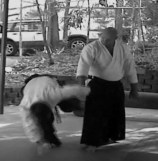
While by no means the most commonly practised “drop” technique, seoi otoshi (or “shoulder drop”) has been part of Aikido since its early days.

In the below video, students from our dojo are practising the technique from a traditional where both of the nage’s wrists are grabbed (ryotedori). This form of practice is excellent for ukemi training and developing aerobic fitness for the nage.


ADDITIONAL NOTES

  • Technical notes

In the following video Peter Kelly Sensei of Aikido Yuishinkai (Tasmania) provides technical instruction for the technique.


ADDITIONAL NOTES

  • Ryotedori kokyu nage

The set up for ryotedori seoi otoshi (as demonstrated in the video) is the same as for ryotedori kokyu nage.  For notes on ryotedori kokyu nage (including its set up) – see Training notes: Ryotedoru kokyu nage (and koshi nage).

  • Difference between seio otoshi and seio nage

Seio otoshi - Ian Grant SenseiThe difference between a seio otoshi (shoulder drop) and seio nage (shoulder throw)  is often a source of confusion. For discussion on the technical differences between the two technique types see – Seio otoshi and seio nage – Whats the difference?

Have a great week.
Ian Grant
Head Instructor
Aikido Warrior Dojo, Brisbane

Training notes: Ryotedori yonkyo

Yonklyo - Peter Kelly SenseiIn the below video, Peter Kelly Sensei, Chief Instructor Aikido Yuishinkai Australia, provides instruction on how to perform ryotedori yonkyo.

A key aspect of Peter Sensei’s instruction is the notion that yonkyo (No 4 wrist technique) is not at its essence intended to be a technique to control a uke by inflicting wrist pain.  Rather it is a method of hyper-extending the uke’s shoulder to control their centre.


ADDITIONAL NOTES

  • Hand position – Initial shoulder extension

Yonkyo 3 Yonkyo5


  • Yonkyo pin

Yonkyo pin

Yonkyo pin close up


  • Ryotedori kokyu nage

The set up for ryotedori yonkyo as (demonstrated in the video) is the same as for ryotedori kokyu nage.  For notes on ryotedori kokyu nage (including its set up) – see Training notes: Ryotedoru kokyu nage (and koshi nage).

  • Yonkyo basics

For notes on the basic principles of yonkyo (including video of Maruyama Sensei teaching the technique) see – Training Notes – Yonkyo (the basics)

Have a great week

Ian Grant
Head Instructor
Aikido Warrior Dojo


Budo (1938): Tachi dori shomen giri kotegaeshi

Bokken kotegaishi 2 osenseiIn 1938 Master Morihei Ueshiba, the Founder of Aikido, finalised the 2nd of his 3 technical texts.  Simply titled “Budo“, the text contains a sampling of techniques from a wide range of attacks, including grabs, strikes and attacks from different weapons.

Budo” is an important reference point for our practice at Aikido Warrior Dojo. The techniques and principles referred to therein are regularly practised.

Interestingly, the Founder only included 3 tachi dori techniques in his 2nd text.  One of these was tachi dori showmen giri kotegaeshi.

The below video features a photographic demonstration tachi dori shomen giri kotegaeshi as it appears in “Budo”.  Also included are demonstrations of the technique by Morihiro Saito Sensei who was a direct student of the Founder for more than 20 years.


ADDITIONAL NOTES

  • O’sensei’s explanation of tachi dori shomen giri kotegaeshi (1938)

In O’sensei’s manual “Budo” (1938), there is substantive instruction given for tachi dori shomen giri kotegaeshi.  In edited form, it reads as follows:

As soon as your opponent cuts, move with the speed of the gods and enter deeply to the right with irimi tankan.  Strike your opponents right wrist with your left te-gatana (hand sword), remain aware of possible attackers to the rear and strike your opponent’s face with your right fist…

Apply …kotegaeshi .. and down your opponent.  In this case it is necessary to control his hand and sword with the little and ring fingers of your right hand.  Next turn your opponent round to the left, pin him face down, take the sword and hold it to his neck

  • Hand position for take down and wrist pin

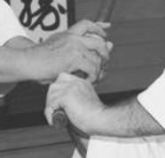
The traditional hand position on the bokken for the takedown to the mat and wrist pin is shown in the pictures below.  Note the hilt of the bokken is grabbed with the nage’s right little finger and ring finger. The nage’s left thumb is at the base of the uke’s right ring finger.

Bokken kotegaeshi 2JPG

Bokken kotegaeshi


  • Atemi

strike kotegaeshiAt the completion of the irimi tenkan movement there is the option of atemi in the form of striking the uke’s face with your right hand.

Practice of atemi in this way is a most useful practice tool to assist in learning the correct positioning for the technique.

 Have a great week.

Ian Grant
Head Instructor
Aikido Warrior Dojo


Training notes: Tachi dori shomen giri kokyu nage

In the below video Peter Brady Sensei ((7th Dan Aikikai) demonstrates and provides instruction for the Aikido technique – kokyu nage (breath throw).  The technique is demonstrated as a response to a downward strike to the head (shomenuchi) where the uke is armed with a wooden sword (bokken).


ADDITIONAL NOTES

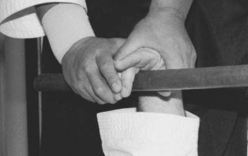
  • Hand position on hilt of the bokken

Bokken tori 1


  • The elbow debate 

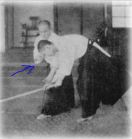
Bokken3JPGThere are contrasting views on whether the nage should place their right elbow under the left elbow of the uke and apply pressure to the uke‘s elbow to take their balance (before attempting to project the uke).  This approach can be seen in the picture to left.

The diverging opinions appear to be based on philosophical and stylistic differences, including differing perspectives on the role of kuzushi and uke compliance in Aikido practice.  That being said, there is no doubt this applied kokyu ho approach is a martially effective option and was practised by O’sensei in the post war period of his training.

Have a great week.

Ian Grant
Head Instructor
Aikido Warrior Dojo


Bokken exercises: Kiri age

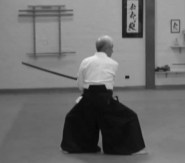
kiriageThe practice of bokken (wooden sword) arts is an integral part of Aikido training in Aikido Yuishinkai.  Amongst other things, solo and paired bokken practice plays an important role in helping develop key skills for unarmed arts.  These skills include foot work, distance, timing, centred movement, relaxed power and correct posture.

In the below video Master Koretoshi Maruyama, Founder, Aikido Yuishinkai demonstrates the fundamental foot work and cutting movements for the solo bokken exercise kiri age (vertical upper cut).

Aikido Warrior Dojo - Bokken kataOne of the key benefits of this exercise is that it facilitates internalisation of moving the body as a single entity rather than moving the arms disconnected from the body.  Those interested in studying advanced internal principles (e.g. yin  yang) in Aikido movement will also find the exercise of interest, particularly if they use a heavier bokken such as a “Musashi oar”.

From a purely mechanical and physical perspective, kiri age also helps develop powerful upper cut atemi (age tsuki) and is a great workout for the thighs and “glutes”.


Other bokken exercises

For other Aikido related bokken exercises see – Bokken arts library.

Have a great week.

Ian Grant
Head Instructor
Aikido Warrior Dojo