Peter Kelly Sensei

Round-up: Peter Kelly Sensei class and 1st kyu gradings (22 April 2015)

On Wednesday 22 April 2015, I had the privilege to grade two of our dojo founding members, Peter and Jeremy, to 1st kyu (brown belt) in Aikido Yuishinkai. The event was made extra special by our Chief Instructor, Peter Kelly Sensei, also attending and afterwards giving an informal “by request” format class.

Grading notes

OLYMPUS DIGITAL CAMERAA major emphasis in our dojo (and Aikido Yuishinkai Australia generally) over the last 18 months is that development of technical and internal art skills is contingent upon our ukemi skills continuing to develop along with them at the same rate.

With this in mind, Peter and Jeremy not only demonstrated the necessary techniques in taninzugake (free form) practice to fulfil their promotion requirements but also demonstrated they could readily receive them as well. I think it would be fair to say that the high quality of their ukemi was very much on display and did them both proud.

By way of more general comment, Peter and Jeremy are two of the most committed aikido practitioners I have ever met and very much embrace the training spirit that underpins Aikido practice. They are more than deserving of the hakamas they now wear and congratulations to them both.

Training notes – By request class  

For those not familiar with this style of class, essentially it involves Peter Sensei giving instruction and assistance with techniques in response to queries raised by the students on the mat. Unlike last year’s similar class where koshinage and ikkyo were the focus, this year it was kaite nage (“wheel throw”) and shiho nage (4 direction throw) applications which inspired the questions. Irimi nage (entering throw) and kokyu nage (breath throw) were also explored.

Key training tips and links to relevant video extracts from the class can be found below.

Commemorative video

As we often do at our dojo when an event occurs, we cobble together the best of our photos and video, to put together a visual memento of the occasion for our dojo record books.

Acknowledgments

A big thank you to Peter Sensei for visiting our dojo and our friends from Griffith Aikido Institute for supporting our grading and joining us in our Wednesday class. It was also great to have family and friends of Jeremy and Peter over to visit the dojo and join us for the gradings.

Last but certainly not least, a personal thanks to our dojo members for not only giving their all as ukes and nages on the night, but for making our dojo such a great place to train every other night as well. Thumbs up also to our wonderful admin team (Desiree, Eden and Darcy) who keep the dojo cooking behind the scenes.

Ian Grant
Head Instructor
Aikido Warrior Dojo
 

Training notes: Yokomenuchi shiho nage (ryutai level)

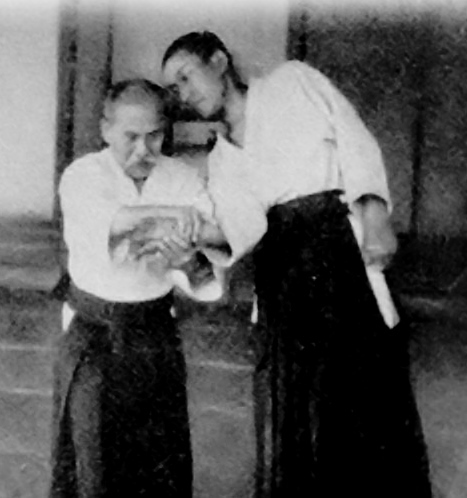
budo-shihonage-640Shiho nage (4 directions throw) is one of the most important, if not the most important pillar technique in Aikido training. It is commonly considered to contain within it the root of every Aikido throwing technique and there is no doubt its proper execution relies on the nage applying all of the fundamental principles that underlie Aikido practice.

The name of the technique stems from the fact that a skilled nage can throw the uke in any of 4 directions. In reality, however, it is possible for the 4 directions to be extended to 8. This ability to effect the technique in any direction makes shiho nage particularly attractive from a self-defence perspective, especially if dealing with multiple attackers.

FotorCreated


The below video examines various aspects of shiho nage in the context of a response to a circular blow to the face (yokomenuchi). The technique is demonstrated at ryutai (flowing forms) level from the Aikido Yuishinkai syllabus.

The demonstration is from a class at Seishin no Shugyo Dojo in Tasmania by Peter Kelly Sensei, Chief Instructor, Aikido Yuishinkai Australia.  Peter Sensei’s instruction emphasises the correct application of the change in direction cutting movement necessary for the successful execution of the technique.

Ian Grant
Head Instructor
Aikido Warrior Dojo

Training notes: Katatedori sumi otoshi

Otoshi (or drop) techniques feature prominently in a variety of martial arts, including Aikido, Judo and Jujitsu. Otoshi techniques are typically thought of as “hand throws” and when applied correctly generate a surprising amount of power that literally has the effect of dropping (some might say “driving”) the uke straight into the mat.

Ueshiba 5Sumi otoshi (corner drop) is probably the most common drop technique practised in Aikido. The particularly appealing features of this technique include its directness in execution and the fact that it is able to be used to in response to a wide variety of traditional attack situations.

However, while sumi otoshi looks deceptively simple on its face, in reality it requires considerable skill to apply  with any degree of martial integrity.  For example skills in kuzushi (i.e. off-balancing), timing, moving off-line and centred movement are essential.

In the below video, Mike Jones Sensei from  New York Aikikai provides instruction for sumi otoshi from an attack in the form of a same side hand grab (Katate dori).


ADDITIONAL NOTES

  • Alternate application

Donovan Waite Sensei (7th Dan Aikikai) in the following video demonstrates and provides training tips for an alternate application of  katatedori sumi otoshi, as well as the variation in the featured video.


  • Learning ukemi

In every technique ii is important to learn not only how to execute it, but also how to safely receive it (ukemi).  In the below video, Waite Sensei demonstrates how the nage can assist the uke in safely learning ukemi for the sumi otoshi.


  • Aikido Yuishinkai (Tasmania)

The demonstration is by Peter Kelly Sensei of Aikido Yuishinkai (Tasmania). The source material was kindly provided courtesy of Bill Hely.

Ian Grant
Dojo Cho
Aikido Warrior Dojo

Training notes – Yokomenuchi irimi nage

In the below video Morihiro Saito Sensei (1928-2002) demonstrates the three traditional versions of  Yokomenuchi irimi nage as practised by O’Sensei (the Founder of Aikido) in the immediate post-war period of his life.

Irimi means to enter physically and spiritually into an attack while at the same time simultaneously side stepping it. In the demonstrated technique irimi nage (“entering throw”) is being used to address a traditional strike to the side of the head.  This form of strike is called yokomenuchi.


ADDITIONAL NOTES

  • Technical notes – Kihon application (1) – London Aikido Club 


  • Technical notes – Kihon application (2) – Morihiro Saito Sensei


  • Technical notes – Yokomenuchi – Ki no nagare – Morihiro Saito Sensei


  • Additional technical notes – Yoshimitsu Yamada Sensei 

In the below video Yoshimitsu Yamada Sensei (8th Dan Aikikai) gives instruction and training tips from an alternate perspective.


All the best

Ian Grant
Dojo Cho
Aikido Warrior Dojo

Pass me a bokken….better make it a big one

The challenge of modern aikido is that it exists in a world where most of us typically don’t operate under regular physical load in our daily lives. This impacts on the way we move and the body quality that we adopt in making those movements. By way of comparison, the Founder of Aikido was a farmer and was use to working in a very physical environment for most of his life. The result is that what was natural movement and posture for him, and many of the masters of past, is well … not that natural for us.

OLYMPUS DIGITAL CAMERARecently, a number of us at the dojo have resolved to include heavy bokken training, through the use of a suburito, as part of our regular weapons practice. For those not familiar with the suburito, it’s a heavy bokken that is thicker at the blade than the handle. It is also longer in length than the standard bokken. The benefit of using a suburito for bokken work is that it is a simple and effective method of bringing load into our Aikido practice.

To move the suburito for any length of time (and we are talking minutes) relies on the practitioner abandoning strength based methods and instead using the “natural” principles of posture and movement that form the basis of our Art. The principles to which I refer include being centered, “heaven man earth”, centerline movements, sinking, using major muscle groups to ignite smaller ones, weight transference, “feet move hips”, “silk-reeling”, “yin-yang”’, keeping knees off lock, etc. When these principles are applied, the suburito can be moved with minimum effort.

The effect on bokken kata practice when using a suburito is also quite interesting. I think it would be fair to say that there is an injection of martial integrity introduced into the kata movements. This does not occur because of the weight per se, but rather the disciplined way that you have to move and hold your posture throughout to allow the additional weight of the bokken to be moved with minimum effort. For an example as to how the Aikido Yuishinkai kata “free wielding sword” looks with a heavy bokken see the below demonstration by our Chief Instructor Peter Kelly Sensei.

We have also found that the internal aspects developed using the suburito flow directly on to our unarmed practice. Particularly noticeable benefits include a reduced urge to “muscle techniques” when encountering resistance. The natural reaction is to instead relax and sink. A greater sense of centered movement, both as uke and nage, is also very evident.

Please be assured that I’m not suggesting that the suburito is the be-all and end-all of effective Aikido practice. There are lots of incredibly proficient Aikido practitioners out there who have never even picked up suburito. All I’m saying is that if you are seeking to widen your current training methods for developing the internal principles underpinning our art – its worth a try.

In the meantime, if you’re going to pass me a bokken….better make it a big one.

Ian Grant
Head Instructor
Aikido Warrior Dojo