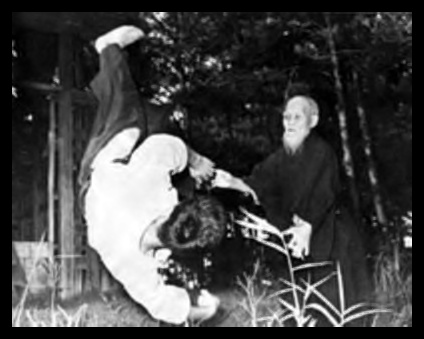
kokyu nage

Training notes: Ushiro ryotedori kokyu nage

In the below video Morihiro Saito Sensei  demonstrates and provides instruction for the pre and post war versions of the aikido technique ushiro ryotedori kokyu nage.

The technique is  categorised as a “breath throw” and is practised as a response to a traditional attack where both hands of the nage are grabbed from behind with the intent to either place a knee in the nage’s back or drag the nage backwards.

Depending on the school of Aikido the technique is sometimes referred to as ushiro tekubidori zenpo nage/kokyu nage.


ADDITIONAL NOTES

  • Alternate attack form

Ushiro ryotedori kokyu nage, like all Aikido applications, can be practised from a static form (typically under resistance) or in a dynamic free flowing form (often referred to as ki no nagare). 

In the following video, the Founder of Aikido, Master Morihei Ueshiba (O’sensei) demonstrates a dynamic version of  ushiro ryotedori kokyu nage  whereby the uke directly attacks from behind and out of the nage’s line of sight (see video below).  We also train this version at our dojo.


  • Alternate application

In the below video Sensei Andy Hathaway of the London Aikido Club demonstrates an alternate kokyu nage application.


  • Ki aikido approach

In the below video the Koretoshi Maruyama Sensei demonstrates and teaches the subject technique as practised in Aikido Yuishinkai. This approach (including the bounce) is typical of many ki aikido schools inspired by the teachings of Koichi Tohei Sensei.

Have a great weekend.

Ian Grant
Dojo Cho
Aikido Warrior Dojo


Munetsuki kokyu nage – Aikido Yuishinkai

kokyu nage munetsukiIn the below video Master Koretoshi Maruyama, Founder of Aikido Yuishinkai, demonstrates and provides instruction for one of the versions of munetsuki kokyu nage The technique is  categorised as a “breath throw” and is practised as a response to a strike or thrust to the stomach (munetsuki).

From a superficial mechanical perspective, the technique appears deceptively straightforward. In reality, however, it can be quite challenging to successfully perform.  It requires substantive skills in entering, timing, sinking, maintaining centre pole and moving as a single relaxed unit.

Further, like most more advanced Aikido techniques the uke’s balance is not taken by movements of the nage’s upper body, but by the correct movement of the nage’s lower half of their body. The nage’s hand on the uke’s arm is merely the connection point.

One of the training advantages that we have found at the dojo with this particular version of munetsuki kokyu nage is that the internal skills and aikido principles necessary to perform it offer a “gateway” to learning other advanced techniques, including for example munetsuki kaitenage.


Have a great weekend.

Ian Grant
Dojo Cho
Aikido Warrior Dojo
 

Training Notes: Jo nage kokyu nage

Jo nage throwIn the below video Master Koretoshi Maruyama demonstrates and provides instruction for the Aikido technique kokyu nage where the nage is armed with a wooden staff (a jo).  This type of training is referred to as jo nage.

For instruction purposes, Maruyama Sensei demonstrates the key components of the technique from a static position. To illustrate how the technique looks from a dynamic perspective, archive footage of O’sensei (circa 1950’s) is also included. The uke in the  footage is a very young Morihiro Saito Shihan.


Technical notes

  • Don’t merge the foot work into one move

In the video Maruyama Sensei demonstrates the foot work in 3 separate segments – (1) enter with leading foot; (2) tenkan; and (3) moon-shadow the lead foot forward to enter into the uke’s space.  These 3 segments are performed as separate movements and should not be merged.  Further, the final projection is not executed by the nage until all 3 segments of the footwork are completed. The key parts of the technique (including footwork) are illustrated below.

jo nage 1ajo nage step 1Jo nage step 2Jo nage step 3


(1) Initial position           (2) Step in                   (3) Tenkan                    (4) Moon-shadow

Jo nage throw


(4) Complete technique

  • Don’t pitch back to “bow and arrow/sling-shot” the projection

There is a tendency when performing tenkan kokyu nage based projections for the nage to pitch back their upper torso after the tenkan movement, or to slide their rear foot an extra distance back. This is done in an effort to put extra power in the move and “sling shot” the uke.

This should be avoided. All it does is separate connection and give the uke an opportunity to counter attack. For further discussion of this point, including the correct way to enter and tenkan in kokyu nage techniques see Training Notes: Munetsuki kokyu nage (ura).

  • Use centre point of jo

saito osenseiMaruyama Sensei particularly emphasises in the video the importance of focusing on the centre point of the jo as measured between the distance of the uke‘s hands.  It is only by focussing movement of the jo at this point that the nage is able to not only retain control of the jo, but also move the uke’s centre so that the conditions for a successful throw are possible.

All the best for 2016.

Ian Grant
Do Jo Cho
 Aikido Warrior Dojo

Tachi dori yokomenuchi udekime nage – Aikido Yuishinkai

udekimeiIn the below video  Koretoshi Maruyama Sensei demonstrates and provides instruction for the Aikido technique udekime nage (arm extension throw). The technique is demonstrated as a defence to a diagonal strike to the head (yokomenuchi) where the uke is armed with a bokken.

Depending on the style of Aikido, udekime nage is sometimes classified as a form of kokyu nage (breath throw) technique


Other examples of  udekime nage

Have a great week.

Ian Grant
Dojo Cho
Aikido Warrior Dojo
 

Training notes: Yokemunuchi aiki nage

Yokemunuchi aiki nage is a technique that has a long history in Aikido.  There are numerous videos of O’sensei performing it dating back to the 1930’s.

In the below video, Aikido Warrior Dojo seniors are recorded practising and experimenting with yokemunuchi aiki nage, including associated ukemi (falling skills).  The experiments include adding atemi and kiai to determine the effect on the uke and the impact on receiving the technique.

ADDITIONAL NOTES

  • Yokemunuchi aiki nage – The fundamentals

In the below video Koretoshi Maruyama Sensei demonstrates and provides instruction for the Aikido technique yokomenuchi aiki nage.

Have a great week.

Ian Grant
Dojo Cho
Aikido Warrior Dojo