kokyu nage

Ninindori kokyu nage – Aikido Yuishinkai

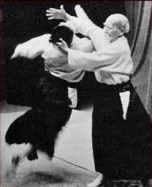
ninindori 2Multiple person grabs are a common training tool in Aikido and are have a long tradition in our Budo.  The Founder of Aikido (Master Morihei Ueshiba) regularly demonstrated and practised this form of training. There are numerous videos of him doing so, the earliest going back to the 1930’s.

Two person grabs in Aikido practice are typically referred to as ninindoriNinindori represents the basic form of multiple grab practice. As a student progresses additional attackers can be added to make the exercise more challenging.

In the below video, Master Koretoshi Maruyama, Founder of Aikido Yuishinkai, demonstrates how to use kokyu nage (a “breath throw”) to escape when ukes in ninindori grab each arm of the nage.  

All the best

Ian Grant
Head Instructor
Aikido Warrior Dojo


Katate kosadori kokyu nage – Aikido Yuishinkai

kokyu nageIn the below video Koretoshi Maruyama Sensei demonstrates and provides instruction for the Aikido technique katate kosadori kokyu nage as practised in Aikido Yuishinkai. The technique is categorised as a “breath throw” (kokyu nage) and is trained from a traditional attack in the form of a cross-hand grab (katate kosadori).

Katate kosadori kokyu nage has a long history in Aikido practice. There are numerous recordings dating as far back as the 1930’s of the Founder of Aikido (Master Morihei Uesiba) demonstrating the technique.


ADDITIONAL NOTES

  • Katate kosadori kokyu nage – No touch variation

In the below video Maruyama Sensei demonstrates and provides instruction for the Aikido technique katate kosadori kokyu nage (reitai level) as practised in Aikido Yuishinkai.

Training at reitai level is sometimes described as “no touch” Aikido.  The difficulty with this descriptor is that it suggests something pseudo mystical is happening which could not be further than the truth.  The uke falls without being touched for no other reason than to avoid being “palmed in the face” (for want of a better description) by a centred nage.


  • Katate kosadori kokyu nage – Basic levels

The above video demonstrates and provides instruction for katate kosadori kokyu nage as practised at ryutai or free flowing level. However, it is often difficult for students to initially practice a technique at this level.

osensei kokyu nageTo assist students to learn the basic shapes and principles for free flowing practice, preliminary exercises are practised which in essence are simplified versions of the flowing technique. They are also practised static and cooperatively.  These learning exercises are referred to as practising a technique at kotai and juntai levels. It is emphasised that these levels of practice are only exercises to learn principles applicable to Aikido practice, they are not Aikido techniques.

In the below video Maruyama Sensei provides detailed instruction for katate kosadori kokyu nage at both kotai and juntai level.


All the best

Ian Grant
Dojo Cho
Aikido Warrior Dojo


Budo (1938): Tachi dori shomen giri kotegaeshi

Bokken kotegaishi 2 osenseiIn 1938 Master Morihei Ueshiba, the Founder of Aikido, finalised the 2nd of his 3 technical texts.  Simply titled “Budo“, the text contains a sampling of techniques from a wide range of attacks, including grabs, strikes and attacks from different weapons.

Budo” is an important reference point for our practice at Aikido Warrior Dojo. The techniques and principles referred to therein are regularly practised.

Interestingly, the Founder only included 3 tachi dori techniques in his 2nd text.  One of these was tachi dori showmen giri kotegaeshi.

The below video features a photographic demonstration tachi dori shomen giri kotegaeshi as it appears in “Budo”.  Also included are demonstrations of the technique by Morihiro Saito Sensei who was a direct student of the Founder for more than 20 years.


ADDITIONAL NOTES

  • O’sensei’s explanation of tachi dori shomen giri kotegaeshi (1938)

In O’sensei’s manual “Budo” (1938), there is substantive instruction given for tachi dori shomen giri kotegaeshi.  In edited form, it reads as follows:

As soon as your opponent cuts, move with the speed of the gods and enter deeply to the right with irimi tankan.  Strike your opponents right wrist with your left te-gatana (hand sword), remain aware of possible attackers to the rear and strike your opponent’s face with your right fist…

Apply …kotegaeshi .. and down your opponent.  In this case it is necessary to control his hand and sword with the little and ring fingers of your right hand.  Next turn your opponent round to the left, pin him face down, take the sword and hold it to his neck

  • Hand position for take down and wrist pin

The traditional hand position on the bokken for the takedown to the mat and wrist pin is shown in the pictures below.  Note the hilt of the bokken is grabbed with the nage’s right little finger and ring finger. The nage’s left thumb is at the base of the uke’s right ring finger.
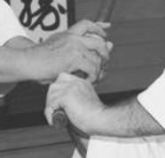
Bokken kotegaeshi 2JPG

Bokken kotegaeshi


  • Atemi

strike kotegaeshiAt the completion of the irimi tenkan movement there is the option of atemi in the form of striking the uke’s face with your right hand.

Practice of atemi in this way is a most useful practice tool to assist in learning the correct positioning for the technique.

 Have a great week.

Ian Grant
Head Instructor
Aikido Warrior Dojo


Training notes: Tachi dori shomen giri kokyu nage

In the below video Peter Brady Sensei ((7th Dan Aikikai) demonstrates and provides instruction for the Aikido technique – kokyu nage (breath throw).  The technique is demonstrated as a response to a downward strike to the head (shomenuchi) where the uke is armed with a wooden sword (bokken).


ADDITIONAL NOTES

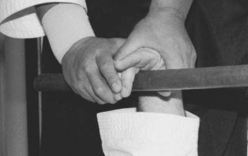
  • Hand position on hilt of the bokken

Bokken tori 1


  • The elbow debate 

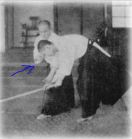
Bokken3JPGThere are contrasting views on whether the nage should place their right elbow under the left elbow of the uke and apply pressure to the uke‘s elbow to take their balance (before attempting to project the uke).  This approach can be seen in the picture to left.

The diverging opinions appear to be based on philosophical and stylistic differences, including differing perspectives on the role of kuzushi and uke compliance in Aikido practice.  That being said, there is no doubt this applied kokyu ho approach is a martially effective option and was practised by O’sensei in the post war period of his training.

Have a great week.

Ian Grant
Head Instructor
Aikido Warrior Dojo


Training notes: Ushiro tekubidori kaiten nage

kaiten 2 JPGIn modern Aikido kaiten techniques are typically referred to as “wheel throws” because the uke is projected in a wheel like shape. Traditionally, however, they were referred to as “open and turn” techniques.  In the text “Budo“, Master Morihei Ueshiba  describes kaiten as a turn and transform movement.

In the below video Master Koretoshi Maruyama demonstrates and provides instruction for ushiro tekubidori kaiten nage as practised in our school.  The technique is trained as a response to a traditional attack where both hands of the nage are grabbed from behind with the intent to place a knee in the nage’s back.

Depending on the school of Aikido, the technique is also sometimes referred to as ushiro ryotedori kaiten nage.


Additional notes

  • Similar beginning as ushiro tekubidori ikkyo

The beginning segments of ushiro tekubidori kaiten nage are the same (up to the downward cut movement) as ushiro tekubidori ikkyo at ryutai level. For notes on this technique, including the entry and set up see: Training notes: Ushiro tekubidori ikkyo (ryutai).

  • Other kaiten nage applications 

For training notes on other applications of kaiten nage see Video Library: Unarmed arts (by technique).  Technique groups (e.g. ikkyoirimi nage etc.) are ordered alphabetically.

  • Other ushiro tekubidori techniques 

For training notes on other Aikido techniques that are practised from a ushiro tekubidori attack, see Video Library: Unarmed arts (by attack type).  In the library, techniques are ordered alphabetically based on attack types (e.g. katadori, katatedoriushiro tekubidori etc.).

Have a great week.

Ian Grant
Head Instructor
Aikido Warrior Dojo