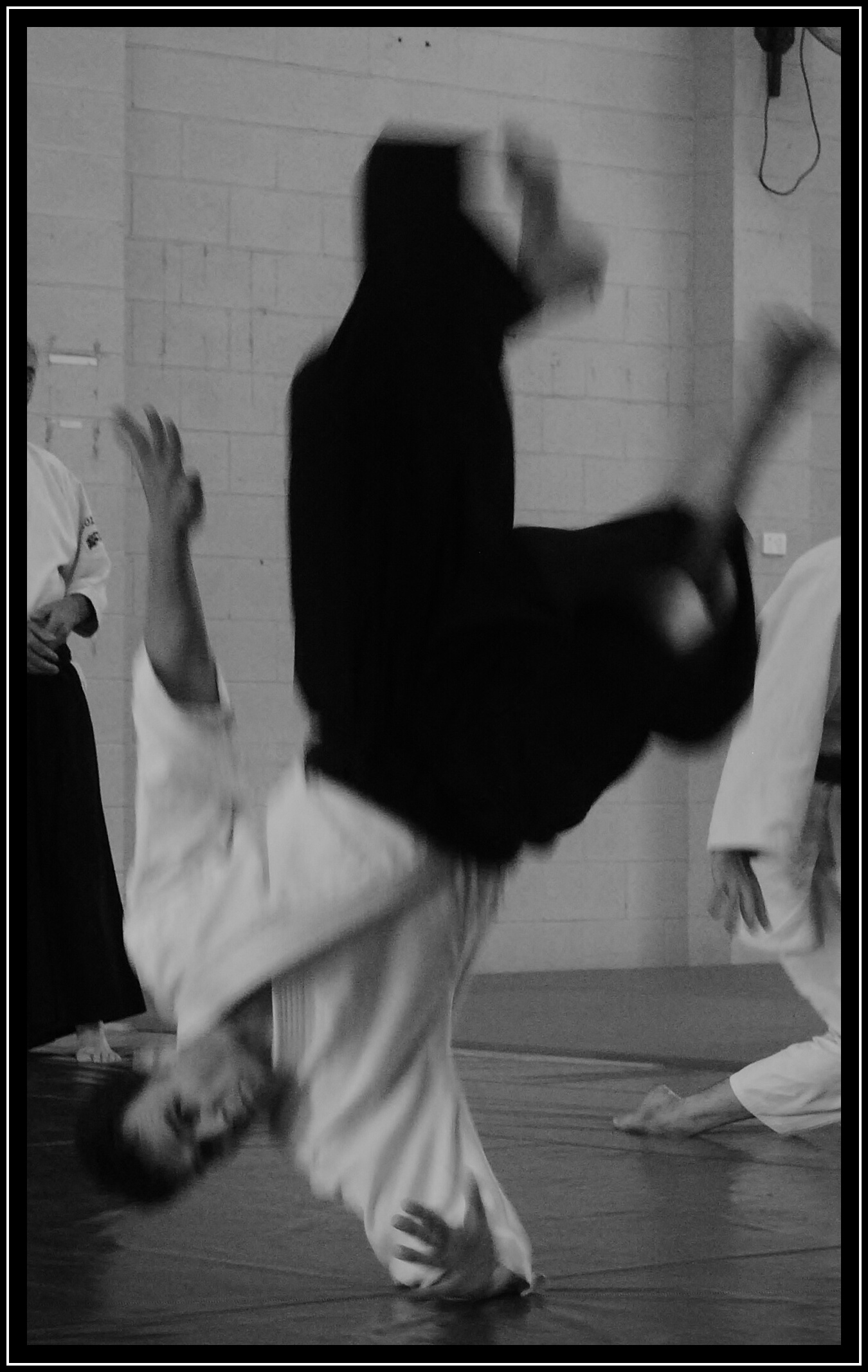
Atemi

Relaxed arm striking – it’s not pretty

Capture3Atemi (or striking) plays an important role in Aikido practice, particularly from a self-defence perspective. Without the use of atemi, or at least the threat of it, most techniques would have substantially less chance of success. This is particularly so when resistance and counter offensives are thrown into the mix. Further, at the highest levels of practice, many techniques in essence are pure atemi.

One of the interesting aspects of Aikido Yuishinkai practice is that it includes the use of relaxed arm (suwaisho) striking methods as a self-defence response to addressing “punch based” attack situations. Exercises to develop skills in vertical and horizontal relaxed arm strikes are practised at the commencement of every Aikido Yuishinkai class.

Capture2Vertical suwaisho strikes in particular are a surprisingly effective self-defence response.  They also have the advantage of being relatively easy to learn. This in part is because they can be applied just using heavy downward and forward energy, rather than relying on a “heaven man earth” body structure which is more difficult to acquire. They are also quite simple in their execution – which is critical in a real life situation. The fact that the downward strikes simultaneously defend the nage’s centreline is another a benefit.

That being said, vertical suwaisho strikes are not pretty to look at and are a million miles from the graceful artistry that is often seen in typical You Tube clips of Aikido. Also, when you are the uke in two partnered practice, it can be a quite confronting and an “in your face” experience to say the least. It feels a bit like being bombarded by a series of oncoming swinging clubs. Although not necessary for general practice, I would also (from experience) suggest giving your uke some protective arm and head gear if you decide to put vertical suwaisho to the test against a “full-on attack” – it will save some major bruises.

The below clip is a brief introduction to vertical suwaisho strikes given at a 2007 seminar in Tasmania by the Founder of Aikido Yuishinkai, Master Koretoshi Maruyama.  The uke is Sensei A Williams.

Ian Grant
Head Instructor
Aikido Warrior Dojo

Related articles

Training notes – Yokomenuchi irimi nage

In the below video Morihiro Saito Sensei (1928-2002) demonstrates the three traditional versions of  Yokomenuchi irimi nage as practised by O’Sensei (the Founder of Aikido) in the immediate post-war period of his life.

Irimi means to enter physically and spiritually into an attack while at the same time simultaneously side stepping it. In the demonstrated technique irimi nage (“entering throw”) is being used to address a traditional strike to the side of the head.  This form of strike is called yokomenuchi.


ADDITIONAL NOTES

  • Technical notes – Kihon application (1) – London Aikido Club 


  • Technical notes – Kihon application (2) – Morihiro Saito Sensei


  • Technical notes – Yokomenuchi – Ki no nagare – Morihiro Saito Sensei


  • Additional technical notes – Yoshimitsu Yamada Sensei 

In the below video Yoshimitsu Yamada Sensei (8th Dan Aikikai) gives instruction and training tips from an alternate perspective.


All the best

Ian Grant
Dojo Cho
Aikido Warrior Dojo

Breaking boards using relaxed power, gravity and centreline – A reality check

Let me say from the outset that breaking boards is not part of Aikido and I am in no way advocating that it should be. It’s just something done at our dojo from time to time after class as a sort of reality check. Participation is purely voluntary.

So much of Aikido is counter-intuitive and for some us (like myself) it is comforting to put principles like relaxed power, gravity and centreline to a personal test. Breaking a board that requires 114 kg of impact power is one way of doing this.  There are no doubt many other ways. Its akin to rolling on hard surfaces from time to time to see if your ukemi is as soft as you think it is (and yes some of us do that too).

The below video was taken at the end of a class at our dojo on 25 October 2014.   Most who decided to have a go at breaking the board were able to do so or very close to achieving it.  The biggest challenge (like most things in Aikido) is believing that relaxed softness, combined with being centred and using gravity, can generate not only sufficient power to break the board but also cause no pain.

In any event these were the results.

Have a great weekend.

Ian Grant
Head Instructor
Aikido Warrior Dojo


Internal strength and Aikido – An experiment in breaking boards

Its always interesting to experiment with Aikido applications.  Sometimes the experiments work out, sometimes not.  Its all part of the learning experience.

With this spirit in mind,  I recently decided to participate in a test to see if Aikido principles could be applied to break boards normally reserved for students of striking arts.  Now I should state from the outset that I have never previously tried or even considered breaking a board with my hand.  The chance of being attacked by a pile of lumber just seemed too remote to bother with such a proposition.

I resolved to attempt to break a board with an open palm downward atemi (strike) using the suwai sho 2 movement from the Aikido Yuishinkai junan taiso.  This taiso exercise is something most Aikido Yuishinkai students do at the start of just about every  class. Most importantly for the subject experiment, it’s an exercise that generates power from your centre in a downward direction.

Throwing  caution to the wind, I tried to break a (new) JOLS re-breakable board designed for advanced karate students. Of some concern was that, according to its packaging, the board required 114kg of impact power to break. Further, there was internet commentary  to the effect that experienced striking art students often had difficulty breaking the board.  This information didn’t inspire me with confidence.

My first attempt failed miserably and painfully. Fuelled by trepidation, I used the one strategy that could never work – I resorted to physical strength.  On contact, my palm felt like it was going to explode and the throw back vibration went through both my hand and arm so hard I’m sure my ancestors felt it. There was no doubt some well deserved bruising was coming my way.

Just prior to my second attempt, I resolved this time to rely only on fundamental Aiki principles – standing straight, relaxing completely, moving from my centre, keeping weight underside, dropping through the elbow and maintaining an unbendable arm.  I also removed from my mind the fact that the point of contact with the board was going to be my still smarting hand.

I’m pleased to say my hand this time went through the board like it was slicing butter (see video below). I didn’t feel any pain or reverberation at all.  After breaking the board a few more times, I then had a go at breaking 2 boards which required 143 kg of  impact power to break.  Succeeded again!

So there you go – Aiki principles like moving from your centre, weight underside, unbendable arm and relaxed power really do work!

All the best

Ian

Credits: Big thanks to Robert Monro for his help in setting up, support and encouragement of the experiment. Also to Darren Philips for his impromptu recording of the exercise.

Aikido – I do all my own stunts!

I recently watched an interview with wrestler Hulk Hogan where he said that in professional wrestling the ending is predetermined but the “bumps are real”.

Ian Grant (a)It crossed my mind that this is the same situation in Aikido.  When we practise kata or tanininzugake the agreement is usually that at the end the nage will still be standing and the uke will one way or another be knocked to the ground.   As in professional wrestling, the pre-arranged understanding between the nage and uke does not change the fact that for the uke the final meeting with the mat is going to be very real.

The message we should probably all keep in mind is that at the end of the day we owe it to ourselves to stay safe.  Below are some personal views on ways to keep in one-piece.

Tanking

Some people will be immediately appalled that I would suggest that tanking (i.e. just falling down) is ever an acceptable strategy.  However, in a modern Aikido world where newcomers can be on the receiving end of techniques within 20 minutes of starting their first lesson, tanking is probably the only safe option available for them.

Predictive ukemi

Predictive ukemi occurs where the uke essentially predicts to varying degrees what the nage is about to do and moves themselves into a position to best take ukemi from it with minimum possibility of injury.

I find this type of ukemi particularly useful where:

  • There is uncertainty as to the ability of the nage to execute their techniques without unnecessarily compromising their own safety or that of the uke’s (This may be linked to the type of technique or practise being explored, the experience levels of the nage or uke, or for other reasons);
  • atemi (strike) based or no touch techniques are being practised or employed (see video below);
  • the “shape of a technique” is being demonstrated to a person who has not previously seen or experienced it; or
  • the uke is seeking to experiment or simply develop their ukemi skills when receiving specific techniques.

The below short video is an example where predictive ukemi is used to protect the uke from getting a good belt to the face (and potential trip to the dentist) from an atemi based technique.

Non-predictive ukemi

I use the term non-predictive ukemi to refer to those situations where the uke strikes or attacks with no regard to the likely technique or action to be taken by the nage.  The form of ukemi ultimately employed by the uke at the conclusion of the technique is accordingly unknown until the last moment.   

While this is a highly worthwhile and quite exhilarating form of training, it requires a strong trust between the nage and uke, including an understanding that the nage will at all times have the highest regard for the uke’s safety when executing their techniques.  Particularly important is that the nage appreciates and adapts the intensity of their techniques to correlate with the uke’s experience level and falling skills.

Reactive ukemi     

This is my favourite form of ukemi.  While still non-resistant in nature, the essence of this ukemi is that when the uke feels their centre is being taken, the uke reacts by blending with nage’s actions and attempts to regain their balance.  A sensitive nage will immediately adjust the application of the technique to compensate.  The typical end result is Aikido being dynamically practised with power and grace.

Many of the Aikido demonstrations by Christian Tissier Sensei (7th Dan) are examples of this type of practice at its highest level – see for example Tissier Bercy 2005 HD (at o:59 to 1:39).

However, I would only recommend engaging in this method of uke arts (particularly in taninzugake) if your ukemi skills are well-developed and have become second nature.  My own experience is that the speed in which you come out of the technique seems to significantly increase with this type of training.  In addition, I sometimes find the gracefulness can be dangerously deceptive and the final powerful meeting with the mat can be quite a mental shock.

Aikido – I do my own stunts

At the end of the day, we in Aikido do our own stunts and no one stands in for us when we fall from an applied technique.  To stay safe, the most important thing for us is to use common sense and practise at a level commensurate with our ability to walk away safely in the most likely event that we meet the mat.

All the best

Ian Grant