Aikido Yuishinkai

Training notes: Hanmi handachi shomenuchi kotegaeshi

morihei-ueshiba-kobukan-c1935Hanmi handachi waza is a common form of Aikido practice whereby the nage is in a kneeling position and the uke  attacks while standing.   In this type of training the uke has the obvious advantage of both mobility and height. However, a skilled nage can still take the balance of the uke by taking advantage of their lower centre of gravity.

Training in hanmi handachi waza is particularly beneficial as it develops skills in taking a ukes balance with only minimal lower body movement.  The training also assists in understanding the importance of centre and use of the centre line in Aikido practice.

The below video extract of Master Koretoshi Maruyama demonstrates the application of kotegaeshi  (outward wrist turn) in hanmi handachi waza to address a straight blow to the centre of the head (i.e. shomenuchi).

Points of note in the demonstration include:

  • The nage is at an approximate 45 degree angle to the uke and not facing head on;
  • The nage’s initial movement is itself a shomenuchi cutting movement through the uke’s centreline;
  • The nage does not attempt to directly clash or in anyway block the uke’s downward strike;
  • The nage draws the attack into their centre and then uses their centre and centre line as the mechanism and line of movement, respectively, to execute the finish of the technique;
  • The balance of the uke is completely taken (i.e kuzushi) from the moment of first contact.
  • The technique is executed to take advantage of the “missing third leg” position to the rear of the uke.

Ian Grant
Head Instructor
Aikido Warrior Dojo
 

Training notes – Bokken happo giri (8 direction cut)

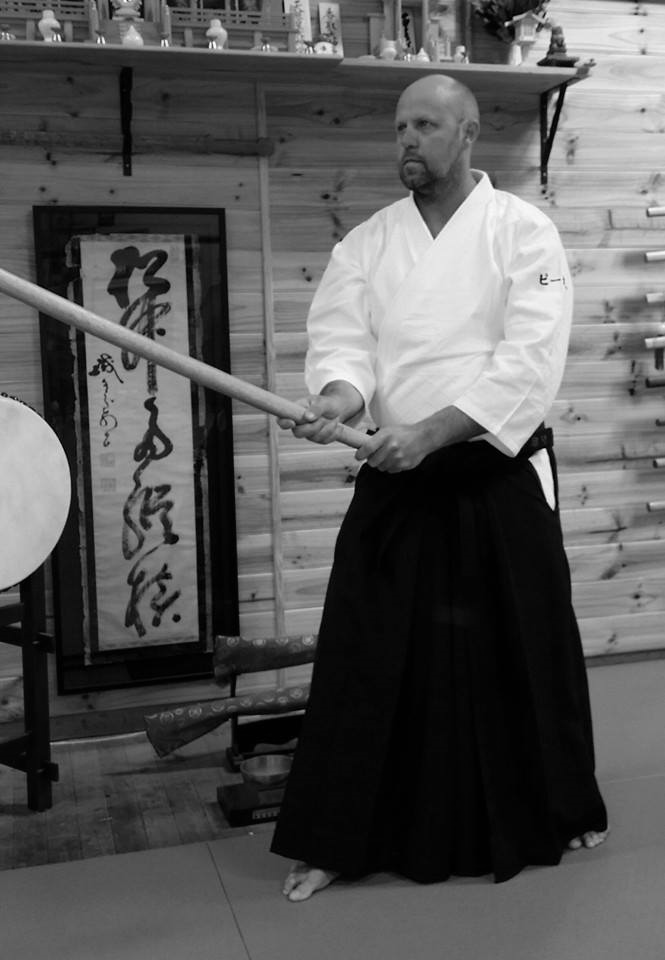
10247471_570367973099377_397839042609517328_nBokken arts are not formally examined as part of the grading syllabus in Aikido Yuishinkai until shodan (black belt).  However, due to the many transferable skills that Bokken arts offer in aiding our tai jutsu (unarmed) training it is quite common for students to be introduced to these wooden sword based arts almost from the outset.

Bokken happo giri is an 8  direction shomen cut that makes for an ideal introduction to solo bokken practice.   This multi-direction kata is an excellent aid to learning and developing spatial awareness, proper posture, heaven-man-earth body quality,  balance and footwork while continually moving and cutting in different directions.

Bokken happo giri  is also helpful in developing the ability to maintain focus in all directions while continually turning.  This ability is particularly useful when dealing with multiple attacker situations in unarmed practice.

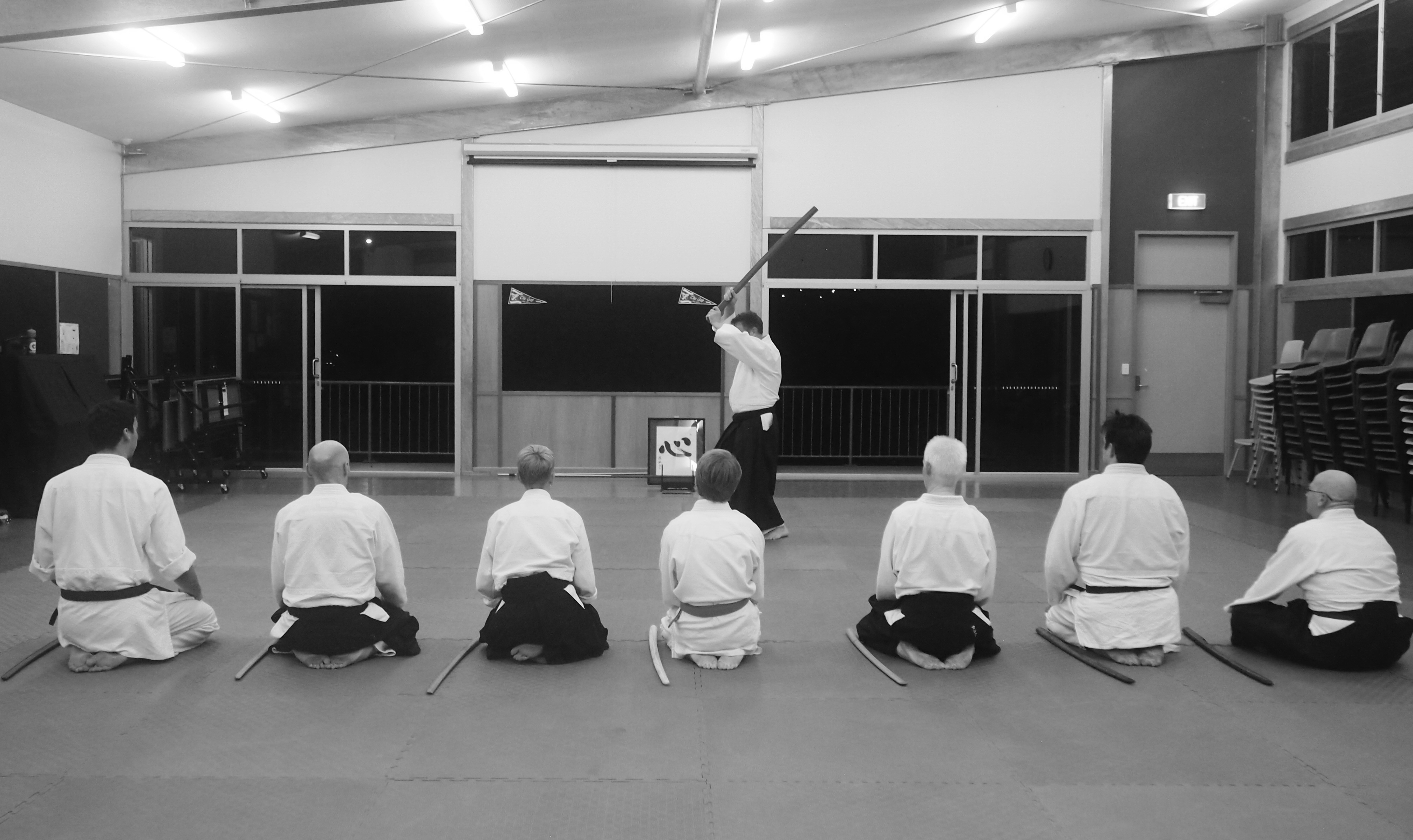
OLYMPUS DIGITAL CAMERAAt our dojo we regularly practice 3 different forms of bokken happo giri.  These are omote, ura and irimi.  All 3 forms involve an 8 way cut, however, the footwork differs in each. Each form directly translates into our tai jutsu practice by automating correct footwork and centred relaxed movement in our Aikido techniques.

The video demonstration below by our Chief Instructor Peter Kelly Sensei is of bokken happo giri omote.

Ian Grant
Head Instructor
Aikido Warrior Dojo
Related Articles

  1. Pass me a bokken ..better make it a big one (2015)
  2. Training tips – Bokken arts (kata and exercises) (2015)


Training notes – Yokomenuchi irimi nage

In the below video Morihiro Saito Sensei (1928-2002) demonstrates the three traditional versions of  Yokomenuchi irimi nage as practised by O’Sensei (the Founder of Aikido) in the immediate post-war period of his life.

Irimi means to enter physically and spiritually into an attack while at the same time simultaneously side stepping it. In the demonstrated technique irimi nage (“entering throw”) is being used to address a traditional strike to the side of the head.  This form of strike is called yokomenuchi.


ADDITIONAL NOTES

  • Technical notes – Kihon application (1) – London Aikido Club 


  • Technical notes – Kihon application (2) – Morihiro Saito Sensei


  • Technical notes – Yokomenuchi – Ki no nagare – Morihiro Saito Sensei


  • Additional technical notes – Yoshimitsu Yamada Sensei 

In the below video Yoshimitsu Yamada Sensei (8th Dan Aikikai) gives instruction and training tips from an alternate perspective.


All the best

Ian Grant
Dojo Cho
Aikido Warrior Dojo

Pass me a bokken….better make it a big one

The challenge of modern aikido is that it exists in a world where most of us typically don’t operate under regular physical load in our daily lives. This impacts on the way we move and the body quality that we adopt in making those movements. By way of comparison, the Founder of Aikido was a farmer and was use to working in a very physical environment for most of his life. The result is that what was natural movement and posture for him, and many of the masters of past, is well … not that natural for us.

OLYMPUS DIGITAL CAMERARecently, a number of us at the dojo have resolved to include heavy bokken training, through the use of a suburito, as part of our regular weapons practice. For those not familiar with the suburito, it’s a heavy bokken that is thicker at the blade than the handle. It is also longer in length than the standard bokken. The benefit of using a suburito for bokken work is that it is a simple and effective method of bringing load into our Aikido practice.

To move the suburito for any length of time (and we are talking minutes) relies on the practitioner abandoning strength based methods and instead using the “natural” principles of posture and movement that form the basis of our Art. The principles to which I refer include being centered, “heaven man earth”, centerline movements, sinking, using major muscle groups to ignite smaller ones, weight transference, “feet move hips”, “silk-reeling”, “yin-yang”’, keeping knees off lock, etc. When these principles are applied, the suburito can be moved with minimum effort.

The effect on bokken kata practice when using a suburito is also quite interesting. I think it would be fair to say that there is an injection of martial integrity introduced into the kata movements. This does not occur because of the weight per se, but rather the disciplined way that you have to move and hold your posture throughout to allow the additional weight of the bokken to be moved with minimum effort. For an example as to how the Aikido Yuishinkai kata “free wielding sword” looks with a heavy bokken see the below demonstration by our Chief Instructor Peter Kelly Sensei.

We have also found that the internal aspects developed using the suburito flow directly on to our unarmed practice. Particularly noticeable benefits include a reduced urge to “muscle techniques” when encountering resistance. The natural reaction is to instead relax and sink. A greater sense of centered movement, both as uke and nage, is also very evident.

Please be assured that I’m not suggesting that the suburito is the be-all and end-all of effective Aikido practice. There are lots of incredibly proficient Aikido practitioners out there who have never even picked up suburito. All I’m saying is that if you are seeking to widen your current training methods for developing the internal principles underpinning our art – its worth a try.

In the meantime, if you’re going to pass me a bokken….better make it a big one.

Ian Grant
Head Instructor
Aikido Warrior Dojo

One last look at 2014

It’s a new year and time to move forward and onward.  For many of us 2014 certainly had its challenging moments. For me it was health issues, for others it was injuries, work pressures, and in some cases, life just not going the direction it was supposed to. One great thing about training, however, is that for the time you are at the dojo it’s a chance to leave the world and all its problems at the front door.

There were lots of highs during the year – successful gradings, opportunities to attend  seminars, the privilege of teachers and seniors from other schools joining us in our training and most importantly enjoying each others’ company.

Before we say goodbye to 2014, I thought we could take one last look at some of the moments that helped define it at the dojo.  Here’s looking forward to training in 2015 (we start on Wednesday 7 January).

Ian

Ian Grant
Head Instructor
Aikido Warrior Dojo