Aikido Warrior

Training notes: Shomenuchi irimi nage

3Irimi nage (or entering throw) is a technique that is unique to Aikido.  Typically it is initially taught as a response to an overhead strike to the temple (shomenuchi).  However, it can be applied against most attack types, including those where the uke is armed with a weapon.

In the below videos Morihiro Saito Sensei (1928-2002) provides instruction on the traditional version of  shomenuchi irimi nage as practised by O’Sensei (the Founder of Aikido) in the immediate post-war period of his life.

The traditional version of irimi nage is a training favourite at our dojo and there would rarely be a training week where some aspect of it is not studied.

  • Basic application (nage initiates)


  • Intermediate applications (nage initiates – uke turns to continue attack)


  • Advanced applications (uke initiates)


ADDITIONAL NOTES

  • Alternate application (1) – Andy Sato Sensei


  • Brief Biography – Morihiro Saito Sensei (1928-2002)

saito_seiza_260Morihiro Saito Sensei’s  practice of Aikido spanned 56 years and he is one of the most important teachers in Aikido history.  Saito Sensei was a live-in student of O’sensei for more than 20 years at his home dojo in Iwama, Japan.

Saito Sensei spent his teaching life dedicated to preserving the technical style of Aikido as practised and shown to him by O’sensei in the post-war period.  Without his commitment to preserving the Aikido of the Founder and extensive efforts to record and document his teachings, much of the Aikido of O’sensei would have no doubt been lost.  The Aikido world owes him a great debt.

Have a great weekend

Ian Grant
Head Instructor
Aikido Warrior Dojo
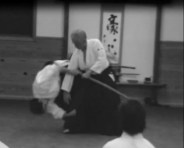
Tachi dori yokomenuchi udekime nage – Aikido Yuishinkai

udekimeiIn the below video  Koretoshi Maruyama Sensei demonstrates and provides instruction for the Aikido technique udekime nage (arm extension throw). The technique is demonstrated as a defence to a diagonal strike to the head (yokomenuchi) where the uke is armed with a bokken.

Depending on the style of Aikido, udekime nage is sometimes classified as a form of kokyu nage (breath throw) technique


Other examples of  udekime nage

Have a great week.

Ian Grant
Dojo Cho
Aikido Warrior Dojo


Training notes: Yokemunuchi aiki nage

Yokemunuchi aiki nage is a technique that has a long history in Aikido.  There are numerous videos of O’sensei performing it dating back to the 1930’s.

In the below video, Aikido Warrior Dojo seniors are recorded practising and experimenting with yokemunuchi aiki nage, including associated ukemi (falling skills).  The experiments include adding atemi and kiai to determine the effect on the uke and the impact on receiving the technique.

ADDITIONAL NOTES

  • Yokemunuchi aiki nage – The fundamentals

In the below video Koretoshi Maruyama Sensei demonstrates and provides instruction for the Aikido technique yokomenuchi aiki nage.

Have a great week.

Ian Grant
Dojo Cho
Aikido Warrior Dojo


Static resistance training: Katadori kokyu nage

katadori kokyu nageDealing with grab attacks where the uke is holding or resisting with physical based strength is an important part of Aikido practice.

While as Aikidoka we train ourselves to use centred relaxed grips (i.e. “holding with ki”), the fact remains that in most self defence situations the attacker will typically be using strength based tactics.  Failure to include responses to strength and resistance based attacks in our regular practice would in effect make our training effectively useless from a martial perspective.

Significantly, when Aikido is used against strong grip static attacks, the movements tend to be more economical and less complex.  Centred sinking movements combined with taking balance by controlling the head or elbow are common.  Atemi (striking) is also more often than not a critical component. The Aikido in general becomes less pretty.

  • Katadori kokyu nage

In the below video, Master Koretoshi Maruyama gives instruction on how to perform the Aikido technique kokyu nage (breath throw) in response to a static shoulder grab (kata dori) where the attacker is holding with strength.


  • Application against a sleeve grab

Kokyu nage as demonstrated in the video can also be used to address an attack in the form of a sleeve grab – see Sodedori kokyunage.

  • Alternate form of katadori kokyu nage

As is often the case in Aikido, there is an alternate method of executing a kokyu nage against a strong shoulder grab.  In the 1950’s, O’sensei practiced the technique without taking the elbow and instead closed the gap between the uke and nage by executing a tenkan –  See katadori kokyu nage (post war version).

  • Other examples of Aikido for static resistance attacks

Static resistance training is a regular form of practice at our dojo.  For examples of other resistance based training that we undertake see – Working with resistance: static hand grabs.

Have a great weekend.

Ian Grant
Head Instructor
Aikido Warrior Dojo

Training notes: Yokomenuchi kotegaeshi

morihiro-saito-kotegaeshiYokomenuchi kotegaeshi is an Aikido technique which uses an outward wrist turn (kotegaeshi) as a defence against a strike to the side of the head (yokomenuchi).

In the below video Morihiro Saito Sensei (1928-2002) provides instruction on yokomenuchi kotegaeshi as practised by O’Sensei (the Founder of Aikido) in the post-war period of his life.


ADDITIONAL NOTES

  • Initial set up – technical notes


  • Additional technical instruction (1) – Kumitachi – Saito Sensei

In the below video, Saito Sensei explains the sword movement underpinning yokomenuchi kotegaeshi.


  • Technical instruction (2) – Tanto – Saito Sensei

In the below video, Saito Sensei demonstrates and explains yokomenuchi kotegaeshi in the situation where the uke is attacks with a knife (tanto).


  • Alternate application (1) – Yoshimitsu Yamada Sensei

In the below video Yoshimitsu Yamada Sensei provides instruction on alternate versions of yokomenuchi kotegaeshi.


  • Alternate Application 2 – Andy Sato Sensei


  • Kuzushi at first contact

Like all Aikido techniques, it is essential the nage take the uke‘s balance at first contact (ie with the initial 2 handed cut). Failure to do this will allow the uke to counter the technique and undertake a follow up attack (eg. a strike or grapple).

  • Option for standing pin

standing pin


  • Yokomenuchi kotegaeshi – Zagi waza

In the below photos O’sensei demonstrates the application of yokomenuchi kotegaeshi where the nage and uke are both on their knees. This is referred to as zagi waza or suwari waza, depending on the school of Aikido.

K1

K2K3

  • K4


  • Brief Biography – Morihiro Saito Sensei (1928-2002)

saito_seiza_260Morihiro Saito Sensei’s  practice of Aikido spanned 56 years and he is one of the most important teachers in Aikido history.  Saito Sensei was a live-in student of O’sensei for more than 20 years at his home dojo in Iwama, Japan.

Saito Sensei spent his teaching life dedicated to preserving the technical style of Aikido as practised and shown to him by O’sensei in the post-war period.  Without his commitment to preserving the Aikido of the Founder and extensive efforts to record and document his teachings, much of the Aikido of O’sensei would have no doubt been lost.  The Aikido world owes him a great debt.

Ian Grant
Dojo Cho 
Aikido Warrior Dojo