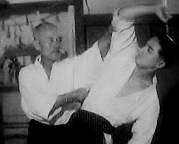
Striking arts (atemi) are an integral part of aikido practice. It is often stated that as much as 70% of Aikido is about atemi. Some sources suggest that this percentage should be more like 90%.
While atemi waza can be an end in itself, it is also used in Aikido to do any or all of the following:
setting up a technique by taking the nage’s balance; or
diverting the uke’s attention; or
completing a technique.
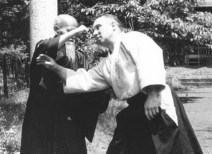
In the below videos, Morihiro Saito Sensei (1928-2002) demonstrates some of the striking options practised by Master Morihei Ueshiba (the Founder of Aikido) in the post war period of his training. Consistent with our commitment to study the Aikido of the Founder, the demonstrated striking options form an important part of the training that we undertake at the dojo.
For ease of reference, the videos are arranged based on classification of technique.
In Aikido, strikes (atemi) are often used to set up techniques, as well as being an end in themselves.
In the below video Koretoshi Maruyama Sensei demonstrates and provides instruction on how strikes to the torso (munetsuki) are executed in Aikido Yuishinkai.
The demonstrated method of munetsuki generates its power through the lower limbs to take full advantage of what is sometimes referred to in Aikido as the vertical-horizontal plane. In most simple terms – one sinks to move forward.
The result is that the strike is backed by the entire body of the nage rather just the activation of the muscle groups in the upper arm. It also allows the nage’s body to naturally move off the line of an incoming direct attack and facilitates extra strike reach than would normally be expected (see below video).
For further videos and discussion of atemi waza in Aikido training on this site see – Atemi arts (striking)
Direct strikes to the forehead (shomenuchi) are a common form of striking technique (atemi) in Aikido practice. However, while there are a variety of effective ways to deal with these types of attacks, none include “blocking” the attack with the same attack.
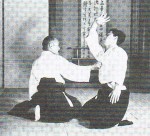
Blocking a shomenuchi with a shomenuchi places the nage in a significantly disadvantaged position as it is very difficult to break the uke’s balance (kuzushi) at first contact. This is due to the fact that the uke started their strike first and in all probability is going to be in the best strategic position (see photo to left). This is particularly so if they are centred, have the size advantage or armed with a weapon.
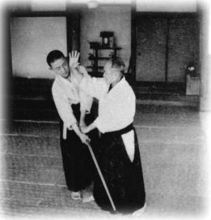
An alternate (albeit not the only) option to address a shomenuchi is to enter and strike the centreline of the uke‘s undefended torso (see photo to left). Key aspects of this option are explored in the below video featuring Peter Kelly Sensei, Chief Instructor of Aikido Yuishinkai Australia.
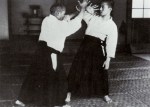
Notably, in O’sensei’s text Budo (1936) there are numerous examples where O’sensei essentially initiates a strike to cause the uke to defend themselves by using shomenuchi. This however is a ruse to set up O’Sensei’s true objective which is to strike the uke‘s centre line as the precursor to executing a technique. Examples where this tactic is used include shomenuchi irimi nage, shomenuchi ikkyo (illustrated in photo above), shomenuchi kotegeashi and katadori menuchi techniques.
Have a great week, particularly those travelling to this year’s annual Aikido Yuishinkaiseminar with Maruyama Sensei in Hobart (25-29 November 2015).
Ian Grant
Head Instructor
Aikido Warrior Dojo, Brisbane
Striking techniques (atemi waza) are an integral part of aikido practice. While atemi is typically used in modern Aikido as a means to set up a throwing technique, it may also be used as method of ending a confrontation on its own.
In the below video Master Koretoshi Maruyama, Founder of Aikido Yuishinkai, provides instruction on how to use atemi as a sole response to addressing a downward direct strike to the forehead (shomenuchi) where the attacker is armed with a wooden sword (bokken).
The video was recorded in 2005 at Byron Bay, Australia.
Have a great week.
Ian Grant
Head Instructor
Aikido Warrior Dojo, Brisbane
Master Morihei Ueshiba (O’sensei), the Founder of Aikido, produced 2 instructional manuals for his martial art in the 1930’s.
Evident in both manuals is the time and effort taken to not only write but also make visual representations to support the instruction. For example, in one of the manuals there are 166 techniques, all of which are accompanied by hand drawings to assist the reader.
In the 2nd manual, the instructional aspects are supported by photographs. However, even this would have been painstakingly long process given the relative primitive state of photography at the time.
Unfortunately, and one might even say bizarrely, neither of the manuals appear to be a major reference point for modern aikido practice with the exception of Iwama Aikido. I have heard a number of reasons given for this. However, they also seem to share the common ground that O’Sensei’s pre-war Aikido (or Aikido Budo as it was then labelled) was very different to post-war, hence making the manuals historically interesting but largely irrelevant.
I have long struggled with this argument as it doesn’t align with personal experience. For example, we frequently use the manuals as reference points to inform our practice in our dojo and have found them to be very relevant and insightful in our study of O’Sensei’s Aikido through Aikido Kenkyukai.
In fact I would go as far to say that in substance O’Sensei’s prewar Aikido share many similarities with his post war Aikido. The main differences being that in his later years O’sensei seems to have stopped teaching the more complex pins. Other changes could be described as refinements and at most, alternative variations.
However, don’t take my word for it. Look at the below video and make up your own mind.
In the meantime, I think we at Aikido Warrior Dojo will continue to hold the only written technical teachings of the Founder of Aikido in the highest regard.
Ian Grant
Dojo Cho
Aikido Warrior Dojo
Acknowledgement: The above video was not made by Aikido Warrior Dojo, but by a person who goes by the You tube name of Marius V. While I have never met Marius V, I would like to acknowledge and thank him for his extraordinary work in producing the video.
 Striking arts (atemi) are an integral part of aikido practice. It is often stated that as much as 70% of Aikido is about atemi. Some sources suggest that this percentage should be more like 90%.
 In the below videos, Morihiro Saito Sensei (1928-2002) demonstrates some of the striking options practised by Master Morihei Ueshiba (the Founder of Aikido) in the post war period of his training. Consistent with our commitment to study the Aikido of the Founder, the demonstrated striking options form an important part of the training that we undertake at the dojo.




 Aikido Warrior Dojo
You must be logged in to post a comment.