All posts

Internal strength and Aikido – An experiment in breaking boards

Its always interesting to experiment with Aikido applications.  Sometimes the experiments work out, sometimes not.  Its all part of the learning experience.

With this spirit in mind,  I recently decided to participate in a test to see if Aikido principles could be applied to break boards normally reserved for students of striking arts.  Now I should state from the outset that I have never previously tried or even considered breaking a board with my hand.  The chance of being attacked by a pile of lumber just seemed too remote to bother with such a proposition.

I resolved to attempt to break a board with an open palm downward atemi (strike) using the suwai sho 2 movement from the Aikido Yuishinkai junan taiso.  This taiso exercise is something most Aikido Yuishinkai students do at the start of just about every  class. Most importantly for the subject experiment, it’s an exercise that generates power from your centre in a downward direction.

Throwing  caution to the wind, I tried to break a (new) JOLS re-breakable board designed for advanced karate students. Of some concern was that, according to its packaging, the board required 114kg of impact power to break. Further, there was internet commentary  to the effect that experienced striking art students often had difficulty breaking the board.  This information didn’t inspire me with confidence.

My first attempt failed miserably and painfully. Fuelled by trepidation, I used the one strategy that could never work – I resorted to physical strength.  On contact, my palm felt like it was going to explode and the throw back vibration went through both my hand and arm so hard I’m sure my ancestors felt it. There was no doubt some well deserved bruising was coming my way.

Just prior to my second attempt, I resolved this time to rely only on fundamental Aiki principles – standing straight, relaxing completely, moving from my centre, keeping weight underside, dropping through the elbow and maintaining an unbendable arm.  I also removed from my mind the fact that the point of contact with the board was going to be my still smarting hand.

I’m pleased to say my hand this time went through the board like it was slicing butter (see video below). I didn’t feel any pain or reverberation at all.  After breaking the board a few more times, I then had a go at breaking 2 boards which required 143 kg of  impact power to break.  Succeeded again!

So there you go – Aiki principles like moving from your centre, weight underside, unbendable arm and relaxed power really do work!

All the best

Ian

Credits: Big thanks to Robert Monro for his help in setting up, support and encouragement of the experiment. Also to Darren Philips for his impromptu recording of the exercise.
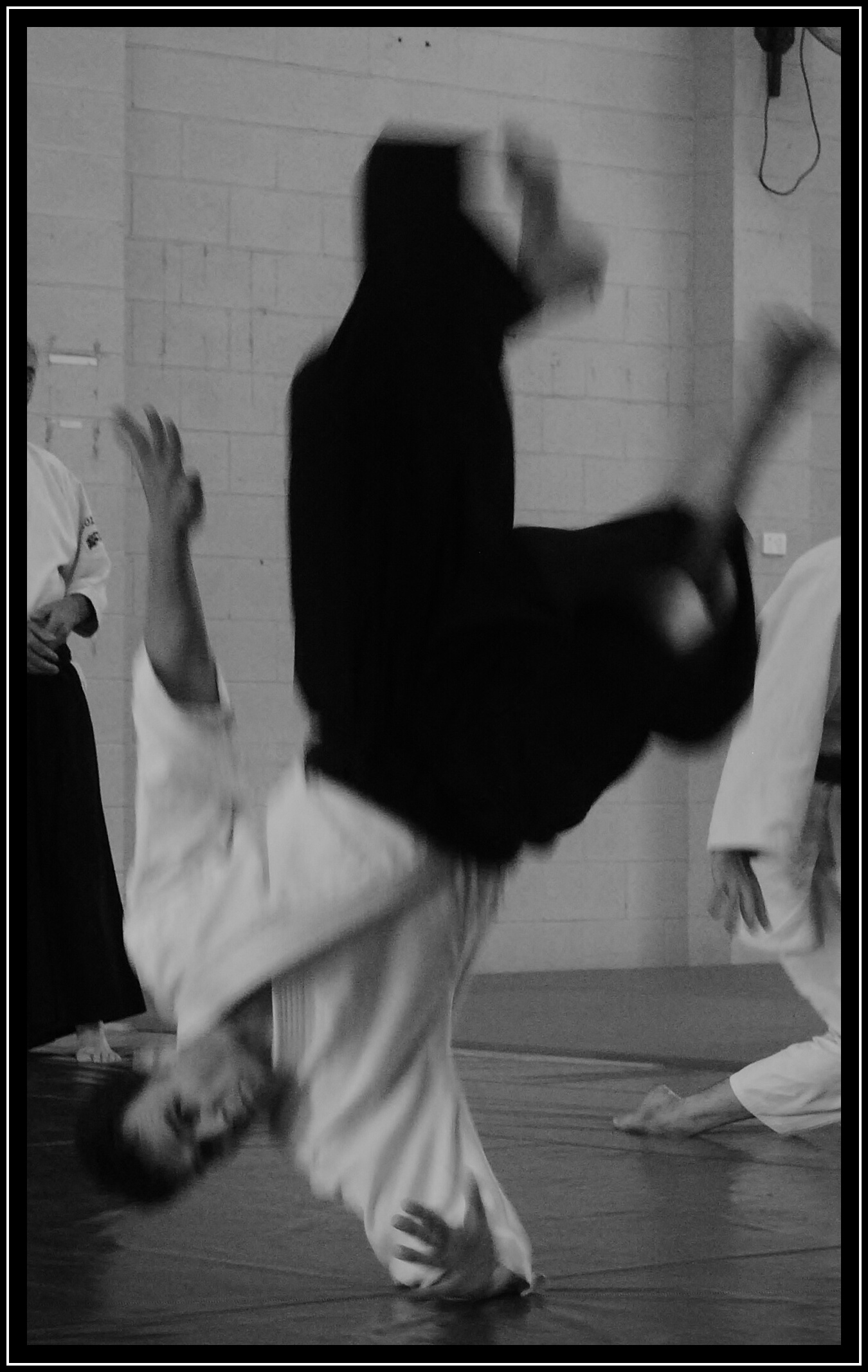
Aikido – I do all my own stunts!

I recently watched an interview with wrestler Hulk Hogan where he said that in professional wrestling the ending is predetermined but the “bumps are real”.

Ian Grant (a)It crossed my mind that this is the same situation in Aikido.  When we practise kata or tanininzugake the agreement is usually that at the end the nage will still be standing and the uke will one way or another be knocked to the ground.   As in professional wrestling, the pre-arranged understanding between the nage and uke does not change the fact that for the uke the final meeting with the mat is going to be very real.

The message we should probably all keep in mind is that at the end of the day we owe it to ourselves to stay safe.  Below are some personal views on ways to keep in one-piece.

Tanking

Some people will be immediately appalled that I would suggest that tanking (i.e. just falling down) is ever an acceptable strategy.  However, in a modern Aikido world where newcomers can be on the receiving end of techniques within 20 minutes of starting their first lesson, tanking is probably the only safe option available for them.

Predictive ukemi

Predictive ukemi occurs where the uke essentially predicts to varying degrees what the nage is about to do and moves themselves into a position to best take ukemi from it with minimum possibility of injury.

I find this type of ukemi particularly useful where:

  • There is uncertainty as to the ability of the nage to execute their techniques without unnecessarily compromising their own safety or that of the uke’s (This may be linked to the type of technique or practise being explored, the experience levels of the nage or uke, or for other reasons);
  • atemi (strike) based or no touch techniques are being practised or employed (see video below);
  • the “shape of a technique” is being demonstrated to a person who has not previously seen or experienced it; or
  • the uke is seeking to experiment or simply develop their ukemi skills when receiving specific techniques.

The below short video is an example where predictive ukemi is used to protect the uke from getting a good belt to the face (and potential trip to the dentist) from an atemi based technique.

Non-predictive ukemi

I use the term non-predictive ukemi to refer to those situations where the uke strikes or attacks with no regard to the likely technique or action to be taken by the nage.  The form of ukemi ultimately employed by the uke at the conclusion of the technique is accordingly unknown until the last moment.   

While this is a highly worthwhile and quite exhilarating form of training, it requires a strong trust between the nage and uke, including an understanding that the nage will at all times have the highest regard for the uke’s safety when executing their techniques.  Particularly important is that the nage appreciates and adapts the intensity of their techniques to correlate with the uke’s experience level and falling skills.

Reactive ukemi     

This is my favourite form of ukemi.  While still non-resistant in nature, the essence of this ukemi is that when the uke feels their centre is being taken, the uke reacts by blending with nage’s actions and attempts to regain their balance.  A sensitive nage will immediately adjust the application of the technique to compensate.  The typical end result is Aikido being dynamically practised with power and grace.

Many of the Aikido demonstrations by Christian Tissier Sensei (7th Dan) are examples of this type of practice at its highest level – see for example Tissier Bercy 2005 HD (at o:59 to 1:39).

However, I would only recommend engaging in this method of uke arts (particularly in taninzugake) if your ukemi skills are well-developed and have become second nature.  My own experience is that the speed in which you come out of the technique seems to significantly increase with this type of training.  In addition, I sometimes find the gracefulness can be dangerously deceptive and the final powerful meeting with the mat can be quite a mental shock.

Aikido – I do my own stunts

At the end of the day, we in Aikido do our own stunts and no one stands in for us when we fall from an applied technique.  To stay safe, the most important thing for us is to use common sense and practise at a level commensurate with our ability to walk away safely in the most likely event that we meet the mat.

All the best

Ian Grant

Class Training Notes 19/1/2013

Another hot Saturday morning and another excellent turnout.  It’s always great to have guests drop in from other dojos.  This week we were fortunate to have Erwin Sensei (Nathan Dojo), Angela (Aikido Republic Dojo) and Neil (Aikido Republic Dojo) drop in for a visit.

Okay lets’ look at what we covered.

Third-third-third principle

The big emphasis this week was having regard to the third-third-third principle to maintain optimal balance. Under this principle, the distance between the feet is divided into thirds and the Aikido practitioner’s centre moves only within the middle third.  The principle applies regardless of whether you’re standing stationary (e.g. in hanmi) or moving.

The principle was explored in the Aiki Taiso (Exercises for Aikido arts) with particular reference to the Ikkyo, Sayu and Sayu choyaku exercises. It was also looked at in the context of applied techniques, including atemi (striking techniques).

Ukemi

Ukemi this week focussed on breakfalling.

I recently watched Erwin Sensei teach breakfalling by having the uke roll out multiples of times from a zenpo nage (projection technique), but each time rolling out smaller and smaller until they ultimately rolled out into a low breakfall.

I intended to cover this rather novel and natural approach to breakfalling in the class today.  It was an absolute bonus when Erwin Sensei decided to visit the dojo.  Big thanks to Erwin Sensei for agreeing to take this part of class and sharing his knowledge.

Yoko otoshi (side drop)

In terms of applied ukemi, the technique this week was yoko otoshi (side drop).  This technique really tests the uke’s ability to take ukemi from a strong projection.  The technique is also interesting as its one of the few sacrifice techniques in Aikido.

20100928081322(3)For those wishing to explore this some more, there are a few examples on You tube (e.g. see Aikido yoko otoshi).  You may also wish to search under uke waza which is the Judo equivalent to this technique.  Maruyama Sensei also covers the technique in one of his earlier instructional DVD’s (sorry no You Tube clips available).

Munetsuki techniques

At Susan’s request we covered menutsuki (punch to stomach or chest) techniques this week.  Techniques covered were as follows:

  • Menutsuki ushirodori (hold from behind)
  • Menutsuki koteagaeshi (outward wrist turn)
  • Menutsuki kirikaeshi (cut and return)
  • Menutsuki zenpo nage (forward projection) – using a single cut.

I particularly like menutsuki ushirodori – it’s simple, direct and effectiveIt’s one of those techniques that just seems to always work once you get the hang of the kuzushi (taking balance) part and the “wet blanket” feel when applying it.

Although slightly different from the munetsuki ushirodori we tend to do in our School, I found some interesting instruction on this technique in the following You Tube video.  What I like about this video is that it demonstrates the power that can be generated if the technique is done properly.

We also looked at responding to munetsuki strikes from the open side. To me, use of atemi (striking) is strongly advisable if the nage is going to avoid the possibility of a second strike from the uke’s other hand.  We looked at entering using Ikkyo atemi for this purpose (again employing third-third-third principle).

Taninzugake

With gradings coming up in a week’s time, taninzugake (multiple attacks) was a big part of the class.  Taninzugake is  particularly emphasised in our school as it gives students the opportunity to develop their techniques in free form practice.

I found this short taninzugake demonstration by Master Koretoshi Maruyama (the founder of Aikido Yuishinkai).  Those who haven’t seen it before may find it quite interesting.

All the best

Ian

Aikido without kuzushi – It’s like pizza without cheese

For Aikido to be practised with any element of martial integrity, the ability to employ kuzushi when applying a technique is a critical skill.

I would go as far as to say that in the absence of employing kuzushi it would be almost impossible to successfully apply any Aikido technique against a structurally centred and non-compliant aggressor of equal size and strength.

For those not familiar with the term kuzushi, it is most commonly used in a martial context as a reference to unbalancing the person who is initiating the attack (uke).  In other words, it involves bringing the uke’s center of gravity beyond their base of support and hence removing their ability to regain uncompromised balance.  While in this unbalanced position, it becomes very difficult for the uke to resist or counter the application of an appropriate Aikido technique.

While it all sounds so simple, learning to employ kuzushi is far from easy in practice. Amongst other things, it requires relaxed sensitivity, timing, and the ability to redirect an attacker’s energy.  If that isn’t challenging enough, kuzushi also needs to be employed at the time of first contact with the uke and then maintained throughout the application of the technique.

Unfortunately, I note there are a number of Aikido commentators around the web that appear to be concerned there is a trend in modern Aikido to de-emphasise and in some cases disregard the important role of kuzushi. I certainly hope these concerns are unfounded.

Excluding kuzushi from our practice would effectively render Aikido useless from a martial perspective.  For me, Aikido without kuzushi is like pizza without cheese. It’s not something I’m interested in trying.

Ian Grant
Head Instructor
Aikido Warrior Dojo


Class Training Notes: 12/1/ 2013

Well Saturday was a scorcher in terms of the weather and I must say I was surprised how many of us decided to hit the mat.  I can’t recall the last time I trained in such heat.  The fact that we all stuck in there until the end (including a rather energetic round of taninzugake) is either a testament to our dedication or madness.   Anyhow – on with the notes.

Ukemi

This week we looked in more detail at the backward roll (ushiro ukemi).

As most people will attest, backward rolling when you first start out can be something of a challenge.

Roll 1In essence a backward roll is nothing more than a forward roll executed in reverse. The problem is if you have poor form in your forward roll (e.g. you circus tumble) and then attempt to execute that poor form in reverse, the chances of successfully executing the roll are close to nil.  There is also the possibility of injuring your neck in the failed attempt.

Below is a link to a You Tube video demonstrating step-by-step how to forward and backward roll by Donovan Waite Sensei (7th Dan).  I would highly recommend anyone who is learning to backward roll or just seeking some pointers on how to improve their backward (or forward) rolling to closely study this video clip.  Further, it’s an excellent resource that caters for those interested in beginner or advanced ukemi.

Link: Aikido Ukemi – Meeting the mat

kaeshi waza

This week we practised kaeshi waza in the context of reversing the execution of katatedori shihonage tenkan (i.e. same side one hand hold – four direction throw).  The significance of this practice was to demonstrate how relatively easy it is to reverse a katatedori technique if the ukes balance is not taken at the moment of first physical contact with the nage (the person executing the technique).

For those interested in looking at this kaeshi waza technique again, you may wish to check out the first part of the following You Tube clip: Kaeshi waza 1 (at o:40 mark).

Katatedori

Katatedori techniques were the theme this week with a particular emphasis on unbalancing the uke (the attacker) at first contact.  This takes considerable practice.

In class we looked at how to unbalance a uke by making contact with the uke’s grab prior to that expected by the uke and, in addition, unexpectedly offering no clash at the time of the early contact.  A You Tube  video that neatly demonstrates and explains this concept is Aikido  Kuzushi Katsu Hayabi  Effortless Activation.

For those who keep a record of such things, the techniques practised this week were Katatedori ikkyo ura and Katatedori irimi kokynage.

Kokydosa

Craig Boyd Sensei kindly agreed to provide us with an instructional session on full contact kokydosa with a standing nage.  I find this type of training quite interesting as it really steps up your sensitivity and hones your awareness of your center.  One thing that I did notice was that when we eventually went back to practising standard kokydosa, the practise from the nage’s perspective felt absolutely effortless.

I would like to particularly thank Craig Sensei for sharing his knowledge of this rather novel form of practice with us.  It’s really interesting stuff and also a reminder of the rich Samurai heritage that predated the formation of Aikido.

Weapons kata

With gradings set for 26 January 2013, Gary and Zac gave excellent demonstrations of the “sword of nine ways” and “Shooting star” weapons katas.

Skills acquired through committed weapon practice translate directly and positively to improving our unarmed techniques. Benefits of weapons practice include the development of ki extension, correct posture, calmness of mind, foot work, atemi (striking), moving from one’s centre, coordination, focus and calmness of mind.

Big thanks to Craig Sensei, Gary and Zac for their contributions in this part of the class, which also served as a tool for looking at some of the ceremonial aspects of our martial art, particularly in a grading context.

Look forward to seeing you all next week.

Ian