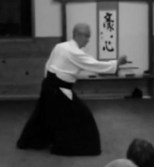
Atemi

Hitotsu no tachi – Aikido Yuishinkai

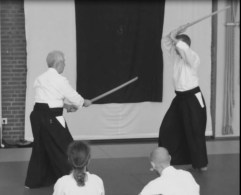
Bokken practice - partnered.In the below video Master Koretoshi Maruyama, Founder of Aikido Yuishinkai, provides instruction for the partnered bokken kata – Hitotsu no tachi as practiced in Aikido Yuishinkai.

Hitotsu no tachi (like all partnered bokken practice in our school) is choreographed with both participants having predetermined movements and roles.

Skills developed through 2 person bokken kata directly transferable to unarmed training include those related to:

  • blending and parrying;
  • timing;
  • using small body movements to generate power and move off-line (this is achieved through correct use of the hips and moving the body as a single entity);
  • Entering and related footwork; and
  • Stillness of mind.


The video was recorded in 2012 in Rotterdam as part of an Aikido Yuishinkai International Seminar.  It was made available courtesy of Aikido Yuishinkai International Instructor, Martijn van Hemmen Sensei.

Have a great week.

Ian Grant
Head Instructor
Aikido Warrior Dojo


“Four Gods” Bokken Kata – Aikido Yuishinkai

4 GodsIn the below video Master Koretoshi Maruyama, Founder of Aikido Yuishinkai, provides instruction on one of the three major bokken katas practised in Aikido Yuishinkai – “The Four Gods” kata (Shishin no ken).

The video was recorded in 2012 in Rotterdam.  In addition to instruction by Maruyama Sensei, it includes a demonstration of the kata by Aikido Yuishinkai International Instructor, Martijn van Hemmen Sensei.


  • Acknowledgements

I would like to thank Martjin Sensei for both making available and giving me permission to publish his video recordings of the 2012 International Aikido Yuishinkai Seminar.

Have a great long weekend.

Ian Grant
Head Instructor
Aikido Warrior Dojo
 

Striking options in Aikido practice

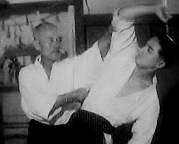
morihei-ueshiba-gozo-shioda-1940-croppedStriking arts  (atemi) are an integral part of aikido practice.  It is often stated that as much as 70% of Aikido is about atemi.  Some sources suggest that this percentage should be more like 90%.

While atemi waza can be an end in itself,  it is also used in Aikido to do any or all of the following:

  • setting up a technique by taking the nage’s balance; or
  • diverting the uke’s attention;  or
  • completing a technique.

atemi o-sensei-atemiIn the below videos, Morihiro Saito Sensei (1928-2002) demonstrates some of the striking options practised by Master Morihei Ueshiba (the Founder of Aikido) in the post war period of his training. Consistent with our commitment to study the Aikido of the Founder, the demonstrated striking options form an important part of the training that we undertake at the dojo.

For ease of reference, the videos are arranged based on classification of technique.

ATEMI OPTIONS

  • Atemi waza – Irimi nage


  • Atemi waza – Kokyu nage


  • Atemi waza – Kotegeashi


  • Atemi waza – Nikyo


  • Atemi waza – Shiho nage


Have a great weekend

Ian Grant
Head Instructor
Aikido Warrior Dojo
 

Atemi waza – Munetsuki strikes

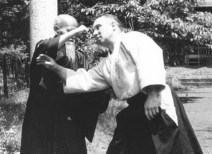
MunetsukiIn Aikido, strikes (atemi) are often used to set up techniques, as well as being an end in themselves.

In the below video Koretoshi Maruyama Sensei demonstrates and provides instruction on how strikes to the torso (munetsuki) are executed in Aikido Yuishinkai.

The demonstrated method of munetsuki generates its power through the lower limbs to take full advantage of what is sometimes referred to in Aikido as the vertical-horizontal plane.  In most simple terms – one sinks to move forward.

The result is that the strike is backed by the entire body of the nage rather just the activation of the muscle groups in the upper arm.  It also allows the nage’s body to naturally move off the line of an incoming direct attack and facilitates extra strike reach than would normally be expected (see below video).


For further videos and discussion of atemi waza in Aikido training on this site see – Atemi arts (striking)

Have a great week.

Ian Grant
Dojo Cho
Aikido Warrior Dojo


Bokken exercise – Mawashi uchi

Morihei-Ueshiba-Bokken-211x300The practice of bokken (wooden sword) arts is an integral part of Aikido training in Aikido Yuishinkai.  Amongst other things, solo and paired bokken practice plays an important role in helping develop key skills for unarmed arts.  These skills include foot work, distance, timing, centred movement, correct posture and striking.

At our dojo we take an integrated  approach to the role of the bokken in our studies. For example, when we practice unarmed arts we look at the inherent bokken movements contained within the particular technique.  Conversely, when practising with the bokken, this is always done with a focus on the skill groups we are trying to develop to aid our unarmed practice.  The benefit of taking this approach is that it continually gives our training context.

In the below video Master Koretoshi Maruyama, Founder, Aikido Yuishinkai provides instruction on the fundamental foot work and cutting movements for the bokken exercise mawashi uchi.  Also included  in the video is a demonstration by Peter Kelly Sensei (Chief Instructor Australia) and Alistair Williams Sensei of the paired practice application of the exercise.

Have a great weekend

Ian Grant
Head Instructor
Aikido Warrior Dojo