Aikido

So why open a dojo?

The decision to open up a new Aikido dojo is certainly not for the faint of heart.  In the modern world, its establishment alone is filled with many challenges and responsibilities, including arranging insurance, dojo space, affiliations, mats, licences, management and financial systems, compliance with legislative obligations, policies and procedures, advertising, …. and the list goes on.
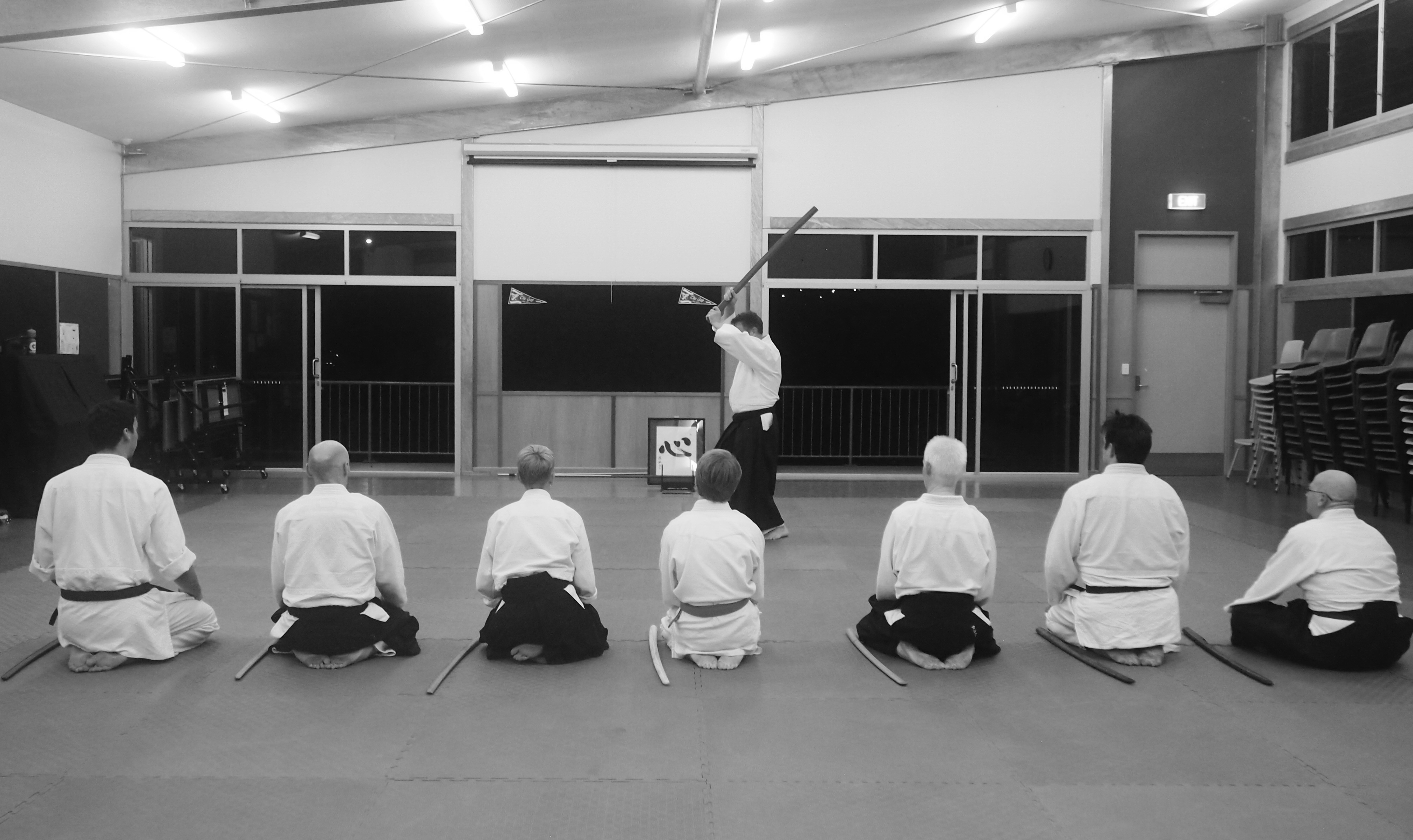
OLYMPUS DIGITAL CAMERAWith all these issues, and the fact that it’s much easier to be a student or guest teacher at someone else’s dojo, the most common question I get asked is why did you open up a dojo?

For me the answer to this question is simple – it’s something I’ve dreamed of doing since the first day I stepped on a martial arts mat some 40 or so years ago. Back then it was a Judo mat, but as time went on I transitioned into Judo’s sister art, Aikido.  While the martial art changed, the dream to start my own dojo never waned.

So what is it about a dojo (or “place of the way”) that makes it so special?  The obvious answer is that it’s a place where you get to learn, explore, share, and practice your Japanese martial art of choice with those who have a similar passion and interest.

For me, however, a dojo is more than this. It’s a place where we can leave our problems at the front door and for the relatively short time that we are there, live in a world which is positive, encouraging, free of politics, welcoming, non-discriminatory and fun.

OLYMPUS DIGITAL CAMERAThe way I see it, the world is full of institutions, systems and individuals apparently hell-bent on putting people down and stripping them of their confidence. A dojo is an escape from this. My suggestion to anyone who has walked into an Aikido dojo and experienced feeling worse about themselves than when they went in – find another dojo.

And so when I opened the doors of Aikido Warrior Dojo for the first time on Saturday morning 8 March 2014, I had no doubts about what I was doing – this is where I was supposed to be. The fact that we were immediately greeted by 2 “welcome swallows” who decided to join us while we set up seemed only appropriate.

Finally a big thank you to everyone who helped set up Aikido Warrior Dojo in the last couple of weeks.  I couldn’t have done it without you.

Ian Grant Sensei
Head Instructor
Aikido Warrior Dojo

One Saturday morning – Aikido in stills

OLYMPUS DIGITAL CAMERAThere are plenty of blogs on the internet devoted to reports about Aikido seminars and other special events.  However, what is not seen so often, are blogs dedicated to a regular Aikido class. That is, the type of class most of us train at each week.

This month’s blog is about one such class that I lead at Everton Hills Dojo on the outskirts of Brisbane, Australia. The date: Saturday, 7 September 2013.

I was going to write a detailed overview of the class.  Then I thought, “what the heck”, a picture (or in this case a photo) paints a 1000 words, so I did a photo library instead.

When you look at the pics, keep in mind most of us are over 35 (some into our 50’s), hold full-time jobs and practice Aikido around our life commitments. Also, those without a hakama (i.e. the black Japanese pants) have been practising less than 2 years.

All in all – I think we do pretty well.

This slideshow requires JavaScript.

Ian Grant

Aikido training – Drawing the line between cooperative and pointless practice

The need for a cooperative dynamic in Aikido practice is widely acknowledged by most of us who practice the Art.  Aside from the non-competitive philosophy that underpins Aikido, there is the practical reality that many techniques would be unsafe to practise without at least some element of compliance from our training partner.

OLYMPUS DIGITAL CAMERAA question worthy of consideration, however, is where to draw the line between cooperative practice and pointless practice (i.e. practice that removes or substantially diminishes the opportunity for both parties to learn).

For example, having our training partner just “tank” at the first opportunity removes the learning opportunity for both the nage and the uke. The same could be said where an often well-meaning training partner just rolls out of a technique regardless of whether the person supposedly executing it has functionally done anything to cause such a reaction.

For training to have learning validity, I think a good starting point is an acknowledgement that Aikido practice is between two equals.  That is, it’s not between a human and a rag doll, or a human and some form of “uke-bag”.

Quite the contrary, Aikido practice involves an ongoing  2 way interaction between the attacking  and responding partners (i.e. the uke and nage) who are acting as equals with a view to enhancing their mutual knowledge and skills. This is so, whether it be in the form of kata or free-form practice (taninzugake).

That being said, where one draws the line between 2 equals engaging in productive cooperative practice, as opposed to pointless practice, is something that might cause reasonable minds to differ. Certainly, even the very notion of such a concept as “pointless  practice” imports an element of subjectivity.

OLYMPUS DIGITAL CAMERAHowever, as a working model for uke’s trying to keep on on the right side of the cooperative line, I think a practice methodology whereby the uke acts as follows is not a bad start:

  • The uke does not give up their centre (this is something the nage learns to take, which is not possible if it is sacrificed by the uke);
  • The uke gives the nage their weight to work with (without this, the nage has no sense of the reality of what they are doing).
  • The uke gives an honest attack (e.g. if the attack is a strike to the head, they don’t aim to miss or predict the nage’s response).
  • The uke gives a committed attack  (i.e. the uke follows the attack through to the end and doesn’t stop half way);
  • The uke stays mentally connected with the nage from the beginning through to the completion of the attack (aside from importing an element of realism, this also enhances the safety of the practice);
  • The uke ensures that the intensity of the attack is commensurate with the abilities of the nage, the skills of the uke to safely respond and the purpose of the practice.

How far the uke can go beyond this line before degenerating into competitive and potentially dangerous practice is worthy of an article on its own.  Certainly, enthusiastic free form practice can inadvertently and quite quickly slip over into competitiveness and potential danger.  Fortunately, one of the roles of the class sensei is to intervene at this point and save us from ourselves!

Ian Grant

Aikido – A forgiving approach to self-defence

Zenponage - Ian Grant and Brendan Carter A couple of weeks back, I was talking after class with a relative newcomer to our Art who had been pondering on a number of philosophical issues relevant to the martial practise of Aikido. The discussion went along the lines that if Aikido is not about teaching people how to fight, then what is it really about.

There is probably no right or wrong answer to this question.  Speaking from a strictly martial context, my own view is that Aikido is about giving the practitioner skills to allow them the choice between a forgiving response and a destructive response to an attack.

I think it would be fair to say that in most violent altercations the respondent to an attack ordinarily only has the option of a destructive response.  This response involves either applying a destructive force to repel the attacker or accepting self destruction through submission.  What Aikido facilitates is giving the recipient of an attack another option.

In Aikido we learn to merge an attacker’s energy (or ki) with our own energy such that the attacker’s centre of balance is taken while our centre remains strong. The result is that for a moment of time the attacker is completely vulnerable.  It is at this point that the Aikido practitioner is in a position to make a choice between one of 2 options.

The first option is a forgiving response where damage to the attacker is minimalized to that necessary to end the attack (i.e. through the application of an Aikido technique). The second option is to take advantage of the attacker’s weakened structural position and execute maximum damage to the attacker, such as a strike to a vital organ.  In Aikido we obviously advocate the first choice.

Taken from this perspective, Aikido is not about learning skills to destroy an attacker, but rather learning skills to have the option of a more forgiving response.

All the best

Ian Grant

Other references which may be of interest

(a) Some thoughts on self-defence by Dan James Sensei at http://www.aikidorepublic.com/articles/brisbane-self-defence

(b) Toppling (kuzushi) by Dan James Sensei at http://www.aikidorepublic.com/internal-strength/03topplingkuzushi

(c) Aikido: Christan TISSIER in Budapest 2013 (teaching) at http://www.youtube.com/watch?feature=player_detailpage&v=9PQv5aR_hsg (particularly at about 11.07 mark) – Christian Tissier Sensei comments on the destruction/forgiveness choice in Aikido applications.

Aikido – I do all my own stunts!

I recently watched an interview with wrestler Hulk Hogan where he said that in professional wrestling the ending is predetermined but the “bumps are real”.

Ian Grant (a)It crossed my mind that this is the same situation in Aikido.  When we practise kata or tanininzugake the agreement is usually that at the end the nage will still be standing and the uke will one way or another be knocked to the ground.   As in professional wrestling, the pre-arranged understanding between the nage and uke does not change the fact that for the uke the final meeting with the mat is going to be very real.

The message we should probably all keep in mind is that at the end of the day we owe it to ourselves to stay safe.  Below are some personal views on ways to keep in one-piece.

Tanking

Some people will be immediately appalled that I would suggest that tanking (i.e. just falling down) is ever an acceptable strategy.  However, in a modern Aikido world where newcomers can be on the receiving end of techniques within 20 minutes of starting their first lesson, tanking is probably the only safe option available for them.

Predictive ukemi

Predictive ukemi occurs where the uke essentially predicts to varying degrees what the nage is about to do and moves themselves into a position to best take ukemi from it with minimum possibility of injury.

I find this type of ukemi particularly useful where:

  • There is uncertainty as to the ability of the nage to execute their techniques without unnecessarily compromising their own safety or that of the uke’s (This may be linked to the type of technique or practise being explored, the experience levels of the nage or uke, or for other reasons);
  • atemi (strike) based or no touch techniques are being practised or employed (see video below);
  • the “shape of a technique” is being demonstrated to a person who has not previously seen or experienced it; or
  • the uke is seeking to experiment or simply develop their ukemi skills when receiving specific techniques.

The below short video is an example where predictive ukemi is used to protect the uke from getting a good belt to the face (and potential trip to the dentist) from an atemi based technique.

Non-predictive ukemi

I use the term non-predictive ukemi to refer to those situations where the uke strikes or attacks with no regard to the likely technique or action to be taken by the nage.  The form of ukemi ultimately employed by the uke at the conclusion of the technique is accordingly unknown until the last moment.   

While this is a highly worthwhile and quite exhilarating form of training, it requires a strong trust between the nage and uke, including an understanding that the nage will at all times have the highest regard for the uke’s safety when executing their techniques.  Particularly important is that the nage appreciates and adapts the intensity of their techniques to correlate with the uke’s experience level and falling skills.

Reactive ukemi     

This is my favourite form of ukemi.  While still non-resistant in nature, the essence of this ukemi is that when the uke feels their centre is being taken, the uke reacts by blending with nage’s actions and attempts to regain their balance.  A sensitive nage will immediately adjust the application of the technique to compensate.  The typical end result is Aikido being dynamically practised with power and grace.

Many of the Aikido demonstrations by Christian Tissier Sensei (7th Dan) are examples of this type of practice at its highest level – see for example Tissier Bercy 2005 HD (at o:59 to 1:39).

However, I would only recommend engaging in this method of uke arts (particularly in taninzugake) if your ukemi skills are well-developed and have become second nature.  My own experience is that the speed in which you come out of the technique seems to significantly increase with this type of training.  In addition, I sometimes find the gracefulness can be dangerously deceptive and the final powerful meeting with the mat can be quite a mental shock.

Aikido – I do my own stunts

At the end of the day, we in Aikido do our own stunts and no one stands in for us when we fall from an applied technique.  To stay safe, the most important thing for us is to use common sense and practise at a level commensurate with our ability to walk away safely in the most likely event that we meet the mat.

All the best

Ian Grant