First training Saturday of the year and an unexpectedly big turnout. It was also a nice surprise to have seniors from Nathan Dojo and Aikido Republic visit and train with us. Being the first class of the year, the emphasis was on revisiting Aikido fundamentals.
Okay so what did we cover.
The four principles of being an effective and safe uke
The four principles underpinning effective uke arts were examined from an applied Aikido perspective. These principles can be conveniently summarised as follows:
- maintain contact throughout the entire interaction;
- offer a committed attack;
- remain relaxed;
- be sincere.
Reference: Aikido Ukemi (Volume 2) Instructional DVD by Donovan Waite Sensei (7th Dan – Aikikai)
 Improving your front roll
The front roll was explored in detail. For further information and instruction (including video) on how to safely and effectively execute a forward roll from beginner to advanced levels see – How to do a forward roll.
Kaeshi waza (Reversal techniques)
Kaeshi waza shihonage was explored with a view to improving both our forward ukemi and improving our uke connection throughout the execution of an Aikido technique. For an excellent You Tube video explaining this Kaeshi waza application see Kikentai-Berlin: Kaeshi-waza Aikido shiho-nage by Sutemi-nage.
Characters of Aikido – what do they mean?
The word “Aikido” is made up of three Japanese characters: AI, KI and Do. In basic terms:
- “Ai” means literally “to fit” (not “harmony” as is sometimes stated);
- “Ki” means “energy”;
- “Do” means “way”.
It seems reasonable to suggest therefore that a simple working definition of Aikido is “the way of fitting (or merging) energy”. This definition also aids in understanding as to how Aikido is intended to work in an applied context.
How does Aikido work?
At its essence, applied Aikido operates as follows:
- the uke executes an attacking energy (eg strike or grab);
- the nage steps off the line of attack;
- The nage merges with and leads the uke’s attacking energy in such a way as to neutralise its effect (note this merging ideally begins to occur prior to physical connection between the nage and uke and requires timing, a calm state of mind, relaxed execution and sometimes atemi);
- the attacking energy will in most instances be effectively neutralised if the uke is placed in kuzushi (i.e off balanced) and the nage is stable and centred. Ideally entry into kuzushi should occur at the point of physical contact;
- The nage merges and redirects the energy of the off-balanced uke in the direction which causes them most likely to fall.
To make their Aikido work, a student Aikido must engage in repetitive and considered practice with a variety of effective uke.
I recall being told when I first started Aikido that it takes 3000 proper practice executions of a technique for a uke to get even a basic idea of how the technique should feel and work with a cooperating uke in a basic kata.
Techniques covered in class
Katatekosadori (one hand hold – opposite side) techniques were explored with an emphasis on understanding the importance of kuzushi (i.e. breaking balance) in an applied Aikido context.
Katatekosadore Shihonage and Ikkyo techniques were examined with particular reference to using the elbow to neutralise the uke’s attack and maintain kuzushi. For an excellent You Tube video on applying Katatekosadore Shihonage from this perspective see – Donovan Waite Sensei 2008 YMCA Class (see at 1.20 min mark).
In addition, Kotegaeshi and Iriminage techniques were covered with an emphasis on achieving kuzushi at first contact.
Aiki self-defence application – Dealing with a strong katadori attack
Simple self-defence applications were explored in the context of using Aiki principles to respond to a strong katadori attack (one hand shoulder or front lapel grab) after contact has been made. I got lucky with this one and found a most informative You Tube video dealing with the same applications (plus some additional ones) see – Aikido Shihan Robert Nadeau: Aikido vs King Kong.
An important message here is that it is okay and quite natural to be startled, panic, freeze etc when confronted by a real-life threatening and strong attack. Training helps us to promptly regain a calmed mind and appropriately respond in this situation.
Another important message is that in a real life self-defence situation – keep your response simple and as direct as possible.
Kokyu Dosa
The “two fingers of doom” to the chest kokyu dosa technique was explored. Okay that’s not its real name – I just made it up.
The purpose of the exercise was to demonstrate the effect of applying ki extension from the outset before the koky dosa exercise has begun and before physical contact. If this approach is taken the uke can be effortlessly off-balanced by lightly applying just 2 fingers to the chest or shoulder.
A sampler of full-contact koky dosa with a standing nage was also briefly looked at. This is new for all of us and something I would like to ask Craig Sensei to demonstrate further in future classes.
Taninzugake
Two ukes-one nage taninzugake (free form multiple attacks) was practised. Ukes were given a choice of Katatekosadori or katatedori attacks. The two attacker dynamic turns up the pressure a bit on the nage and is certainly a worthwhile practice, particularly as we had so many seniors.
All the best. Look forward to seeing you next week for those who can make it.
Ian Grant
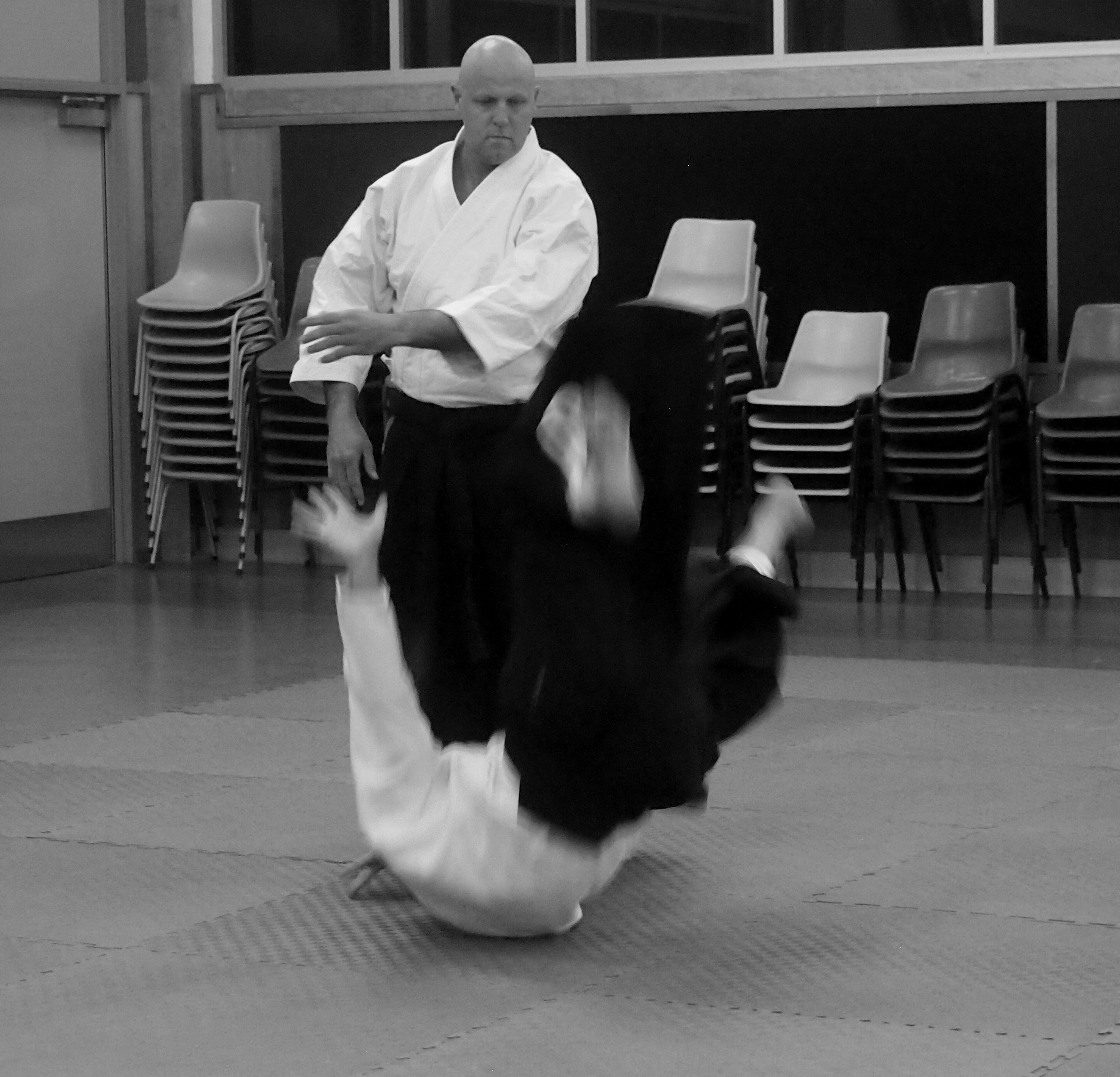 To say his teachings were most insightful would be an understatement. I’ve heard the statement sometimes said that Aikido techniques can be divided into 2 categories – “those for go and those for show”. Peter’s motto is more like there are 2 types of techniques – “those for go and those you haven’t figured out yet”.
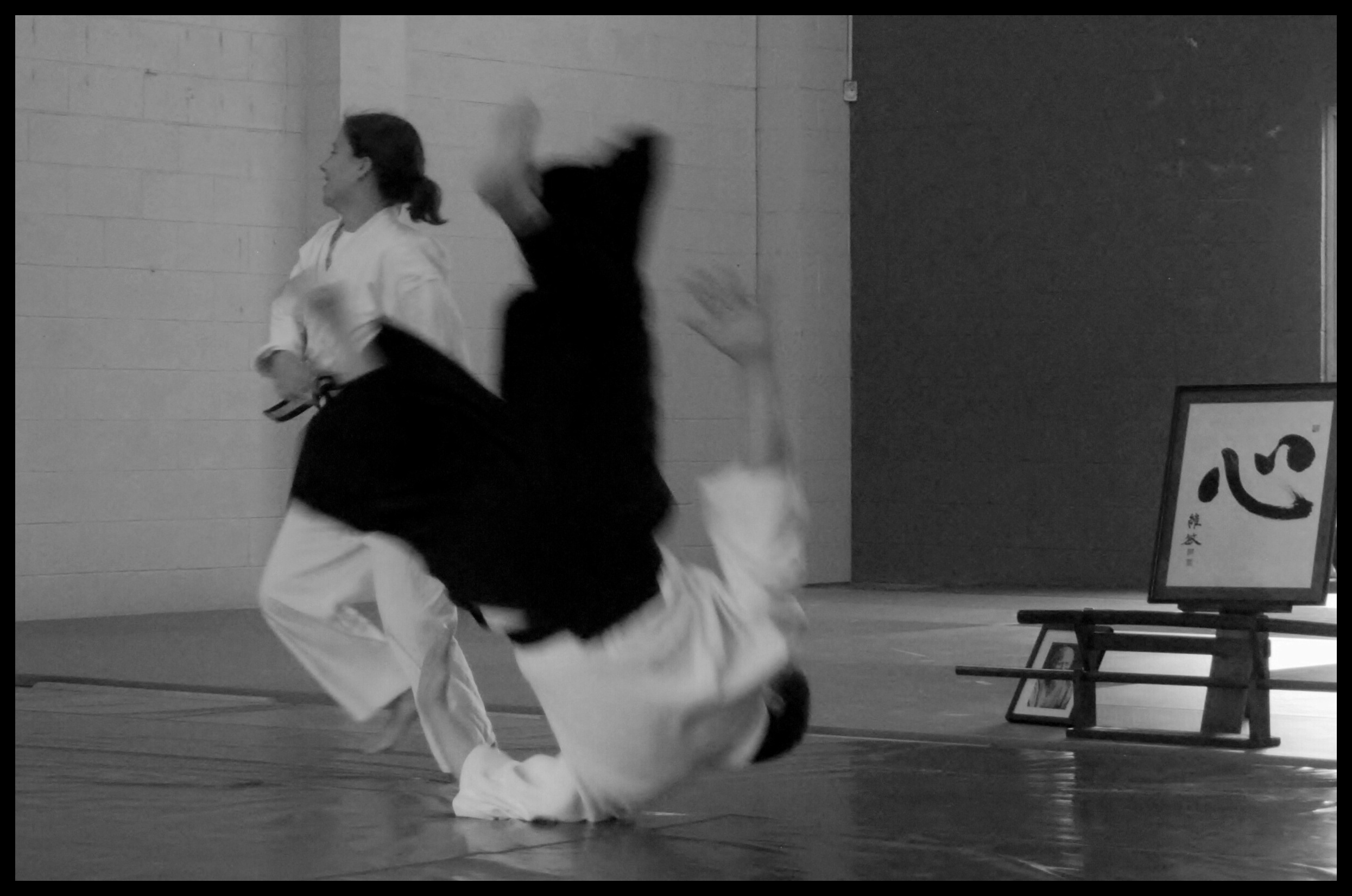
 Aikido Warrior Dojo
You must be logged in to post a comment.