Aiki otoshi techniques are commonly referred to as “blending drop” techniques. While not as commonly practised as other forms of technique, they have a long history in Aikido.
In the below video Mike Jones Sensei from New York Aikikai demonstrates and provides instruction on the basic and advanced versions of Katate dori aiki otoshi. This form of aiki otoshi is practised from a same side wrist grab.
From a safety perspective, it recommended that the advanced form of aikiotoshi not be attempted except under the close guidance and instruction of an experienced instructor familiar with the technique, including how to receive it.
ADDITIONAL NOTES
Ukemi
On the following video Peter Kelly Sensei, Aikido Yuishinkai (Tasmania), provides instruction on the following:
In the below video, Christian Tissier Shihan (8th Dan Aikikai) demonstrates the omote and ura versions of the Aikido technique ushiro ryotedori ikkyo.
The demonstrations are completed in a dynamic free flowing form whereby the uke commences the attack by proceeding to the front of the nage, grabbing the nage’s wrist and then moving to the rear (with a view to also grabbing the nage’s second wrist).
This form of practice is referred to in some schools as ki no nagare. In ki aikido schools it is sometimes referred to as ryutai.
ADDITIONAL NOTES
Movement and Sword principles
In the below video Chicko Xerri Sensei (6th Dan Aki Aiki kai) explores the sword principles that underpin the higher level practice of ushiro techniques. The exploration is particularly applicable to ikkyo applications.
Our dojo is part of the Aikido Kenkyukai Fodoshin Dojos (Australia). Chicko Sensei is the Shihan for our school.
Balance breaking principles – Kuzushi
In the below video produced by Senshin Center Aikido Dojo, balance breaking principles applicable to ushiro attacks are explored. Kuzushi is unfortunately something that is sometimes overlooked in Aikido. The fact remains, however, that it is near impossible to throw a centred uke unless they are either cooperating or overpowered by a significantly larger nage.
In the below video Chicko Xerri Sensei explores an alternate option for addressing a ushiro attack whereby the uke is not permitted to move to the rear of the nage. Chicko sensei emphasises the important aiki principle of creating a space to move before attempting an aikido application.
In the below video Chicko Xerri Sensei explores a further option for addressing ushiro attacks. The option readiy sets up the circumstances for an ikkyo application.
Ki Aikido
In the below video, Koretoshi Maruyama Sensei provides instruction on Ushiro tekubidori ikkyo as practised in Aikido Yuishinkai. The method of application is typical of the approach taken by ki aikido schools.
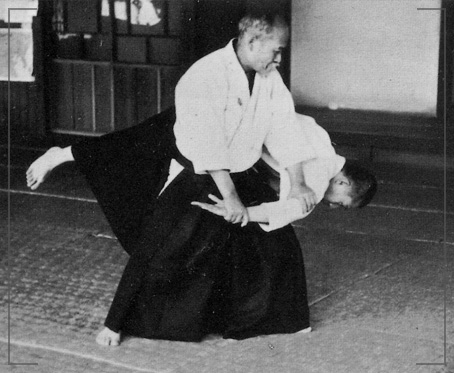
See below a short video taken at the dojo where we explored munetsuki irimi nage as illustrated in O’Sensei‘s 1938 text “Budo“.
Although difficult to see in the below photo demonstrations featuring O’Sensei, a key technical aspect of the technique is the placement of the nage’s hand on the upper part of the uke’s shoulder. As the technique is executed, this hand eventually ends up immediately below the nage’s armpit. Relaxed and centred execution of the technique is essential to avoid any clash and achieve the necessary off-balancing of the uke.
For the uke, receiving the technique feels a bit like hitting a “wall of feathers”. As you would have noticed in the video, we also played with adding extra atemi. It makes receiving the ukemi a bit more challenging in terms of uke sensitivity but is well worth the experiment.
Big thanks to dojo senior Peter Marendy for joining me in the demo and to Eden for filming it.
ADDITIONAL NOTES
Munetsuki irimi nage – A deeper look
In the below videos Morihiro Saito Sensei (1928-2002) provides instruction on the traditional version of munetsuki irimi nage as practised by O’Sensei (the Founder of Aikido) in the immediate post-war period of his life. Notably the method of execution is the same as that outlined in the “Budo” text.
Morihiro Saito Sensei’s practice of Aikido spanned 56 years and he is one of the most important teachers in Aikido history. Saito Sensei was a live-in student of O’sensei for more than 20 years at his home dojo in Iwama, Japan.
Saito Sensei spent his teaching life dedicated to preserving the technical style of Aikido as practised and shown to him by O’sensei in the post-war period. Without his commitment to preserving the Aikido of the Founder and extensive efforts to record and document his teachings, much of the Aikido of O’sensei would have been lost.
Opposite side one-hand hold wrist grabs are typically one of the first basic attacks that a new student to Aikido is trained to address. Although arguably not a particularly martial or common contemporary attack form, learning to neutralise and redirect an attack of this kind can nonetheless be surprisingly challenging both at static and free-flowing level.
Training to deal withwrist grabs is particularly useful for learning and reinforcing many of the basic principles that underpin our Art. The less aggressive nature of the attack (compared to say a strike) allows the nage (i.e. the receiver of the attack) to more readily focus on such things as correct footwork, moving around the point of contact, basic balance breaking principles, correct posture and movement, maintaining centre and getting off-line.
Cross hand wrist grabs in Aikido practice are referred to as Ai hanmi katate dori, Kosadori or Katate kosa dori. The name used depends on the school and some use the terms interchangeably. Generally speaking, ki aikido schools tend to use the term Katate kosa dori.
In the below video, Mike Jones Sensei (New York Aikikai) demonstrates and provides instruction on the 2 basic forms (omote and ura) of the Aikido technique ikkyo when applied in response to a static cross hand grab. Further detail on how to apply the technique is provided in the Additional Notes section below.
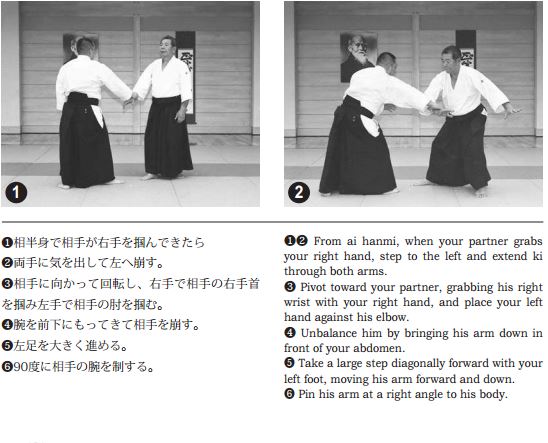
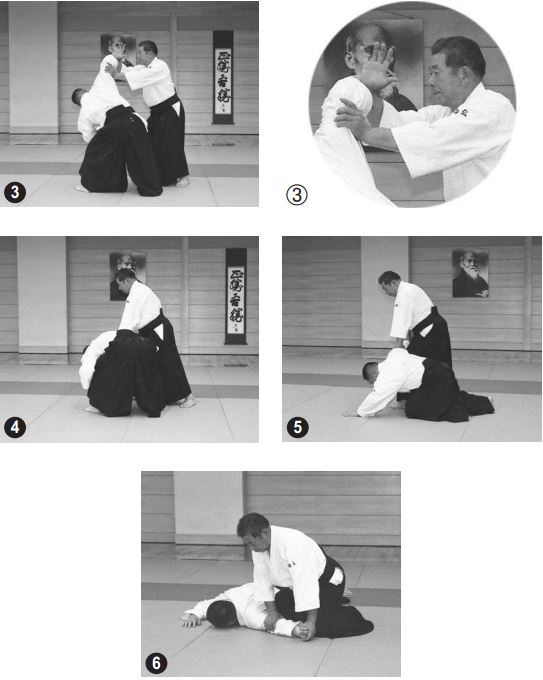
See below a photo demonstration (including description) and accompanying video by Morihiro Saito Sensei (9th Dan) of the key elements that make up the basic form of Kosadori ikkyo omote.
*Source: “Morihori Saito’s Complete Guide to Aikido” (2015)
Kosadori ikkyo omote (Basic) – London Aikido Club
The below video provides important training tips by Sensei Andy Hathaway (London Aikido Club) for performing Ai hanmi katate dori/ kosadoriikkyo (omote).
Kosadori ikkyo (ki no nagare) – Aikido Warrior Fudoshin Dojo
In the below video seniors from our dojo demonstrate the way we typically practise kosadori ikkyo at ki no nagare (free flowing) level. Notably, the application incorporates a direct entry movement combined with an atemi intent (i.e. an elbow strike) to break the balance of the uke. As demonstrated in the video, this method of application is more easily learnt by first practising it from shomenuchi ikkyo.
Ai hamni katate dori/kosadori ikkyo (ura) – London Aikido Club
The below videos provides important training tips by Sensei Andy Hathaway (London Aikido Club) for performing the traditional version ura version of Ai hamni katate dori/kosadori ikkyo.
Otoshi (or drop) techniques feature prominently in a variety of martial arts, including Aikido, Judo and Jujitsu. Otoshi techniques are typically thought of as “hand throws” and when applied correctly generate a surprising amount of power that literally has the effect of dropping (some might say “driving”) the uke straight into the mat.
Sumi otoshi (corner drop) is probably the most common drop technique practised in Aikido. The particularly appealing features of this technique include its directness in execution and the fact that it is able to be used to in response to a wide variety of traditional attack situations.
However, while sumi otoshi looks deceptively simple on its face, in reality it requires considerable skill to apply with any degree of martial integrity. For example skills in kuzushi (i.e. off-balancing), timing, moving off-line and centred movement are essential.
In the below video, Mike Jones Sensei from New York Aikikai provides instruction for sumi otoshi from an attack in the form of a same side hand grab (Katate dori).
ADDITIONAL NOTES
Alternate application
Donovan Waite Sensei (7th Dan Aikikai) in the following video demonstrates and provides training tips for an alternate application of katatedori sumi otoshi, as well as the variation in the featured video.
Learning ukemi
In every technique ii is important to learn not only how to execute it, but also how to safely receive it (ukemi). In the below video, Waite Sensei demonstrates how the nage can assist the uke in safely learning ukemi for the sumi otoshi.
Aikido Yuishinkai (Tasmania)
The demonstration is by Peter Kelly Sensei of Aikido Yuishinkai (Tasmania). The source material was kindly provided courtesy of Bill Hely.
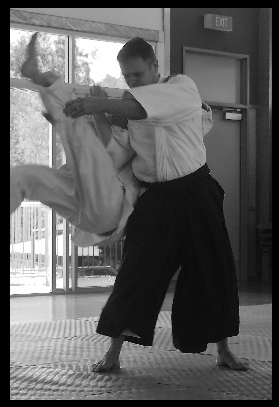 Aiki otoshi techniques are commonly referred to as “blending drop” techniques. While not as commonly practised as other forms of technique, they have a long history in Aikido.



 Aikido Warrior Dojo
You must be logged in to post a comment.