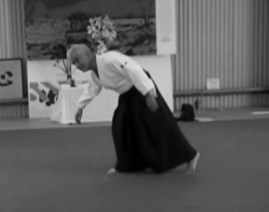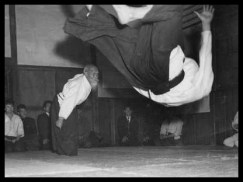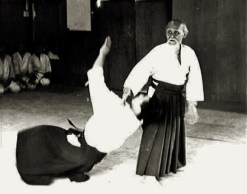
Master Koretoshi Maruyama

Katate kosadori kokyu nage (reitai) – Aikido Yuishinkai

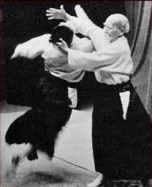
osensei reitai kokyu nageIn the below video Master Koretoshi Maruyama, Founder of Aikido Yuishinkai, demonstrates and provides instruction for the Aikido technique katate kosadori kokyu nage (reitai level) as practised in Aikido Yuishinkai.

Katate kosadori kokyu nage is categorised as a “breath throw” (kokyu nage) in Aikido practice and is trained from a traditional attack in the form of a cross-hand grab (katate kosadori).

Training at reitai level is sometimes described as “no touch” Aikido.  The difficulty with this descriptor is that it suggests something pseudo mystical is happening which could not be further than the truth.  The uke falls without being touched for no other reason than to avoid being “palmed in the face” (for want of a better description) by a centred nage.


ADDITIONAL NOTES

Katate kosadori kokyu nage – Other levels of practice

For training notes on katate kosadori kokyu nage as practised at kotai, juntai and ryutai levels in Aikido Yuishinkai see: Training notes: Katate kosadori kokyu nage.

Have a great week

Ian Grant
Head Instructor
Aikido Warrior Dojo

All the best

Ian Grant
Head Instructor
Aikido Warrior Dojo


Ninindori kokyu nage – Aikido Yuishinkai

ninindori 2Multiple person grabs are a common training tool in Aikido and are have a long tradition in our Budo.  The Founder of Aikido (Master Morihei Ueshiba) regularly demonstrated and practised this form of training. There are numerous videos of him doing so, the earliest going back to the 1930’s.

Two person grabs in Aikido practice are typically referred to as ninindoriNinindori represents the basic form of multiple grab practice. As a student progresses additional attackers can be added to make the exercise more challenging.

In the below video, Master Koretoshi Maruyama, Founder of Aikido Yuishinkai, demonstrates how to use kokyu nage (a “breath throw”) to escape when ukes in ninindori grab each arm of the nage.  

All the best

Ian Grant
Head Instructor
Aikido Warrior Dojo


Katate kosadori kokyu nage – Aikido Yuishinkai

kokyu nageIn the below video Koretoshi Maruyama Sensei demonstrates and provides instruction for the Aikido technique katate kosadori kokyu nage as practised in Aikido Yuishinkai. The technique is categorised as a “breath throw” (kokyu nage) and is trained from a traditional attack in the form of a cross-hand grab (katate kosadori).

Katate kosadori kokyu nage has a long history in Aikido practice. There are numerous recordings dating as far back as the 1930’s of the Founder of Aikido (Master Morihei Uesiba) demonstrating the technique.


ADDITIONAL NOTES

  • Katate kosadori kokyu nage – No touch variation

In the below video Maruyama Sensei demonstrates and provides instruction for the Aikido technique katate kosadori kokyu nage (reitai level) as practised in Aikido Yuishinkai.

Training at reitai level is sometimes described as “no touch” Aikido.  The difficulty with this descriptor is that it suggests something pseudo mystical is happening which could not be further than the truth.  The uke falls without being touched for no other reason than to avoid being “palmed in the face” (for want of a better description) by a centred nage.


  • Katate kosadori kokyu nage – Basic levels

The above video demonstrates and provides instruction for katate kosadori kokyu nage as practised at ryutai or free flowing level. However, it is often difficult for students to initially practice a technique at this level.

osensei kokyu nageTo assist students to learn the basic shapes and principles for free flowing practice, preliminary exercises are practised which in essence are simplified versions of the flowing technique. They are also practised static and cooperatively.  These learning exercises are referred to as practising a technique at kotai and juntai levels. It is emphasised that these levels of practice are only exercises to learn principles applicable to Aikido practice, they are not Aikido techniques.

In the below video Maruyama Sensei provides detailed instruction for katate kosadori kokyu nage at both kotai and juntai level.


All the best

Ian Grant
Dojo Cho
Aikido Warrior Dojo


Exercise – Forward rolls and learning to relax

UkemiFor many beginners to Aikido, learning to forward roll is one of the most challenging and frustrating parts of Aikido training.  Further, once the mechanical skills of rolling are learnt, first from a kneeling position and then from a solo standing position, the next challenge is to learn to relax when rolling.  The more one relaxes the easier rolling is to do. The lumps and bumps that also come with learning this skill also quickly disappear.

In the below video Master Koretoshi Maruyama, Founder of Aikido Yuishinkai,  demonstrates a fun way to learn to relax when solo forward rolling.  Essentially, it involves the practitioner pretending to stumble and walk around relaxed (as if drunk) prior to executing the roll.

As bizarre as it may seem, this exercise actually works.  In fact, at our dojo the exercise is done as part of our regular solo ukemi practice at the beginning of each class and has proven beneficial to both seniors and newcomers in developing relaxation in not only forward rolling but also other forms of ukemi (e.g. backward rolling and opposite leg rolling).


Needless to say this exercise should never be practised by people actually under the influence of alcohol or drugs.

ADDITIONALO NOTES

  • Other ukemi articles and video

See: Video library: Falling and uke arts

  • Maruyama Sensei’s comments on receiving ukemi from O’sensei 

Ueshiba 5“After I became a full-time instructor in 1967, Ueshiba Sensei used me as his uke. As a deshi (student), it was important to take ukemi. One deshi didn’t know how to take ukemi from O-Sensei and went down with a bang. I already knew that Ueshiba Sensei used ki. I wondered, “How to take ukemi from O-Sensei?” So I decided to extend ki to him. He said, “Come, Maruyama!”, and I attacked him.

After taking ukemi from him, Ueshiba Sensei looked at me, and said, “Good ukemi!” He then asked what rank I held and I told him I was a 5th dan. He gave me a 6th dan and told me to go to the office to get the certificate! I thanked him but I never picked up my certificate. However, I had learnt an important lesson, “Extend ki to your opponent!””

Source: http://www.shinsei-dojo.co.uk/koretoshi-maruyama-sensei

Have a great weekend

Ian Grant
Head Instructor
Aikido Warrior Dojo
Training notes: Ryotedori yonkyo

Yonklyo - Peter Kelly SenseiIn the below video, Peter Kelly Sensei, Chief Instructor Aikido Yuishinkai Australia, provides instruction on how to perform ryotedori yonkyo.

A key aspect of Peter Sensei’s instruction is the notion that yonkyo (No 4 wrist technique) is not at its essence intended to be a technique to control a uke by inflicting wrist pain.  Rather it is a method of hyper-extending the uke’s shoulder to control their centre.


ADDITIONAL NOTES

  • Hand position – Initial shoulder extension

Yonkyo 3 Yonkyo5


  • Yonkyo pin

Yonkyo pin

Yonkyo pin close up


  • Ryotedori kokyu nage

The set up for ryotedori yonkyo as (demonstrated in the video) is the same as for ryotedori kokyu nage.  For notes on ryotedori kokyu nage (including its set up) – see Training notes: Ryotedoru kokyu nage (and koshi nage).

  • Yonkyo basics

For notes on the basic principles of yonkyo (including video of Maruyama Sensei teaching the technique) see – Training Notes – Yonkyo (the basics)

Have a great week

Ian Grant
Head Instructor
Aikido Warrior Dojo